The House in the Pines
61 pages • 2-hour read
Ana ReyesThe House in the Pines
A modern alternative to SparkNotes and CliffsNotes, SuperSummary offers high-quality Study Guides with detailed chapter summaries and analysis of major themes, characters, and more.
Symbols & Motifs
The Cabin, or the House in the Pines
The book’s title, The House in the Pines, refers to Frank’s cabin. This cabin symbolizes many things: escapism, a yearning for safety and belonging, and the power of imagination. Frank first imagines his cabin at the age of 10 as a way to escape his father’s psychological abuse and to make it through a night alone in the woods. Frank later weaves this fantasy cabin into existence for others, like Maya and Cristina, through hypnosis and storytelling. Descriptions of the cabin are lyrical and vivid: Images of “a crackling fire” (279) and “fragrant steam” from a stew (197) convey warmth and nourishment, while “a cathedral ceiling” with “soaring beams” made “of pine and rose gold by the fire” (194) give the cabin a sense of sacred and elevated beauty. Frank connects these descriptors with emotions of satiety: “You’re safe now, says the stream. You’re home. And that’s just how it feels, like coming home” (236).
The house is an allusion to the gingerbread house from the “Hansel and Gretel” fairy tale. Like the witch’s cottage in that story, Frank’s cabin at first appears to be a place where lost children seek comfort and feed their hunger. However, in reality, both forest dwellings are dangerous illusions hiding a gruesome truth: The witch eats the children she lures in, and Frank murders the young women he entraps. While this place feels like an ideal of home, it is actually a tomb.
Myths and Fairy Tales
There are numerous allusions to myths and fairy tales throughout the novel.
Maya’s inability to make anyone take her accusations about Frank seriously links her to the oracle Cassandra from Greek myth—“the woman cursed to utter a truth no one would believe” (23). She also sees herself as another mythological figure—Eurydice, a woman entombed in the prime of her life; this is why Maya describes Dan as her Orpheus, “helping her return to the land of the living” (163) from trauma and addiction, much like the mythical Orpheus rescued Eurydice from the underworld.
Aubrey’s love of fairy tales and Jairo’s unfinished novel based on a folk story put this genre of narrative front and center. The Tender Wallpaper concert the young women attend is themed after the fairy godmothers from Sleeping Beauty. Frank’s cabin in the woods references two fairy tales. In his boyhood, its false escapism hearkens to the gingerbread house in “Hansel and Gretel”—a seemingly safe idyll that turns out to contain mortal peril. At the same time, Frank’s serial luring of young women to a house where he kills them connects him to the antagonist of “Bluebeard.” At the book’s conclusion, Maya and Dan adopt a dog they name “Toto” (312)—a character from a children’s novel whose protagonist is desperate to return home.
These motifs give the novel an otherworldly tone while highlighting the good and bad sides of Maya’s imagination, which fuels her writing, but also makes her susceptible to hypnosis. This motif of myths and fairy tales also shows how stories influence the way we experience and interpret the world, supporting the story’s argument about The Power of Stories and Resilience of Imagination.
The Key
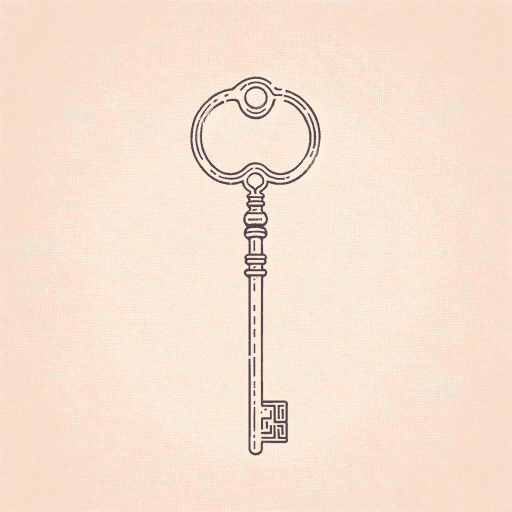
Frank’s key is an explicit reference to the “key” Maya needs to recover the missing memories locked away in her mind. The key represents Frank’s control over those he hypnotizes—his ability to enter and exit their minds at will while barring them out of their own memories. Frank’s key can also open doors to fantasy worlds, like the cabin, locking away reality. Since Frank holds the key, he is the one in control. The key has notably sharp teeth, representative of pain and danger.
Frank’s key is an essential part of his hypnosis technique, which uses the Bellamy Induction technique invented by his father. The Bellamy Induction works by training subjects to associate a specific object with a hypnotic trance they can enter in just a few minutes. Frank’s key is thematically tied to his story about his cabin, allowing Frank to introduce the object while weaving his story, hypnotizing his victims with quickness and ease.
Cristina gets a tattoo of Frank’s key to represent her desire to live in Frank’s cabin forever—that is, for Frank to kill her. This tattoo thus gives Frank the key to her mind. This tattoo is Maya’s first clue in the novel, a way to open up the mystery of Frank’s power over Maya and Aubrey.
“The Hymn of the Pearl” and Jairo’s Unfinished Manuscript
When Jairo dies, he leaves behind an unfinished manuscript, a retelling of the poem “The Hymn of the Pearl” set in Guatemala City. Maya uses this poem to decipher the meaning of Jairo’s novel and, in doing so, finds a clue to Frank’s secret and Maya’s missing memories.
“The Hymn of the Pearl” is from The Acts of Thomas, a piece of biblical literature from the third century. It tells of a boy who seeks a pearl from a serpent in Egypt. However, once there, he forgets his quest and his home. Jairo adapts this poem in a work of magical realism, titled Olvidé que era hijo de reyes, or I Forgot I Was the Son of Kings. In his retelling, a young boy named Pixán, who lives in a magical village in the clouds, is sent to Guatemala City to collect an inheritance. However, he is hit by a car and has amnesia.
Jairo’s novel and the poem it is based on relate to multiple themes in the novel. The loss of memory echoes Maya’s quest to reconstruct her own lost memories. Forget one’s true home, and thus losing one’s sense of self is part of the novel’s interest in the theme of Yearning for Home and the dangers of escapism.
The manuscript also plays an important role in the novel’s plot. Maya first meets Frank while reading her father’s work, which shows him how deeply she wants to know her father and her Guatemalan roots. Frank preys on this yearning for belonging to manipulate Maya. Later, when Maya loses her sense of time and reality in Frank’s illusory cabin, remembering the meaning of her father’s story reminds her that Frank’s cabin is not her true home. This connection between her father’s story and Frank’s cabin helps Maya to unlock her memories seven years later and to escape Frank’s final murderous hypnotism at The Whistling Pig.
Jairo’s writing reaches across time to give Maya the context and strength she needs to persevere against Frank. It is thus fitting that she ends the novel determined to finish the novel Jairo began.

Unlock the meaning behind every key symbol & motif
See how recurring imagery, objects, and ideas shape the narrative.
- Explore how the author builds meaning through symbolism
- Understand what symbols & motifs represent in the text
- Connect recurring ideas to themes, characters, and events