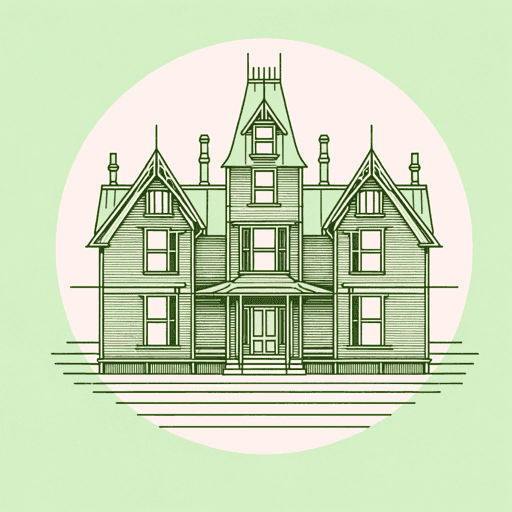
The House of the Seven Gables
The House of the Seven Gables
A modern alternative to SparkNotes and CliffsNotes, SuperSummary offers high-quality Study Guides with detailed chapter summaries and analysis of major themes, characters, and more.
Summaries & Analyses
Quizzes
NEWReading Tools
Chapters 19-21Chapter Summaries & Analyses
Chapter 19 Summary: “Alice’s Posies”
Early the next morning, posies beam bright red from the roof. Uncle Venner goes to the back stoop to collect the scraps for his pig that Hepzibah always leaves for him, but there are no scraps to be found. Holgrave is there, however, and he leans out his window to speak briefly with Uncle Venner.
Various townspeople pass by the house, with one woman banging on the shop door, perturbed that it is not open for business, and others stop by the shop, too. One of the townspeople sees the judge’s card at the doorstep of the house, with yesterday’s schedule scrawled on it, and decides to take it to the police.
In the meantime, Phoebe returns to the house, but she is unable to get in. She goes around to the garden, finally finding a door that opens when she knocks, and she goes inside.
Chapter 20 Summary: “The Flower of Eden”
It is so dark that Phoebe cannot see her surroundings. A hand reaches out: It is Holgrave’s, and he brings her into a room full of sunshine.
Though Holgrave is very warm and seems particularly happy, he tells Phoebe that Hepzibah and Clifford have disappeared and that Judge Pyncheon is dead. He has just taken a daguerreotype of Judge Pyncheon’s dead body. He thinks that this might be helpful, as he is worried that Hepzibah and Clifford fled after seeing the judge’s body. Holgrave thinks they have been particularly terrified because the death looks very similar to the death of Uncle Jaffrey, for which Clifford was convicted 30 years ago.
Phoebe insists that they must reveal all to the authorities, and Holgrave concedes that she is right, although he secretly wants to hold onto this moment of secret knowledge, which “separated himself and Phoebe from the world, and bound them to each other” (305). Holgrave tells Phoebe that he loves her. Phoebe says she is skeptical of how the two of them could ever be together. She is worried that he will lead her “out of [her] own quiet path” (306) with his reforms. Holgrave assures her, though, that he will no longer “oscillate” in the midst of her “poise” and will “conform” to societal norms. He may, despite his previous protests, even build a house for their children. Phoebe insists that she does not want him to change and confesses that she loves Holgrave.
Hepzibah and Clifford walk through the door. Hepzibah bursts into tears upon seeing Phoebe, and Clifford proclaims that the “flower of Eden has bloomed!” (308).
Chapter 21 Summary: “The Departure”
News of the judge’s death circulates, and the community quickly changes the narrative surrounding Uncle Jaffrey’s death. People now approach the death of Jaffrey as one for which Clifford took the fall. The new story is that the future judge was going through his uncle’s papers one night when his uncle unexpectedly walked in the room. The Pyncheon men have a hereditary condition, which Maule wove into his threat, and Jaffrey had a stroke (gurgling) and fell upon seeing his nephew rifling through his possessions.
After Uncle Jaffrey falls, the future judge finds a new will that favors Clifford and destroys it so that the old one, in which he is favored, remains. While Cousin Jaffrey did not intend to frame Clifford, when suspicion falls on him and he is convicted of murder and sent to prison, the judge does not say anything.
Soon after the judge dies, news arrives that his son has died of cholera on his return home. This means that the three remaining Pyncheons—Hepzibah, Clifford, and Phoebe—will inherit the judge’s estate. They all decide to move to the judge’s home in the country, and they have a farewell party in the parlor with Holgrave and Uncle Venner.
Clifford remembers that there is a lever in the old portrait of Colonel Pyncheon. The portrait falls to the floor after the lever is pressed, and the old deed to the land is revealed in a niche behind the painting. It is, however, no longer valid. Holgrave then reveals his own identity as a Maule and also confesses that he already knew about the lever and the deed.
Uncle Venner is invited to live in a cottage on the estate where the Pyncheons and Holgrave are headed, and as they leave, Hepzibah gives a heap of silver to her first customer, the gingerbread-eating schoolboy.
Chapters 19-21 Analysis
In the novel’s closing chapters, the family’s dilemmas concerning both The Legacy of Violence and The Complications of Home are neatly resolved. In the wake of Judge Pyncheon’s death, all of the main characters successfully confront the past and, in doing so, find a way toward a better future for them all.
Although Clifford and Hepzibah initially fear a repeat of the past, it is Judge Pyncheon’s sudden death that ultimately frees them from The Influence of the Past on the Present. It is now the turn of the present to influence the past, as the town comes to a new understanding of what really happened to Uncle Jaffrey and Judge Pyncheon’s cynical machinations against the innocent Clifford are revealed. The “gurgling” sound noted in Judge Pyncheon’s throat—which Phoebe earlier linked to Matthew Maule’s curse of the colonel choking on blood for his crime—is revealed to be a warning sign of a stroke, which is what killed both Uncle Jaffrey and Judge Pyncheon. This new knowledge exonerates Clifford, enabling him to move forward with his life without living under clouds of shame and suspicion due to his prior (unjust) conviction.
In confessing his love for Phoebe, Holgrave also decides to move forward with his life. Unlike Clifford and Hepzibah, who decide it is time to make a bold new change in leaving their old home for the countryside, Holgrave’s major change is to start putting down permanent roots for the first time in his life. After recently insisting to Phoebe that houses should only be temporary and not inherited, he proclaims that he very well may build a house for his descendants. Both Clifford and Hepzibah’s new start and Holgrave’s change of heart about settling down suggest that The Complications of Home can be resolved through confronting the path and choosing a healthy new path voluntarily.
There are further revelations at the novel’s close that also help to end The Legacy of Violence that has plagued the Pyncheon family. When Clifford seeks the expired land deed behind the colonel’s portrait, the colonel’s portrait falls, symbolizing how his power over his descendants is now at an end (See: Symbols & Motifs). The parchment deed no longer has value, and the house of the seven gables, now that Uncle Jaffrey’s is available, is no longer needed. Thanks to these circumstances, the power the house and its legacy has held over the family for generations is, at long last, definitively broken. Furthermore, Holgrave reveals that he knew about the deed all along and that he is himself a Maule. Rather than being bound together by secrets, this last chapter is one of revelation after revelation, where parchments and people are both moved out of the gloom of the house and into the light of new beginnings.
The love affair and anticipated marriage of Holgrave and Phoebe brings a final layer of closure to the story, as the Pyncheon and Maule families can now be united in love and harmony instead of being set against one another through their ancestors’ legacy of violence. Thus, in leaving the house of the seven gables behind to start a new life together in a different house in the countryside, both the Pyncheons and the Maules are now able to open a new, optimistic chapter for both themselves and their own descendants.

Get in-depth, chapter-by-chapter summaries and analysis from our literary experts.
- Grasp challenging concepts with clear, comprehensive explanations
- Revisit key plot points and ideas without rereading the book
- Share impressive insights in classes and book clubs