46 pages • 1-hour read
The House with Chicken Legs
A modern alternative to SparkNotes and CliffsNotes, SuperSummary offers high-quality Study Guides with detailed chapter summaries and analysis of major themes, characters, and more.
Chapter 24-EpilogueChapter Summaries & Analyses
Content Warning: This section of the guide includes discussion of death.
Chapter 24 Summary: “The Arctic”
The house takes Marinka to the arctic. There is nothing around but snow. Marinka and Jack light a fire and build the fence. Entirely alone, Marinka can’t stop thinking about Baba. She still believes she might bring her back. Meanwhile, she tries making amends with the house. She explains her concerns about guiding the dead alone and begs for its help retrieving Baba. She knows the house “was trying to protect [her]” (218) by closing The Gate but asks for it to let her through now.
Marinka prepares for the ceremony of the dead. She cleans and cooks food but still the house won’t open The Gate. Marinka understands that she must open up to the house first and tell her how she really feels. Finally, Marinka vocalizes all of her fears and desires. The house comforts her, eventually giving in and agreeing to help Marinka look for Baba.
Chapter 25 Summary: “The Lake District”
Marinka wakes up the next day and discovers that the house has returned to the Lake District where she first met Benjamin. She dresses and races outside to play with Benji. She studies the mountains, fields, and valleys, and wonders if the house brought her here so she could return Benji to Benjamin before passing through The Gate.
Marinka finds Benjamin. He is relieved to see her as he was worried when he discovered she and her house had disappeared without a trace. Marinka tells him about her life and recent troubles, relieved when he doesn’t judge her. He updates her on his life, too. Finally, she asks him to care for Benji and Jack while she goes beyond The Gate to find Baba. She is thankful when he agrees, but feels sad realizing she may never see him again.
Chapter 26 Summary: “Through the Gate”
Marinka prepares for the ceremony of the dead, talking to the house while she works. Finally, The Gate appears and opens. Marinka crosses through the open door, and darkness envelops her. She splashes through deep waves, swimming a great distance. Then Jack appears and tries to guide her through the inky dark. Marinka “lose[s] all sense of time” (235) as she desperately seeks out Baba, calling her name. She feels her presence but can’t see her anywhere. She eventually realizes that Baba really is gone. She feels a set of hands on her back and hears Benjamin calling her name. He and Jack pull her back through The Gate. She tells Benjamin what happened and explains that Baba is not coming back after all. Benjamin explains that the house came for him and asked for his help retrieving Marinka.
Marinka, Benjamin, and Jack sit together in the house. Marinka now understands many of Baba’s lessons about friendship and loss, but still doesn’t know what her life will be now that Baba isn’t coming back.
Chapter 27 Summary: “Planting Seeds”
Marinka and Benjamin spend a few days together. The house is doing better. Marinka gets to know Benjamin’s father. She starts leading the dead, too. Then one day, the Old Yaga comes for a visit in her cracked and sagging house. The Old Yaga is surprised the house made it at all. She talks to Marinka about her journey through The Gate—which she learned about via her whispers with the dead. The Old Yaga was surprised that Marinka made a splash in the waters of the beyond, because that only happens to the living.
Chapter 28 Summary: “Growing”
The Old Yaga suggests that the house may have turned Marinka back into a living girl. The house admits this is exactly what it did, hoping to make Marinka happy. Marinka falls asleep that night, overwhelmed by thoughts and dreams.
In the morning, Marinka has tea with the Old Yaga and Benjamin. The Old Yaga encourages Marinka to spend time with Benjamin far beyond the house to test if she really is alive; if she is, she won’t fade as she strays from the house’s perimeter. Although afraid, Marinka enacts the plan. She and Benjamin go to a park festival and listen to music. Marinka feels happy, especially when she realizes she is not fading. At the end of the day, Benjamin gives her a sketch he made from a photo he found of her and Baba. When Marinka returns home afterwards, the Old Yaga is waiting for her with open arms.
Epilogue Summary: “Yaga and More Than Yaga”
Over the following years, Marinka and the Old Yaga create a life together. They merge their houses so Marinka’s house can carry the Old Yaga’s house wherever they go. They help each other with ceremonies and look out for each other. They often have parties with the other Yagas, too. They continue traveling, but often return to the Lake District to see Benjamin. Tonight, in Benjamin’s dad’s field, Marinka stares into a puddle and sees the galaxy reflected in the water.
Chapter 24-Epilogue Analysis
The final chapters of The House with Chicken Legs lead Marinka’s narrative through its climax, descending action, and resolution. Throughout the majority of the novel, Marinka has endeavored to travel beyond The Gate’s threshold to bring Baba back from the other side. In Chapter 26, she is finally able to enact her plan and go in search of her absent grandmother; this narrative sequence beyond The Gate acts as the novel’s climax. Once she travels through The Gate and the darkness beyond, Marinka is forced to accept that Baba is “something else now, some part of this swirling light and energy that I don’t understand” (236). This aspect of Marinka’s story is a metaphor for acceptance. Marinka has been grieving her grandmother’s death throughout the novel; each phase of her narrative is metaphoric, too, and represents the stages of the grieving process. First, Marinka denies that Baba’s death is possible; then she lashes out in anger at the Yagas and her house for foiling her plans to save Baba; then she bargains with the house to help her seek out Baba; then she despairs when she cannot find Baba; and finally, she reconciles with Baba’s absence from her life. The author takes inspiration from Slavic and Russian folklore to weave a complex tale of death and loss, mourning and renewal.
Once Marinka reconciles with Baba’s death she is better able to reconcile with the Tension Between Tradition and Self-Determination, one of the novel’s primary themes. The images of her spending time with Benjamin, Jack, and the Old Yaga after her trip through The Gate convey her attempts to accept her new life. With her friends’ help, Marinka is able to appreciate that “Nobody is yours to keep. Nothing is forever” (241). Life is fleeting, but it can be beautiful, too. Marinka learns how to appreciate this dichotomy—which relates to the novel’s theme of the Relationship Between Life and Death—when she joins her life with the Old Yaga’s. She is now a living girl, but still assumes the position of Guardian and accepts the Yaga lifestyle. She is balancing the positive and negative aspects of being alive, while accepting the bittersweet, inevitable aspects of death. She is accepting that life will always contain loss and sadness, but can be joyful, too. The images of her sharing space with the Old Yaga, attending the music festival with Benjamin, and partying with the Yagas captures the richness of her life. She finds freedom and autonomy through acceptance.
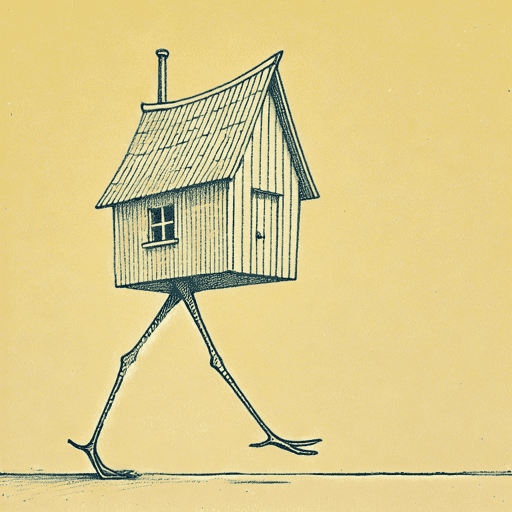
The epilogue lends Marinka’s story a happy, resolved ending. The beginning of the section starkly resembles the opening lines of the prologue, affecting a cyclical structure. Both sections begin with the line “My house has chicken legs” (259), but the epilogue has a more positive, accepting tone. Marinka’s house still travels “to islands and wetlands, rain forests and heathlands, high mountains and deep ravines” (261), but Marinka now delights in these adventures. The house also stays put more often than it once did, which offers Marinka more stability than in the past. Marinka’s house is now joined with the Old Yaga’s, too—an image that evokes notions of connectivity and family. Marinka has found belonging right where she was (in her house) because she has stopped fighting tradition and fate.

Unlock all 46 pages of this Study Guide
Get in-depth, chapter-by-chapter summaries and analysis from our literary experts.
- Grasp challenging concepts with clear, comprehensive explanations
- Revisit key plot points and ideas without rereading the book
- Share impressive insights in classes and book clubs