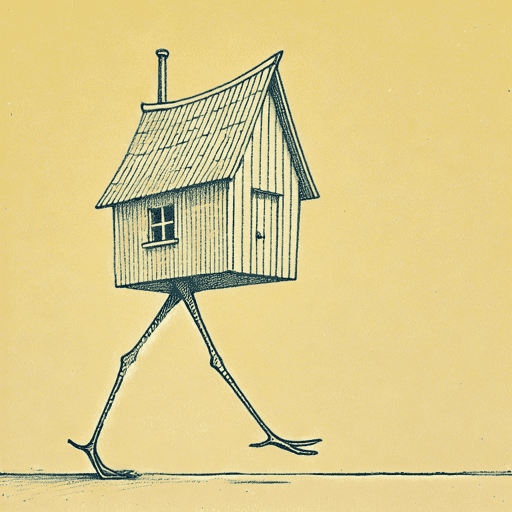
The House with Chicken Legs
46 pages • 1-hour read
Sophie AndersonThe House with Chicken Legs
A modern alternative to SparkNotes and CliffsNotes, SuperSummary offers high-quality Study Guides with detailed chapter summaries and analysis of major themes, characters, and more.
Important Quotes
Content Warning: This section of the guide includes discussion of bullying and death.
“But the real, live, living people, they all stay in the town and villages far below us. Maybe if it was summer, a few of them would wander up here, to picnic and look at the view. They might smile and say hello. Someone my own age might visit—maybe a whole group of children. They might stop near the stream and splash in the water to cool off. Perhaps they would invite me to join them.”
(Prologue, Pages 1-2)
Marinka’s musings on her life in the chicken-leg house versus the lives of the living villagers introduce the novel’s theme of the Search for Friendship and Belonging. Marinka has a home in the traveling Yaga house with her grandmother but is reluctant to accept it. She wishes she did not have to be surrounded by the dead and thus sees the world beyond the house as idyllic. As long as she lives in conflict with her home and circumstances, she will feel unsettled wherever she goes and in every relationship.
“I don’t want to be a Guardian. Being Guardian means being responsible for The Gate and all the guiding of the dead, forever. And while guiding makes Baba happy, seeing the dead drift away every night makes me feel even more alone. If only I was destined to be something else. Something that involved living people.”
(Chapter 1, Page 9)
Marinka’s internal monologue in this passage establishes the novel’s theme of the Tension Between Tradition and Self-Determination. Marinka loves and respects Baba but has no interest in assuming her Guardian role or communing with the dead for the rest of her life. Destiny is a trap to Marinka, and she vows to do everything in her power to stave off this fate. She tries defying the traditions she has been raised with because they feel antithetical to freedom and independence.
“A living, human friend my own age, to talk to and do things with. And Benjamin and I have so much in common. It’s like this is meant to be! But what about the house? And Baba? If they find out I’ve been talking to a living soul, they won’t let me out of their sight for a month. Probably longer.”
(Chapter 2, Pages 25-26)
Benjamin’s character offers Marinka an opportunity for connection and acceptance. Marinka is so delighted by Benjamin because she feels an affinity for him. At the same time, she knows the relationship is forbidden and fears it will create upheaval in her home. Marinka’s Search for Friendship and Belonging is so protracted because her desires and reality conflict.
“Playing make-believe games with the house was exciting when I was young. […] But now that I’m older, no matter what the house grows for me, I still want to leave and explore the real world, meet the living, and have friendships that last for more than one night.”
(Chapter 3, Page 30)
Marinka tries to deny her past to manufacture the life she wants for herself. She remembers playing with her house but is eager to cast off these memories. She is trying to disassociate from her childhood because she longs for an autonomous adulthood. She has yet to realize that the more resistant she is to her circumstances and experiences, the less free she will feel.
“Baba squeezes my fingers. ‘You need to accept what you are. Being Yaga is in your blood and you can’t change that. If you would focus more on the life you have instead of daydreaming about the life you don’t, then I think you would be happier.’”
(Chapter 5, Page 48)
Baba’s character plays the role of the archetypal guide in Marinka’s story. Baba is not Marinka’s biological grandmother, but she has raised, nurtured, and taught her since her infancy. Her gentle but firm words in this passage capture the importance of her guardianship to Marinka’s safety. She loves Marinka and wants her to be happy, but is also urging her to change her perspective if she wants peace of mind. Baba’s advice foreshadows the lessons Marinka will learn by the novel’s end.
“But as I go to help Baba prepare for the guiding, I can’t shake an image from my mind, of The Gate opening and pulling Nina inside, like an ant being pulled into an ant lion trap. The thought of losing her makes my blood run cold, and I don’t know how to stop it from happening. Just like I don’t know how to control my own destiny.”
(Chapter 6, Page 62)
Marinka hides the truth about Nina from Baba because she is afraid of loss and grief. Marinka’s life is defined by death. She fears that telling Nina she is dead, and asking Baba for help leading her through The Gate will only create more upheaval and sorrow in her life. She is desperate “to stop it from happening” because she has yet to acknowledge the inevitable Relationship Between Life and Death.
“She asks me what I want to be. I don’t tell her I’m destined to be the next Guardian. I imagine that my future is undecided, that I could be an artist like Benjamin, or a teacher, or an actress in a theater. I think of all the jobs I’ve read about in books […] Then I imagine that I could live in a normal house, a house without legs, and stay in one place and make friends.”
(Chapter 8, Page 71)
Marinka’s relationship with Nina allows her to daydream about the life she could have. Marinka does not imagine anything extravagant for herself, but the wishes she shares with Nina are all her own. The idea of taking a job, reading books, or pursuing artistic endeavors feels freeing and exciting in comparison to her present life. Marinka’s daydreams are typical of adolescent imaginings, but they also convey Marinka’s struggle to accept life as it is.
“Then I feel her emotions. My heart races as she chases swallowtails, and bursts with joy when her sisters are born. I have to clench my teeth to stop from crying out when I feel her mother die. I wonder if this is what Baba meant when she said the dead’s lives would add to mine. If it is, I don’t like it. It’s frightening, having someone else’s memories and feelings inside my head.”
(Chapter 8, Page 75)
When Marinka helps Baba guide Serina through The Gate, she experiences the intense Relationship Between Life and Death for the first time. Listening to Serina recall her life with her family moves Marinka; Serina is honoring the life she had so that she might find peace in death. Marinka physiologically and emotionally experiences this interconnection between life and death, but still refuses to accept it.
“I didn’t want to be a guide. I didn’t even think I could. Now that I have, I wonder if it means being Guardian is a destiny I will never escape. All my daydreams of friends and futures unknown crumble away as I imagine life as a Guardian stretching ahead of me once more, long and straight. Always stuck in this house.”
(Chapter 9, Page 79)
Marinka’s refusal to accept reality traps her emotionally. She resists her fate so ardently because she believes that accepting it would be to accept her powerlessness. Language like “escape,” “crumble,” “stretching,” and “stuck” underscores the intensity of Marinka’s fear. She is so desperate to liberate herself from her circumstances that she keeps herself from noticing the good things she does have.
“‘You’re a good girl, Marinka. So I know you’ll care for the house as it cares for you, and I know you’ll do the right thing for the dead.’ A smile spreads across her face. ‘But you’re also clever, stubborn, and fiery, so if anyone can figure out how to be Yaga and more than Yaga, then it’s you.’”
(Chapter 11, Page 102)
Baba offers Marinka encouragement before she passes through The Gate. Baba wants Marinka to accept her new Guardian role because she believes in the Yaga tradition. At the same time, Baba knows Marinka better than anyone, and is thus confident in her ability to fulfill the position. The moment offers clarity on Marinka’s often dichotomous nature while underscoring Baba’s guiding influence in her life.
“I stare into the fire, guilt weighing me down. So many of the things I’ve said to Baba I regret now. I don’t hate my life, my death, whatever it is. It’s been good, growing up with her in this magical house. I need her to come home. Nothing else matters. Whether I’m alive or dead, a Yaga or not, I don’t care anymore. I just want Baba back.”
(Chapter 12, Page 108)
Marinka’s use of halting, fragmented syntax in this passage enacts her sorrow, confusion, and guilt. Marinka is going over everything she said or did leading up to Baba’s departure. She is second-guessing her behaviors because blaming herself feels easier than accepting Baba’s absence. Her stilted narration in this moment conveys the intensity of her sorrow and desperation over losing Baba.
“I had no idea there were so many Yaga. I’ve only ever seen fleeting glimpses of one or two here, at the market. For a moment, it feels comforting to know there are so many others, and I begin to imagine what they might be like. But then I push the thoughts away. It’s pointless wondering, because I’ll never know them. They all lead secret, lonely lives—like me.”
(Chapter 13, Page 123)
Spending time with the Old Yaga offers Marinka a gateway to understanding the Yaga tradition. The Old Yaga—and her stories of other Yagas and the Yaga tradition—also offer Marinka a new perspective on the Search for Friendship and Belonging. If there are other Yagas like her, she might find acceptance from them. However, Marinka is still in the denial phase and immediately negates this possibility; as long as she resists her circumstances, she will feel isolated and alone.
“Warmth floods into my cheeks. This morning Salma and her friend thought I looked like an ugly witch, but now she’s calling me pretty. It feels good to know that although I’m dead, and sort of a Yaga, at least I can pass for a normal, living girl. While I’m near the house anyway.”
(Chapter 15, Page 138)
Marinka changes herself in an attempt to find acceptance from Salma and Lamya. The living girls have demonstrated nothing but cruelty and derision toward her and others. Even still, Marinka is eager to please them. She is glad when they compliment her altered appearance because she thinks they might welcome her in as their friend; however, she fails to realize that she is compromising her ideals for the illusion of acceptance.
“Satisfied the house will not be able to stand, let alone walk, I emerge from the tangle of wood, wire, and chicken legs with a huge smile on my face. Tonight, for the first time in my life, I will fall asleep knowing that tomorrow I will wake up in the same place.”
(Chapter 16, Page 151)
Marinka’s decision to tie up the house conveys the Tension Between Tradition and Self-Determination. The house represents the Yaga lifestyle and tradition, in that it promises to stand up and walk away without notice. Marinka binds it with wire in order to assume power over it and assert her autonomy. She does not realize that hurting the house will hurt her; disparaging tradition will only impede her self-acceptance journey.
“I don’t understand why the girls seem to want to be nice to me, yet then be so mean to others. Pushing that boy was an awful thing to do. And they said cruel things about Jack and the Old Yaga when they don’t even know them. After so long wanting to make friends with the living, now I’m not sure I like them at all.”
(Chapter 17, Page 161)
Marinka struggles to make sense of Salma and Lamya’s behaviors because she is unaccustomed with the living. Her gut tells her that the girls are cruel, but she doesn’t want to believe this, because she desperately wants friends. This moment intensifies Marinka’s loneliness and complicates her Search for Friendship and Belonging.
“My new green dress is torn and stained from scrambling on the floor untangling the house and feeding Benji and Jack, but I don’t care. I change into one of my old wool dresses and feel more like myself as I head out into the night.”
(Chapter 18, Page 165)
The recurring dress imagery throughout the novel reifies Marinka’s self-discovery and self-acceptance journeys. At first, Marinka is eager to cast off her drab wool garments for the “new green dress” from Salma and Lamya. The dress represents newness and possibility. However, it soon gets torn—which suggests that this idyllic new identity is inauthentic. Marinka feels “more like herself” when she removes the dress. In her old clothes, she is able to access her authentic character.
“My breath catches in my throat as I realize this isn’t all Salma’s fault. I wanted to be something I’m not. I wanted to be living, like Salma. So I happily went along with everything she suggested. I wish I had been stronger in myself, and stood up for Jack and the Old Yaga when Lamya said cruel things about them, and stood up for that boy in the market, too.”
(Chapter 19, Page 179)
Marinka’s internal monologue in this passage marks a turning point in her self-discovery journey. Marinka has willingly cast off her traditions and ignored her instincts for the sake of fraudulent friendships. Once she realizes she has been negotiating herself, she understands her need to change. Her relationships with Salma and Lamya do not offer her acceptance, but they grant her perspective on who she wants to be.
“Tonight is going to be wonderful. And tomorrow, Baba will be home to guide the dead, the crack in the house will heal, the great cycle will be back in balance, and I will be free to figure out what I want to do with my life. And being dead, stuck in a house with chicken legs, might not be so bad once I find a different destiny.”
(Chapter 20, Page 188)
Marinka’s use of the future tense affects a hopeful mood. Marinka is desperate to believe that passing through The Gate will bring Baba back and resolve all her troubles. Her use of language here conveys her attempts to convince herself of this reality. Her plan must work if she is to exact “a different destiny” for herself.
“I don’t feel brave. All of a sudden I feel very cold and unsure of myself. The thought of leaving all these Yaga, and the light and music of the ceremony, to step alone into the darkness of the Gate makes me shiver.”
(Chapter 21, Page 198)
Marinka’s fear of leaving the Yagas during the Ceremony of Bonding contributes to the novel’s theme of the Search for Friendship and Belonging. Marinka has been determined to jump through The Gate ever since Baba left her behind, but as soon as it is time, she hesitates. The Yagas are offering her the friendship, acceptance, and belonging she has wanted for years. Enacting her plan will mean forsaking the very community she has sought out.
“‘I’m so sorry,’ I whisper to the rafters. ‘I didn’t mean to trick you, or upset you. It’s just that I miss Baba so much. Bringing her home means everything to me. She is the only person I have ever known and loved, and I’m scared to live without her. I need her. Not just so she can guide the dead and save me from being Guardian. I need her here, to love me and keep me safe.’”
(Chapter 23, Page 211)
Marinka’s conversation with the house marks a change in her character. This is one of the first times in the novel that Marinka has been open and honest. She is expressing her thoughts and feelings in a raw manner. She is not hiding the truth. Her display of vulnerability will help her to make amends and reestablish a connection with her house—doing so will lead her to acceptance and peace.
“It rocks me to sleep under the stars, like it used to do when I was little, and in the middle of the night I feel its vines lift me up and carry me indoors and tuck me into bed. And although I don’t know what will happen next, I feel better for telling the truth, and for knowing that me and the house will figure it out together.”
(Chapter 24, Page 223)
The image of the house cradling and rocking Marinka evokes notions of maternity, comfort, and care. The house symbolizes home and belonging, although Marinka has not been able to understand this truth until now. The house has always had her best interest in mind, and is better able to protect her once Marinka opens up to it. The house is thus a pseudo mother figure for Marinka.
“I’ve been in the desert, watching ant lion traps and turning cartwheels in the sand. I took a friend to see the ocean for the first time, jumped over waves on a tropical beach, and chased an octopus through the shallows. I made some friends in a market, who turned out not to be friends at all, but I saw a snake charmer and swam in a beautiful riad.”
(Chapter 25, Pages 227-228)
Marinka’s stories of her time away from the Lake District affect an adventurous, exciting mood. Marinka has historically longed for freedom and exploration, convinced that her life in the Yaga house has inhibited her. When she recounts her recent experiences to Benjamin, her tales are rife with excitement and discovery—proving that she has had what she has wanted all along.
“It’s warm and peaceful. But I can’t feel Baba at all. I felt closer to her at home, in our house, than I do now. She’s not here. I try to blink away the light and the glitter and the tears, as I realize the truth. She’s not here.”
(Chapter 26, Page 236)
When Marinka passes through The Gate, she is compelled to accept that Baba is gone. In this moment, Marinka is coming to terms with Baba’s death for the first time. She had to seek out Baba on her own to reach this stage of her grieving process. The repetition of “She’s not here” enacts her work to acknowledge and hold this truth.
“‘Yaga houses are clever and loyal. If they know what their Yaga wants, they’ll do everything they can to give it to them. Like my house grew me a laboratory, and walked me all the way here.’ She gazes at her house affectionately, then turns back to me. ‘I think your house made you alive because it wants you to be happy.’”
(Chapter 28, Page 250)
Marinka’s house helps her exact the life she wants. Marinka has demonized the house for some time, but ultimately discovers how much the house loves her. Marinka remains bound to the house and the Yaga tradition, but with the house’s help she is able to live again, to adventure, and to find safety and belonging.
“I am living, dead, and Yaga. Different to everyone I meet. But I am happy this way. It means I can move between different worlds.”
(Epilogue, Page 260)
The Epilogue has a resolved and happy tone that underscores Marinka’s internal change. Her life is largely the same as it was at the novel’s start; only now, Marinka has accepted it. Because of her adventures, she can now understand the Relationship Between Life and Death, and the beauty of moving between both spheres.

Unlock every key quote and its meaning
Get 25 quotes with page numbers and clear analysis to help you reference, write, and discuss with confidence.
- Cite quotes accurately with exact page numbers
- Understand what each quote really means
- Strengthen your analysis in essays or discussions