46 pages • 1-hour read
The House with Chicken Legs
A modern alternative to SparkNotes and CliffsNotes, SuperSummary offers high-quality Study Guides with detailed chapter summaries and analysis of major themes, characters, and more.
Themes
Content Warning: This section of the guide includes discussion of bullying and death.
Tension Between Tradition and Self-Determination
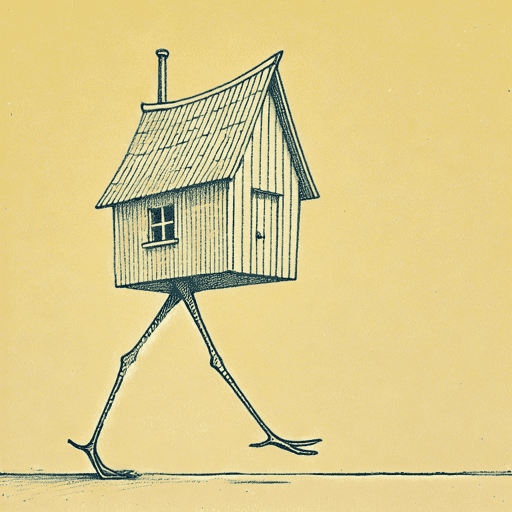
Marinka’s first-person narrative is a coming-of-age story, which traces her struggle to find autonomy while accepting her fate. Marinka lives in a Yaga house with chicken legs where her grandmother Baba is raising her to guide the dead into the afterlife when she gets older. Marinka knows “it’s [her] destiny to become the next Guardian” (6) but is reluctant to accept this future for herself. Instead, she wants a life of freedom and adventure. She wants to live outside the house, to make her own decisions, and foster her own friendships. She lives in conflict with Baba’s expectations for her life because she is a curious and self-driven individual.
Baba’s death intensifies Marinka’s internal conflict between accepting the fate preordained for her and the life she has imagined for herself. Baba’s character represents the traditions Marinka has been raised with and the Yaga future she has been learning. Once she is gone, however, Marinka feels desperate, alone, and confused. She does not know how to guide the dead through The Gate or to venture out on her own. Her repeated attempts to connect with the living are acts of self-determination. She tries spending time in the market, wearing new clothes, and going on adventures amongst the living. While these decisions offer her the illusion of agency and autonomy, they do not grant her lasting happiness. This is particularly true when Marinka witnesses how living people like Salma and Lamya regard the Yagas. They scorn the Old Yaga and bully Marinka for being creepy, weird witches; Marinka becomes defensive of her family’s tradition as a result. She begins to realize that even without Baba, she is attached to the Yaga lifestyle and values the rituals of transition they practice.
Marinka reconciles with her competing realities by the end of the novel. At the start of her narrative she believes that “as long as [she] stay[s] in this house [she] will never be in control of [her] life, [her] future, or [her] destiny” (44). After coming to terms with Baba’s death, she makes amends with her house and accepts the Yaga tradition and Guardian role. Her house offers her a happy medium between her family traditions and individual dreams; the house reenlivens her and agrees to stay put in the Lake District for most of the year. These compromises let Marinka “move between different worlds” (260), taking pleasure in both the customs she was raised with and the ideals she has developed independently.
Search for Friendship and Belonging
Marinka’s complex interpersonal relationships teach her about who she is, what she believes, and what she wants for herself. In the early chapters of the novel, Marinka “ache[s] to have friendships that last for more than one night” (11). She derides the dead because she suffers each time she makes their acquaintance and says goodbye. She does not like traveling from place to place in her magical house, because as soon as she gets settled somewhere new, she must leave again. Her life is defined by loss, upheaval, and change—causing Marinka to feel perpetually unsettled and out of place. Wherever she goes and whomever she meets, Marinka is hopeful she’ll get “the chance to see if [she] fit[s] in or not” (23).
Marinka’s interactions with characters like Benjamin, Nina, Salma, Lamya, and the Old Yaga convey her deep longing for acceptance and security. When she meets Benjamin, her “heart races with excitement” at being in the company of “a real, live, living boy” (16). When she meets Nina, she is thrilled to have “a chance at friendship” (56) even if it is with a dead girl. When she meets Salma and Lamya, she decides “they aren’t cruel or mean after all” (177), because she longs for their acceptance and approval. When she spends time with the Old Yaga, she searches for points of connection because she misses her late grandmother. Each of these relationships offers Marinka a chance at connection. None of them is what she expects, which complicates Marinka’s ability to feel safe and secure.
Marinka discovers a more definite sense of belonging when she accepts herself. At the novel’s end, she is living with the Old Yaga in their conjoined houses and has assumed the role of a Guardian. This is not the life she imagined for herself, but she now understands that if she is happy with and proud of who she is, she will feel at home wherever she goes. She bonds with her house and with the Old Yaga, with whom she has created an atypical family structure. She still misses Baba, but “[she] ha[s] Jack for company and [her] house takes good care of [her]. The Old Yaga watches over [her] too” (259). Friendship and belonging do not look the way Marinka thought, but she has found peace in her new life and with the other Yagas because she is at peace with herself. She and her house continue to travel together, too—imagery that implies that the individual can find a sense of home wherever she is if she is assured in herself.
Relationship Between Life and Death
Marinka’s Yaga lifestyle is a metaphor for the inextricable connection between life and death. Throughout the majority of the novel, Marinka tries to deny death’s influence over her life. She actively tries to ignore the dead and disparages the Yaga rituals of transition between life and death. She longs for a normal family and a normal house, but “[her] house has chicken legs, and [her] grandmother is a Yaga and a Guardian of The Gate between this world and the next” (4). She is perpetually weighed by death’s omnipresence. As a young and vibrant adolescent, Marinka only wants to think about life, happiness, friendship, and exploration. Death feels antithetical to these pursuits and threatens to rob her of her freedom. What Marinka must learn over the course of the novel is that the more she ignores death, the more power she gives it.
Marinka’s inability to accept her grandmother’s death conveys her fear of loss and grief. Although Baba does not come back through The Gate after leaving with Nina, Marinka convinces herself that her grandmother is not gone and that she has the power to retrieve her. Her ongoing attempts to bring Baba back are an extended metaphor for the grieving process. This process contains five phases—denial, anger, bargaining, depression, and acceptance—which Marinka exhibits over the course of the novel. Her refusal to believe that Baba is no longer with her captures her resistance to accepting that death is inevitable and final. Once she does realize and accept the truth, she is able to live a fuller life. Her internal monologue after coming back through The Gate captures her work to reconcile with death and to live the life in front of her:
Baba used to say it’s not how long a life but how sweet a life that counts, and I think maybe the same is true with friendships. I’m not sure how long I will get to spend with Benjamin, but I will appreciate the time I have. I wish I had appreciated the moments I had with Baba more (241).
Marinka now understands the fleeting nature of life. At the same time, she realizes she can enjoy life even if it is short and fragile.
Marinka’s new life after venturing beyond The Gate balances both life and death, sorrow and joy. She still has to move from place to place, make friends and say goodbye, but she can now appreciate each of these transient experiences. Life is always shadowed by death, but death is more meaningful when Marinka acknowledges the beauty that preceded it.

Unlock every key theme and why it matters
Get in-depth breakdowns of the book’s main ideas and how they connect and evolve.
- Explore how themes develop throughout the text
- Connect themes to characters, events, and symbols
- Support essays and discussions with thematic evidence