31 pages • 1-hour read
The Knight in Rusty Armor
A modern alternative to SparkNotes and CliffsNotes, SuperSummary offers high-quality Study Guides with detailed chapter summaries and analysis of major themes, characters, and more.
Chapters 1-2Chapter Summaries & Analyses
Chapter 1 Summary: “The Knight’s Dilemma”
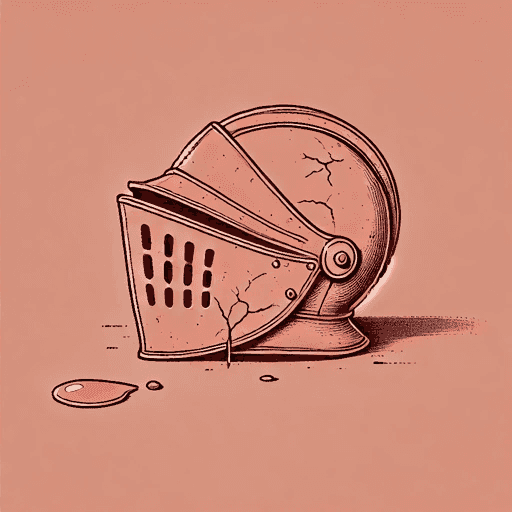
A knight who prides himself on acts like rescuing damsels, whether they want it or not, begins to wear his armor more often so that he is always prepared to rush off on his next mission. He spends all his time striving to be the best knight in the realm, wearing his armor until his wife Juliet and his son Christopher begin to forget what his face looks like. Christopher only knows what he looks like from a portrait on the mantle.
Juliet confronts the knight and gives him an ultimatum: He must take off the armor or she and Christopher will leave. Though the knight doesn’t want to, he decides to take off the armor. When he cannot remove it or lift the visor, he goes to the local smith to remove it by force, but they cannot make the armor budge. Juliet is frustrated, believing that he isn’t really trying to remove it.
The knight decides to seek help. When he goes to say goodbye to the king, he runs into the king’s jester, Gladbag, who spouts mysterious wisdom. He says the knight can find help in the forest from Merlin, the tutor of the legendary King Arthur.
Chapter 2 Summary: “In Merlin’s Woods”
The knight wanders in the woods for months, looking for Merlin and growing increasingly weak, as it is difficult to eat through his visor. Finally, he finds Merlin, who intuitively knows that the knight has come for help. The knight falls asleep, and when he wakes, Merlin gives him a drink called “Life” that is bitter at first, then pleasant. Woodland animals help to feed the knight through his visor. Over time, he grows strong again.
Merlin often speaks in riddles, trying to get the knight to question why he put on his armor or why he needs to prove he’s “good, kind, and loving” (16). The knight is shocked to realize that he is starting to be able to communicate with the animals, and Merlin says it is because he has become sensitive to their vibrations. The knight wants to go back to his family, but Merlin says that they might not want him back in his current state. The knight decides to send a note to Christopher, asking him if that’s true. Christopher sends back a blank paper, as he doesn’t know enough about his father to answer. This makes the knight cry.
Chapters 1-2 Analysis
These first two chapters provide exposition that establishes the character of the knight and the central internal and external conflict he faces, which in turn will launch the rising action of the plot. Chapter 1 paints a picture of a knight who is overly concerned with appearances and external perceptions of his character, to the point where his continuous manufacturing of circumstances to “prove” his worth begins to harm the people around him. For instance, he has “the annoying habit of rescuing damsels even if they did not want to be rescued” (1). The knight thinks that stereotypical trappings of knightly valor signify desirable internal qualities: He subconsciously reasons that if he does things that make people think he is “good, kind, and loving” (1), then he really will be good, kind, and loving. This desire blinds him to the will of other people, such as “damsels” who do not consent to being saved by him. Only later does the knight realize he has created a false equivalence in imagining that seeming “good, kind, and loving” means that he really is those things. This belief that external validation equals inner qualities is tied to the theme of The Struggle With Personal Fears and Doubts: The knight is searching for ways to prove his worth that don’t involve confronting his fears or making himself vulnerable. Though he doesn’t realize how fear has trapped him in his armor yet, the way the knight treats the people around him in the early chapters foreshadows this realization.
The knight’s belief in external validation is symbolized by his armor, a stereotypical trapping of his trade that embodies everything that he thinks a knight is and should be perceived as. The knight was “famous for his armor” (1), and he believes that the armor “showed everyone who he was” (3): He believes that his legacy is bound up in people’s perception of this external signifier of knightliness, rather than his inherent, internal, self-realized goodness. Because he believes that the armor signals his internal character, he depends on it and soon refuses to remove it. However, he doesn’t realize how his refusal to remove it is actually hurting himself and others. When he tries to insist to Juliet that he loves her, he hugs her “clumsily in his cold, stiff armor and nearly break[s] her ribs” (3). Later when talking to the king’s jester Gladbag, he “reached out and shook Gladbag’s hand in gratitude, nearly cruising the jester’s finger with his gauntlet” (9). In both moments, the knight is trying to be kind, illustrating a pattern of behavior: His harm is always inadvertent, caused accidentally by his armor despite his good intentions. These important details show how it is possible to cause harm to one’s loved ones due to the “armor” we put up, even if we have no conscious intent to be harmful.
Even though the harm the knight is causing is accidental, that does not mean that others are misinterpreting the knight’s actions and behavior. He is still causing real harm due to the symbolic and literal “armor” he encases himself in, and it is his responsibility to adjust his behavior so that he no longer introduces harm into the world. When he meets Merlin and is confronted with how his armor has made him “lost” in both his life and relationships with others, the knight becomes offended and says, “I didn’t come all this way to be insulted” (12). He thinks that Merlin’s comments are unfair because he doesn’t recognize his own culpability in the harm his armor causes. Merlin drives home the point that holding the knight accountable isn’t personal or fallacious when he proposes that the knight has “always taken the truth to be an insult” (12). The “truth” of the knight’s inadvertent harm is not an “insult,” and it is the knight’s duty to take responsibility for his own actions. At this point in the novella, he is incapable of understanding The Importance of Introspection for Self-Improvement, as he is too concerned with external approval and validation. He is defensive and brushes off Merlin’s efforts to inspire some self-awareness in him.

Unlock all 31 pages of this Study Guide
Get in-depth, chapter-by-chapter summaries and analysis from our literary experts.
- Grasp challenging concepts with clear, comprehensive explanations
- Revisit key plot points and ideas without rereading the book
- Share impressive insights in classes and book clubs