31 pages • 1-hour read
The Knight in Rusty Armor
A modern alternative to SparkNotes and CliffsNotes, SuperSummary offers high-quality Study Guides with detailed chapter summaries and analysis of major themes, characters, and more.
Symbols & Motifs
Armor
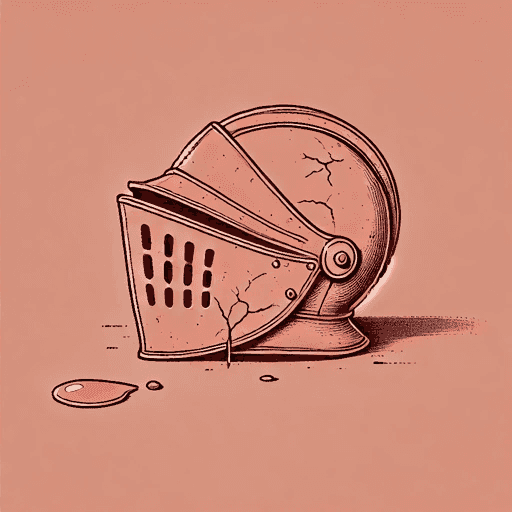
At the beginning of The Knight in Rusty Armor, the knight is literally encased in metal plate armor. Ostensibly merely the trappings of his profession, in this case, this physical armor symbolizes the intangible defenses that the knight—and all people—put up as protections against fear and doubt. This mental “armor,” however, can obstruct true self-awareness and growth, hiding one’s true self from others and thus obstructing one’s ability to reach one’s true potential.
When the king’s jester Gladbag sings, “We’re all stuck in armor of a kind. / Yours is merely easier to find” (9), he directly points to the knight’s literal armor as a symbolic representation of the metaphorical armor that everyone wears. The knight’s armor is easy to find because it is physically manifested on his body as plate armor. However, Gladbag’s assertion that “we” (humans) are “all” stuck in armor “of a kind” implies that this armor can take more than one form. He says this couplet right after the knight tells Gladbag he’d be singing “a different tune if you were the one stuck in here” (8). At first, the knight doesn’t understand that what Gladbag truly references when he says “armor” is symbolic, not literal, and only by working on intangible self-improvements can he be freed. The knight’s statement frames his problem as unique rather than universal, discounting the idea that some “armor” is intangible. Only by realizing what the “armor” truly means can the knight finally shed it.
Tears
In this narrative, tears symbolize personal accountability, selflessness, and self-acceptance. This symbol is tied to the theme of The Importance of Introspection for Self-Improvement: The knight sheds tears whenever he begins to truly realize, account for, and repent for the mistakes of his past. This acceptance, symbolized in his tears, rusts away his physical armor, which represents his symbolic internal defenses.
The knight is first tempted to shed tears when Christopher sends him a blank letter because he doesn’t know the knight well enough to say whether he’d want him back as his father. When he feels the tears approach, the knight thinks about how “knights in shining armor didn’t simply cry” (21-22). His assumptions about what makes a good knight and how he has to perform a certain set of prescribed actions to fulfill those expectations stymie his emotions. Though the knight associates this emotional repression with his physical armor, it is also associated with the symbolic armor he’s erected around his real self.
The knight cannot fight the urge to cry, and as a result, his tears rust the visor, which falls away. This sparks the knight’s understanding that “tears from real feelings” can rust the armor away (29). By crying over Christopher’s letter, the knight holds himself accountable for being such a distant father that his son doesn’t know him. As he progresses through the castles along the Path of Truth, tears continue to serve as checkpoints for the knight’s emotional progress, outward manifestations of his internal accountability and increasing self-acceptance that also work to remove his literal and metaphorical armor.
The Woods
The woods are symbolic of journeys and the loss and disorientation that often precede them. This common trope of the woods can be seen in many popular literary works. For instance, in Robert Frost’s famous 1915 poem “The Road Not Taken,” the narrator finds himself in a location where “[t]wo roads diverged in a yellow wood,” symbolizing a turning point in life. In Dante Alighieri’s 1321 Inferno, the Italian poet famously finds himself in a selva oscura, or “dark wood,” having lost the “straight way” through life. Dante is about to succumb to darkness and fear when his guide, Virgil, finds him and begins to lead him on his quest, much like Merlin finds the knight.
Similarly, the knight is “lost for months” in the woods (12), growing “weaker and weaker” (11). While the knight prides himself on being smart, the new challenges introduced by this location result in him not feeling “very smart at all trying to survive in the woods” (11). The failure the knight experiences in this setting introduces a new paradigm into the knight’s life: Maybe the things he has always assumed and the stories he’s told about himself are not as true as he’d like them to seem. This challenge in the woods is what introduces a crossroads into the knight’s life: Should he continue to journey through the unfamiliar woods (literally and symbolically) and confront his own shortcomings, or should he turn back to realms he feels more comfortable in and lose his family due to his complacency? Merlin literalizes this conundrum by showing the knight two paths through the woods. The one that returns the way he came “leads to dishonesty, greed, hatred, jealousy, fear, and ignorance” (25), while the difficult “Path of Truth” on the other side of the woods can lead him to self-acceptance and freedom from his physical and symbolic armor.

Unlock the meaning behind every key symbol & motif
See how recurring imagery, objects, and ideas shape the narrative.
- Explore how the author builds meaning through symbolism
- Understand what symbols & motifs represent in the text
- Connect recurring ideas to themes, characters, and events