The Landlady
The Landlady
A modern alternative to SparkNotes and CliffsNotes, SuperSummary offers high-quality Study Guides with detailed chapter summaries and analysis of major themes, characters, and more.
Poem Analysis
Analysis: “The Landlady”
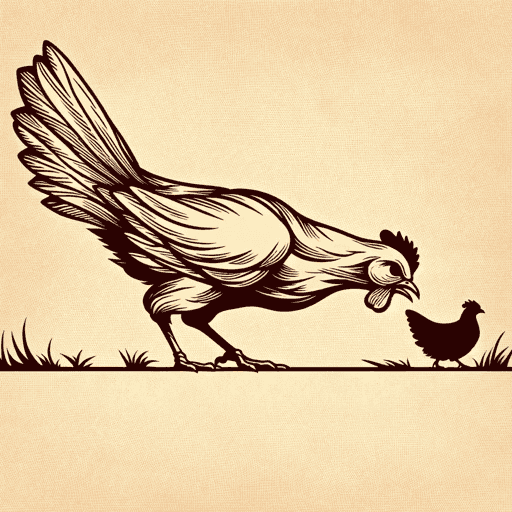
The poem begins with a single line stanza stating, “This is the lair of the landlady” (Line 1). The statement sets the tone for the poem, as it paints the landlady as a villain by using the word “lair,” which has negative connotations, e.g., a dragon’s lair, and positions the reader directly in the landlady’s path to make the reader feel trapped by her the way the speaker does. In the second stanza, the landlady becomes a disembodied, “raw voice” (Line 3). In Line 4 the landlady is “loose in the rooms beneath me,” evoking the image of an animal with unfettered access. In Stanza 3, the reader is directed back to the voice of the landlady and the urgency of situation is diminished momentarily as, instead of a dragon, the chatter of the voice is now akin to “henyard / squabble” (Lines 5-6), and instead of an animal roaming through the building, the noise is “going on below / thought” (Lines 6-7) as in background noise or something only revealed in the unconscious mind. This brings to mind the chattering of old ladies telling each other the latest gossip. By the last line in Stanza 3, the landlady is merely “the bicker of blood through the head,” like a headache or the pulsing of blood at the temples, and she becomes an internal threat rather than an external one.
This idea of an internal threat is carried into Stanza 4, which begins, “She is everywhere, intrusive as the smells” (Line 9). To smell something, it must be taken into the body. It is also more difficult to get away from an internal threat since it is something carried around within the body as well. In Lines 11 and 12, the omnipresent landlady “presides over my / meagre eating” and “generates the light for eyestrain,” which tells the reader the landlady controls every aspect of the speaker's life, from the food they eat to the amount of electricity they can use.
From Stanza 4 to Stanza 5, the speaker elaborates that it is not simply these things the landlady controls but it is also “[f]rom her I rent my time” (Line 14). The landlady is not only pervasive but a powerful force that controls the speaker and “slams / my days like doors” (Lines 15-16). The speaker concludes Stanza 5 by saying “[n]othing is mine” (Line 17). She relinquishes control to the force of the landlady, whom she cannot escape.
Stanza 6 begins with a lower case “and,” indicating the first line in the stanza, “and when I dream images” (Line 18), is a continuation of a thought or an idea the speaker only fully crystallizes part-way through. The speaker tells the reader they can't even escape the landlady while dreaming of “daring escapes through the snow” (Line 19) because they find themselves “walking / always over a vast face / which is the land–lady’s” (Lines 20-23) only to “wake up shouting” as if from a nightmare. The omnipresence of the landlady pervades every aspect of the speaker’s life, from the air they breathe to the light they use to see and even into the speaker’s dreams.
In Stanza 7, the speaker elaborates on the feeling of being trapped and surrounded by the landlady and describes her as “a bulk, a knot / swollen in a space” (Lines 24-25). The space is the speaker’s home, a place they should be able to relax and leave the worries of the day at the door, but the landlady does not give her room to breathe or move around the place without the feeling of someone else being there. The stanza ends with “my senses / are cluttered by perception / and can’t see through her” (Lines 27-29). These lines illustrate the speaker's confused state and how befuddled they are from being completely overwhelmed by the landlady’s constant presence. The idea has been building throughout the poem: In Stanza 3 the landlady “is everywhere, intrusive as the smells / that bulge in under my doorsill; / she presides over my / meagre eating, generates / the light for eyestrain” (Lines 9-13). The landlady has infiltrated her senses of smell, taste, and sight, and now the speaker “can’t see through her” (Line 29).
A less literal interpretation of the poem so far is that the speaker is speaking in metaphors about depression. Even when the speaker might feel fine, the depression, represented by the landlady, still creeps around just out of the speaker's conscious mind. The threat of a darkening mood is always there "loose in the rooms beneath me" (Line 4). As the depression settles in, it becomes a "continuous henyard / squabble" (Lines 5-6) in the speaker's mind. It mitigates the speaker's ability to eat, and though they may be able to sit in the artificial light, the darkness inside makes seeing things clearly a challenge. Eventually, the speaker becomes overwhelmed by the growing melancholy and has a difficult time seeing beyond it—they can't really remember what their life was like before the depression settled in, and they also can't really see their way out of it. Their depression is their landlady since it has control of their basic abilities to function.
In the final lines, the speaker concludes that the landlady “stands there, a raucous fact / blocking my way: / immutable” (Lines 30-32). The speaker sees the landlady as an unmovable thing that cannot be challenged and who is assaulting the speaker's sense of sound, sight, and touch and “blocking my way” so the speaker cannot be themself (Line 31). This also plays into the metaphor of depression, as the speaker is fully immersed now and cannot see their way out. The speaker's "senses / are cluttered by perception" (Lines 27-28), which means the depression is deep enough now that it shades everything for the speaker—they can see, hear, feel, taste, or touch just like they could before, but their perception is skewed, thus they interpret the world around them as darker and sadder than it was before. Everything in their world is influenced somehow by this deepening depression.
The poet ends the penultimate stanza by adding that the landlady is “a slab / of what is real,” noting that the landlady’s world is small, but like a slab the landlady blocks the speaker from the world that lies beyond (Lines 32-33). The final stanza, like the first, is a single line, “solid as bacon,” that references the slab in Line 32 as well as giving the reader a sense of taste (Line 34). To American readers it may be important to note that Canadian bacon is much thicker than American bacon and more closely resembles a small slab of meat. This idea of the slab being bacon also shrinks the landlady and the world in which she has trapped the speaker: While the landlady is a large presence in the speaker's daily life, her presence is still small and relatively inconsequential to the world at large. It could also be a firm insult to make sure the reader understands exactly what the speaker thinks about the landlady—she's a pig. This not only ends the poem with a declarative stab, but it calls back to the barnyard imagery of the chickens in the "henyard / squabble" in Lines 5-6. This ties the imagery at the beginning of the poem to the imagery at the end and helps the poem feel complete.
Enjoying this free sample?
Get in-depth, chapter-by-chapter summaries and analysis from our literary experts.
- Grasp challenging concepts with clear, comprehensive explanations
- Revisit key plot points and ideas without rereading the book
- Share impressive insights in classes and book clubs