The Last House on the Street
The Last House on the Street
A modern alternative to SparkNotes and CliffsNotes, SuperSummary offers high-quality Study Guides with detailed chapter summaries and analysis of major themes, characters, and more.
Summaries & Analyses
Quizzes
NEWReading Tools
Important Quotes
Content Warning: This section of the guide discusses racism, racist violence, and miscarriage.
“‘‘How can you move into the house that took him from you?’ She asked the question I’ve been wondering myself. ‘No one should have put a house there to begin with. All those new houses. They don’t belong. But especially that one. Yours. So modern. And stuck back in the trees like it is.’”
(Chapter 1, Page 3)
This quote, from a woman calling herself Ann Smith, is actually from Brenda, Ellie’s former friend. The comment is ironic in that Garner, Brenda’s husband, also died as a result of a fall on the same property. Brenda manipulates Grieving a Romantic Partner, establishing the novel’s suggestion that people who are grieving should strive not to perpetuate more grief. Chamberlain also highlights the distinction between the old residence in Round Hill and the new house that is completely modern, a contrast between old and new that runs through the narrative.
“As I continued to interview the students, their passion and commitment—their belief in the rightness of what they were doing—made sense to me. Those students, white and Negro put themselves on the line, body and soul. They were steadfastly nonviolent, not even fighting back when abused by passersby or dragged away by the police, and my articles about the protests grew more sympathetic toward them even without me realizing it.”
(Chapter 2, Page 10)
Ellie describes the process of becoming aware of and then committed to the “rightness” of the civil rights movement in the 1960s. Through her, Chamberlain explores Ignorance of Racial Disparity and the significance of educating oneself. Ellie’s reference to a Black individual as “Negro” is characteristic of the time—1965—in which the narrative takes place. She finds it surprising when individuals refer to themselves as “Black,” which Win characterizes as a stronger term, highlighting the importance of language and emphasizing the successes of the civil rights movement by 2010 when the characters use the term “Black.”
“Standing silently at the rear corner of the house, I watch Daddy and Rainie in the yard, where he’s spotting her as she climbs the jungle gym. He’s created a veritable playground for her back here.”
(Chapter 5, Page 33)
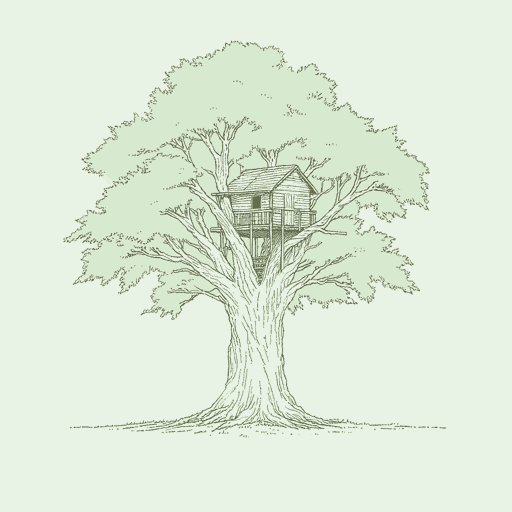
Chamberlain introduces Reed Miller and directly characterizes him as an amenable figure. The playground that Reed constructed for Rainie, Ellie’s three-year-old daughter, mirrors the great treehouse that Ellie’s father built for her and her brother in the 1950s. One is a modern jungle gym out in the open air and the other is hidden in a secretive forest in a giant oak tree. This again symbolizes the contrast between the ideals of the past and the present.
“The first house I see—the first house anyone would see as they drive into this developing neighborhood—is the old Hockley place. Buddy Hockley refuses to sell to the developers, who would like to squeeze two more houses into the wide lot where the big white, red-roofed house stands. The house is ancient, and although I think it couldn’t be more different from the style of house I love to design, I think it is beautiful. […] It’s an inviting ‘come over and have a glass of sweet tea’ sort of porch. The Hockley house is an abomination to everyone else who is having a house built on Shadow Ridge Lane.”
(Chapter 7, Page 43)
Chamberlain contrasts the “ancient” Hockley house—where Ellie and Buddy grew up, that is adjacent to the woods leading down to the lake—to Kayla’s new house, which is completely modern. These two distinct design concepts–the welcoming old Southern house and the sleek new house–embody the contrast and conflict between traditional Southern ways and contemporary sensibilities. Chamberlain points to the old house and the traditional ways as nostalgic and attractive but completely outmoded.
“‘So... are we breaking up here?’ he asked. […]
‘I think you should do what you want,’ I said finally. ‘Go out with other girls.’ […] I hated the thought of him being with another girl. That told me something. I did love him, but not so much that I’d give up my plan.”
(Chapter 8, Pages 54-55)
This exchange between Reed and his longtime girlfriend Ellie is revelatory to both. Reed, who wants to marry Ellie eventually, discovers that she is not as deeply invested in the relationship as he is. It is also a surprising development for Ellie, who only discovers how passionate she is about joining the civil rights movement when she realizes that it means she must give up her relationship with the young man who loves her deeply. This interaction highlights the novel’s thematic message regarding The Drastic Consequences of Personal Decisions, since Ellie realizes that the potential of fighting for civil rights outweighs the cost of her relationship.
“I sit on the edge of the bed and before I know it, I’m sobbing. Big gut-wrenching sobs that hurt my chest and throat. I’m tired of trying to be strong. I miss my husband. My best friend for the last ten years. It’s so unfair. We were supposed to have more children together. Design more houses together. Grow old together. We had it all planned out. Damn it! I pound my fist on the bed. It doesn’t even make a sound.”
(Chapter 10, Page 68)
Kayla faces layers of negative feelings: grief over her deceased husband, fear about the unknown person threatening her and Rainie, and ambivalence over moving into a foreboding house built on a large, forested, frightening lot. When her anxiety at last boils over and she bursts forth with sadness and rage, the result—her hand striking the bed—is so miniscule as to be unnoticed. Chamberlain implies that Kayla realizes that her feelings are insignificant in the face of what she faces and that Grieving a Romantic Partner involves pain but need not generate pain for others.
“‘Sweetheart, do you have any real idea what you’re getting into?’ He asked. ‘You’re used to living in this pretty house with pretty things.’ He swept an arm through the air to take in our house. ‘Your daddy works hard to provide all this for you.’ […]
‘It can be dangerous,’ Uncle Byron said. ‘You know about those three civil rights workers who were killed last year? Not pretty deaths, either.’
‘In Mississippi, not North Carolina. […] I know there might be some slight danger, Uncle Byron, I know all that. I still want to do this.’
‘It’ll just make it worse for those folks if you all shake things up,’ he said. ‘You might do more harm than good.’”
(Chapter 11, Page 73)
As Ellie prepares to leave for Atlanta to train to register voters, many different people in her community approach her to ask her to change her mind. The final person who attempts this, as recorded in this conversation, is the town sheriff. Byron is depicted as an archetypical Southern police officer. His comment about making things worse for local Black individuals foreshadows the fact that Ellie’s voter registration efforts result in terrorism, physical injury, property damage, and ultimately the death of the person Ellie loves. This interaction also characterizes Ellie’s naivety despite her insistence that “I know all that.”
“‘Don’t fall in love with anybody.’ His eyes grew wide with the warning. ‘You fall in love, you’ll be tempted to put the welfare of that person ahead of the good of the team,’ he said. ‘Don’t go to parties, and absolutely don’t get involved with Negro boys.’
I nodded along with the other girls as he issued his warnings, knowing I had no intention of going to parties or falling in love. That was not why I was there.”
(Chapter 14, Page 102)
This admonition is given to the young white women on the voter registration teams. While Ellie is completely sincere in her commitment to follow these rules and stay out of trouble, this is foreshadowing. She ends up breaking several of these rules, particularly that she avoid falling in love. For Chamberlain, this is an ironic statement in that, in the previous chapter, when Kayla is telling the mature Ellie about how her intentions got sidelined, Ellie comments, “[l]ife intervened” (88).Thus, Chamberlain emphasizes the reality that one’s best intentions may get co-opted.
“Then, suddenly, we come to a large opening in the woods. It’s almost a perfect circle, about the size, if not the shape, of our great room. It’s the strangest space. It looks as though nothing has ever grown here. The ground is mostly a carpet of brown pine needles. Nature didn’t make this circle, I think, and I feel that cool chill around my shoulders again despite the sticky heat of the day. I look up at the mix of pine trees and massive oaks, one of them almost certainly that huge oak I can see from our deck. I catch my breath when I see a tree house nestled between its enormous branches.”
(Chapter 15, Page 109)
With this descriptive passage, Chamberlain introduces the circle in the woods that is the setting of many significant happenings in both timelines of the story. She uses gothic features of strange feelings and “cool chill[s]” to emphasize its dark part in the murder mystery and establishes that the motif of foliage represents the secrets of the text.
“‘Call me Win. I’m a junior at Shaw University in Raleigh, and I’m also from Derby County,’ he said, surprising me. ‘They’re sending me up there because I know it. I know the people. I can help you all to get a foot in the door.’ […]
Listening to Win talk about how the sharecroppers suffered, how they were afraid to even attempt to register to vote because they might lose their income and their homes, I felt a blush creep up my neck at my ignorance. Win struck me as bright but humorless. There was a tense feeling about him, like if you scratched his calm, almost intellectual surface, you’d find a very angry man.”
(Chapter 16, Page 113)
Win’s lecture to the other volunteers about the conditions faced by Black citizens in Derby County is, for Ellie, both the first time she has heard the depth of the impact of racial prejudice and also her introduction to Win as an individual. This passage highlights her Ignorance of Racial Disparity and characterizes Win as a good and loving figure through the symbolism of light.
“One other thing, and of course I feel foolish writing this, but…when I was young, everyone thought the woods where you plan to build were haunted. I don’t believe in spirits, of course, but I can’t help it; I’ve always had an uncomfortable feeling about that area. But who knows? If you and Kayla decide to build there, maybe it will be your beautiful new home that puts my discomfort to rest.”
(Chapter 22, Page 144)
This is a portion of a letter that Kayla’s father, Reed, wrote to Jackson, her late husband, when they were planning to buy the heavily wooded property and design and build their dream home. This letter is a red herring that makes Reed a suspect in the murder mystery, since it suggests that Reed has voiced this reluctance because, like other characters in the story, he knows that Win’s body is buried on the property. By planting this red herring, Chamberlain generates more surprise during the denouement when Brenda and Pat are the culprits.
“The children loved the novelty of us. We were new people to talk to and to sing with and to walk with. Many of them were particularly interested in me. They didn’t see white people very often, if ever, and they held my hand, swinging my arms as I taught them ‘I’ll Fly Away’ and ‘I Love Everybody,’ inserting the names of people they loved and—at my insistence—the people they hated, and they taught me their favorite songs and took us to see their parents, giving us exactly the introduction we needed.”
(Chapter 22, Page 147)
As Win and Ellie walk through the exclusively Black part of Derby County, populated mostly by the families of sharecroppers, the first people they encounter are children who are instantly, fearlessly drawn to them. For Chamberlain, children serve as the unfailing bright spot of each storyline and generation. Their innocence is described with joy and light, though the specter of danger always lurks regardless of who the children are.
“Outside, Mr. and Mrs. Dawes and the two older boys ran back and forth from the pump to the fiery cross, buckets of water sloshing. Embers flew through the air from the cross and I was terrified one of them would land on the roof and set the house ablaze. I thought I should help, but Mrs. Dawes yelled at me. ‘Just keep the children on the porch!’
So I stayed in the rocker, GiGi asleep on my lap, Sally on the splintery porch floor sucking her thumb. The two older girls stood next to me, clinging to my shoulder, my neck, staring at the flames. I could see the fire and fear reflected in their eyes. And I knew I was the person who put it there.”
(Chapter 22, Page 152)
After the first protest meeting at the Derby County Courthouse in Carlisle, white citizens of Derby County figure out that Ellie is living with the Dawes family. The Klan responds by setting a cross afire in the front yard of the house. This passage is meant to complete and comment on the earlier passage in the chapter in which children take great delight in Ellie’s presence. Chamberlain uses this incident to juxtapose the happy reality of interacting with delighted children with the reality of the haunted faces of terrified children. This expresses the truth of The Drastic Consequences of Personal Choices.
“‘Garner didn’t die right away like that,’ she says. ‘I lost him in the emergency room.’
Ellie suddenly opens her eyes. ‘I’ll never understand why you called Uncle Byron for help instead of an ambulance,’ she says.
‘You don’t think rationally at a time like that, Ellie.’ Brenda speaks quietly, but I see the muscles in her throat contract. She looks at me and I nod. I know what she means. You become a different person in a moment of panic, if only for a few seconds.”
(Chapter 23, Page 158)
This conversation is Kayla’s first introduction to Brenda. There are several subtle hints about Brenda’s guilt in this passage, including the fact that she did not call an ambulance after Garner’s fall and her contracting muscles. Chamberlain plants subtle clues to provide revelation in hindsight to readers during the denouement: The real reason that Uncle Byron took Garner to the hospital is that the two were in the process of brutalizing and murdering Win when Garner was knocked from the treehouse by Ellie.
“‘Civil rights workers are villains and must be stopped. Now we’ve got coloreds running for office. Gaining power. Any day now, they’re gonna have the vote and they’ll be sitting next to your daughters in their high school classroom. I tell you, I’m not about to let my daughter sit next to no colored boy!’
There were whistles and applause and cheering, a palpable, mounting hysteria that frightened me. This was always the hot button issue; every Southerner knew that. Black boys and white girls. Danger! Bob Jones knew just what he was doing, planting that image in the eyes of every scared white parent in the field. Making them crazy with fear and anger.”
(Chapter 25, Page 173)
This passage establishes the racist construction of vulnerable white womanhood and threatening Black masculinity. Jones’s speech is personally felt by Ellie, who already realizes she is falling in love with her Black co-worker, Win. This construction foreshadows the fact that Klansmen attack Win because of his relationship with Ellie. It is also ironic given that Pat and Brenda kill Win, making white womanhood the real threat to Black masculinity in the novel. The passage also highlights the Klan’s deliberate perpetuation of the Ignorance of Racial Disparity in their fellow white community members; the “knew just what [t]he[y] were doing”—maintaining power hierarchies.
“‘You got to think what this is costin’ you, honey,’ she said. ‘It’s something my people learned early on. We learned to weigh and measure the cost of everything. You got to decide what’s worth fighting for. When your daddy left alone, I knew you’d made your choice. I was proud of you. But it’s a decision you’ll have to make over and over again, not just once, and nobody’s gonna blame you if you change your mind.’
I joined SCOPE to honor Aunt Carol’s memory as well as to ease my guilt over what happened with Mattie. Now my reasons were a whole lot bigger than just myself.”
(Chapter 30, Page 203)
As she cries the morning after her father told her she would not be welcomed home if she continued as a voter registration volunteer, her hostess, Miss Georgia, gives Ellie this nuanced understanding of how those involved in the civil rights movement continually weigh the potential benefits against the personal cost of their participation. This explicitly spells out the thematic point regarding The Drastic Consequences of Personal Choices: that people must “weight and measure” before making decisions. Georgia points out that the cost and benefits continually shift. In her unspoken response, Ellie adopts the position of those in the movement who made the ultimate commitment of their lives, time, and talents: the goals of the movement were more important than their own possible losses.
“‘I think you’re really pretty,’ he said. ‘I think you’re beautiful, actually. You’re smart and you have a big heart. I watch you when we canvass, how you’re genuinely interested in people and their problems. And you don’t give up on SCOPE even when you’re scared or have to sleep in a bed with a dozen little kids or your father tries to drag you away. I admire you.’ He looked away as though he might have said too much. After a moment, he turned back to me. ‘I don’t have a problem with Black and white mixing in general, but it’s not right for me,’ he said.”
(Chapter 32 , Page 215)
In this passage, Win attempts both to tell Ellie how wonderful he thinks she is and simultaneously explain why they cannot be lovers. This establishes the star-crossed nature of their impending relationship, heightening the romantic tension and foreshadowing their inevitable romantic encounter.
“Miss Pat makes a dismissive motion with her arm. ‘She turned her back on us, she says. ‘Cost us our friends. It wasn’t like it is today. You couldn’t imagine a Black president back then. Hard to imagine it now, frankly. No one approved of what she did. I could never get back my standing in Round Hill. She didn’t care who she hurt. I don’t know how she turned out so selfish.’
[…] ‘Do you love her?’ I ask the question, flat out.
‘I love Brenda,’ she says with great certainty and a nod of her head.”
(Chapter 35, Pages 234-235)
Pat’s words are loaded with irony. She has lost all love and respect for the child whom, she says, has no love and respect for her family. Having said that Ellie put others ahead of her own family, Miss Pat readily acknowledges that she places Brenda ahead of Ellie. This characterizes Pat as hypocritical and selfish.
“‘Everybody knows you’re out here, doin’ what you’re doin’. Tryin’ to change things when they’re just fine the way they are. Some of Daddy’s longtime customers are taking their business to the Dellaire Pharmacy. I’ve lost a few folks, myself, and Mr. Cleveland—Garner’s daddy—raised my rent by five percent on account of what you’re doing. Mama’s friends are giving her a rough time of it, too. Plenty of gossip she’s got to deal with. So it ain’t all just about you, Ellie.’
His words upset me, I couldn’t deny it. I didn’t want my actions to hurt my family, yet I had to do what I thought was right, didn’t I?”
(Chapter 38, Page 255)
Buddy confronts Ellie during a Friday night courthouse protest. His words and Ellie’s response mirror the conversation she had with her father, who confronted her and demanded that she leave the program. In each case, as with the myriad of community people who plead with her, someone tells her that she is needlessly upsetting their way of life, causing permanent harm. Each time, Ellie attempts to explain the importance of what she is doing. It is never the case that any of her family, friends, or acquaintances can see the merit of what Ellie is doing, the social injustice that must be addressed, or their own complicity in perpetuating. radical racial inequity. Chamberlain uses this as a clear example of Ignorance of Racial Disparity.
“I felt as though I was losing everything that mattered. Win, yes, of course. But all my new friends, too. The power of the protest. The song circles. The people who invited me into their homes for lemonade and conversation. The children who held my hand on the dirt road as Win and I canvassed. I wasn’t just moving from one town to another. I was moving from one world to another, and I wasn’t ready to make that move. Not at all.”
(Chapter 39, Page 260)
These are Ellie’s thoughts when the local supervisor, Greg, forces her to leave the local SCOPE team after Win’s severe beating at the hands of Buddy. Ellie has inhabited two worlds: the sleepy, Southern world which the white population perceived as needing no change; and the energized, precarious world of the civil rights movement, full of idealism and striving for long-needed change. Through Ellie, the two worlds collide, each dramatically impacting the other. She learns The Drastic Consequences of Person Choices.
“‘I’ve got a little gift for you,’ he said. He pulled something from his pants pocket and pressed it into my hand.
I sat up and turned on my light to reveal a silver bangle bracelet. When I saw the engraving, emotion flooded over me. Ellie—We’ll Fly Away—love, Win. I was moved by the thought that went into the gift, the time it must have taken him to steal away from his SCOPE duties to buy it. I was moved by the obvious love behind it.
I turned out my light, wrapped my arms around him. ‘I love it so much,’ I said, clutching the bracelet in my hand. I wished I could wear it. But I didn’t dare. Not yet.”
(Chapter 44, Page 287)
The bracelet is a surrogate for an engagement ring, symbolizing eternity in its circularity and tellingly pressed into Ellie’s “hand” rather than placed on her wrist. However, it is not yet a ring, highlighting the fact that they do not yet see marriage as a possibility. The inscription of “We’ll Fly Away” recalls the hymn that Ellie taught the young children when canvassing, thereby enshrining within it their shared values, hope for a future generation, and a desire to leave behind their circumstances.
“‘You need to help your father today, she said. ‘He had a rough night. And I have some very bad news.’ She looked away from me. ‘I don’t even know how to tell you.’
[…] ‘Last night, Garner was trying to repair the ceiling in the room they’re turning into a nursery and he lost his balance. Fell off the ladder and knocked himself out. Brenda called Byron, and Daddy was playing cards with him, so they both went over and drove Garner and Brenda to the hospital, but Garner was gone by the time they got there.’
[…] ‘And that’s not all,’ Mama said. ‘Brenda was so beside herself that she lost the baby. She’s still in the hospital.’”
(Chapter 46, Pages 298-299)
Pat, Ellie’s mother, offers an explanation for the death of Garner and the resulting loss of Brenda’s child. The fact that she “looked away” offers a subtle clue about her guilt and lies before Chamberlain reveals them. Her method of compounding the information, beginning sentences with “and”—“And I have some very bad news,” “And that’s not all”—suggests her desire to make Ellie feel guilty.
“‘It was the thing to do in some circles, back then. Be a part of the Klan. To be honest, I sometimes felt […] left out, because I chose not to be involved. But most of the guys I knew were in it. Garner Cleveland. His father, Randy Cleveland, was a wealthy bigwig in town and a bigwig in the local Klan. My own father was in it.’
‘Ellie’s father was in it…I don’t know if she knows that. I think Brenda even got caught up in it through Garner. There was a so-called auxiliary for the women. I don’t know what they did. Baked cookies for the men. I don’t know.’”
(Chapter 48, Pages 310-311)
Chamberlain captures the sense of acceptable normalcy exuded by Klan membership and the social pressure exerted by the Klan upon young adults, men and women, to become members. Chamberlain implies an inculcation process that led to inclusion, the rejection of which—as Reed describes—led to feelings of exclusion. She uses a negative statement, “chose not to be,” to emphasize that while Reed abstained from the group, he did not take positive action. Furthermore, she highlights his subtle misogyny in his assumption that Brenda and Pat “[b]aked cookies” to further draw suspicion away from them and hence suggest that the racist construction of white womanhood as feminine and innocent is dangerous and obstructs justice.
“I’m only now getting to know the real Kayla. The unhaunted Kayla. She’s a lovely young woman and I’m going to miss her. She offered to let me stay in her guest room for the few days between my house being demolished and my flight home, but I turned her down. I’m not the superstitious or squeamish type and I don’t like to think I’m still stuck in the past, but beautiful though Kayla’s house is, I don’t want to stay in those woods.”
(Chapter 52, Page 329)
Ellie makes these observations as she waits for her flight home to San Francisco after mourning her brother’s death, demolishing her family’s old house, and selling the property. The unmitigated anger expressed by Brenda, the spite meted out by Pat, and Ellie’s unwillingness to remain in the woods where so much tragedy occurred reveals that, while these characters feel no closure about the events of 1965, there is at least clarity. The two storylines resolve together with renewed friendship for Ellie and Reed and a peaceful new beginning for Kayla.
“I hired a landscaper to do something with the empty circle in my woods. He had no idea how much history I was asking him to erase with his horticultural skills. […]
He did some planting in the late summer and fall and will do more this spring. The ground will be covered with moss, and I’ll have hostas, colorful astilbe, Lenten roses, ferns, and anything else he can think of that will grow in the shade. A path of decorative stepping-stones will run through the circle. I picture myself sitting on one of the benches with a book. I hope he’s right about it becoming my favorite spot. We’ll see.”
(Chapter 53, Page 337)
In the same way that Ellie tears down the historic house she grew up in and sells the property around it to allow the neighborhood to reclaim the land, so Kayla takes steps to reclaim the problematic circle in her backyard. This circle had been a site where Klansmen held meetings and where Klan members kidnapped, beat, and dragged Win away to his death. Rather than ignoring the site and simply avoiding it, she has chosen to remake it into something new, beautiful, and useful. Through the motif of foliage, Chamberlain implies that the scars of the old, failed history of the past can be made new and beautiful by those of proper intentions.

Unlock every key quote and its meaning
Get 25 quotes with page numbers and clear analysis to help you reference, write, and discuss with confidence.
- Cite quotes accurately with exact page numbers
- Understand what each quote really means
- Strengthen your analysis in essays or discussions