The Last of the Moon Girls
61 pages • 2-hour read
Barbara DavisThe Last of the Moon Girls
A modern alternative to SparkNotes and CliffsNotes, SuperSummary offers high-quality Study Guides with detailed chapter summaries and analysis of major themes, characters, and more.
Symbols & Motifs
Content Warning: This section of the guide includes discussion of graphic violence, death, child death, and child sexual abuse.
Scents
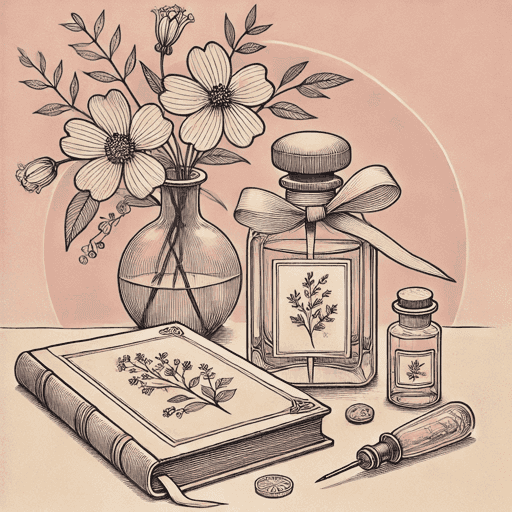
Lizzy’s psychic power is an ability to smell people’s emotions, as well as create fragrances. She has “her own brand of quiet magick—the glorious, mysterious alchemy of fragrance” (29). Furthermore, to Lizzy, some people are associated with a specific scent that represents them as a person, rather than what they are feeling at the moment. For instance, Althea’s human and ghostly presence smells like “lavender and bergamot” (43). Rhanna also smells this scent when Althea dies. It is the scent of the perfume Lizzy made for Althea and symbolizes her spirit.
Rhanna’s scent changes over the course of the novel. She chooses to scent herself and her space with patchouli. To Lizzy, she smells like “bonfire and tea leaves, rose petals and rain” (187). The “smell of the cemetery and funeral flowers. The smell of death” comes from Rhanna’s psychic gift of being able to see people’s deaths (250). It also is associated with guilt. After Rhanna confesses her gift to Lizzy, and Lizzy begins to uncover the real murderers, Rhanna smells different: “[T]he unsettling pong of damp earth that used to cling to her was beginning to dissipate, a sign that she’d begun to release the pain and guilt associated with Heather and Darcy” (259).
Susan and Roger also have the damp earth smell of grief. This is because Roger lost his wife and son and Susan lost her stepdaughters. When Lizzy meets Susan, she gets a “whiff of something murky and dank, a combination of mildew and freshly turned earth […] Loss. Regret. Soul-crushing grief” (131). Fred, after the death of his daughters, has a different smell. Lizzy registers his “tangy brine of sweat mingled with the stench of a festering wound, as if he were slowly rotting from the inside” (280). This combination of scents signals both grief and malevolence, as he abused his daughters after his first wife died.
The antagonistic characters have unpleasant scents. Chief Summers is “throwing off the scent of hot metal as he struggles to tamp down his anger” when Lizzy talks to him about the murders (66). Dennis, one of the murderers, has a “mud-and-blood stench, mingled with alcohol” (324). On the other hand, beloved people have pleasant scents. For example, Andrew “smell[s] of amber and sandalwood, of crisp fall days with the hint of smoke underneath” (56). This is a scent that Lizzy enjoys.
Herbs
For the Moon women, herbs have healing powers and symbolize a connection to nature, the land, and past generations. These healing properties were a core part of Althea’s teachings when she was alive, and they become central to Lizzy’s character development while in Salem Creek.
After her death, Althea leaves behind several books. One is her recipe book, which details how to use herbs, such as lavender and vanilla in a soap for insomnia. Another recipe is for “[a]ssurance oil […] combination of cedar and carnation oils, used to inspire confidence” (84). While insomnia is both physical and psychological, the latter oil is meant to help with a purely psychological issue: a lack of self-esteem. Plants heal a variety of ailments, both for clients and for the healer herself. Althea’s Book of Remembrances includes plants that Althea specifically selected for Lizzy to accompany her emotional journey. Evvie helped Althea “press the flowers and herbs” (99), a mark of the close and sustaining bond between the two women. Althea’s discussions of these herbs often mirror what she told Lizzy when she was alive. In other cases, Althea adds additional associations on top of what she drilled into Lizzy.
The healing properties of plants are part of the Moon family’s spiritual tradition. Lizzy thinks, “Rosemary, for remembrance. Basil, for courage. Thyme, for warding off nightmares. It was the catechism of her childhood—the catechism of all the Moon girls” (11). She memorized the associations as one would remember a prayer. In this catechism, and in Althea’s book, rosemary represents “remembrance” (32). However, in the Book of Remembrances, Althea expands on the associations for basil. She begins one entry with “[b]asil…for the mending of rifts” (203). It takes courage to forgive and mend a relationship. This expanded definition helps Lizzy reconnect with her estranged mother, Rhanna.
There are two plants that Althea discusses that help Lizzy make a choice in love. Althea discusses “[d]andelion…for resilience” and “[g]ardenia…for secret love” (366, 376). In the accompanying entries in the Book of Remembrances, Althea reveals that she had a secret love, Peter, and turned down his marriage proposal because of Sabine’s edict. Althea also confesses that she regrets this decision. Althea’s encouragement of Lizzy to go against tradition and follow her heart is what helps her choose to marry Andrew. When he asks why she changes her mind and decides to pursue a long-term love with him, she says that it is because of “[n]ine generations of Moon women, a dandelion—and [him]” (374). Althea’s teachings about plants have a profound impact on both familial and romantic love for Lizzy.
Plants play an important role in Lizzy’s life and the lives of her ancestors. They are connected to the earth and understand how the earth can help them with physical and emotional ailments. Over time, plants can gain more associations; they become more nuanced. Being attuned to the earth means that Lizzy is able to be persuaded by plants and her family’s discussions of them.
Fire
Another important symbol is fire, which appears figuratively as well as literally. Figurative fire represents fast and wide moving rumors. Salem Creek residents started a rumor that Althea killed the girls, and “[t]here’s no reasoning with people once an idea takes root. The whispers caught fire, and that was that” (34). The whispered rumors traveled quickly and extensively, overtaking the town. After these rumors circulated, Rhanna cursed the town in the coffee shop, and “[w]ord of the incident spread like a wildfire, and the outcry for something to be done about that Moon woman and her girls quickly swelled” (125). The rumors about Rhanna were linked to the rumors about Althea. They were equally pervasive and damaging.
These figurative fires foreshadow literal fires set by one of the murderers. Dennis first sets the Moon Girl Farm’s orchard on fire with a “Molotov cocktail” (180). A little while later, after Lizzy keeps up her investigation, he sets the Moon’s barn on fire. However, Lizzy uses alcohol, which is an ingredient in the perfume she is making when Dennis attacks, to defend herself. She throws the alcohol at Dennis’s lighter before he lights the cocktail: “His sleeve caught first, quick tongues licking up the spilled kerosene. He stared at it, eyes wide and blank, as if he were stunned to find himself on fire. Eventually, he began to flail” (327). Fire goes from representing rumors to literally destroying property and being a force for self-defense.
Books
The motif of books develops the theme of The Tension Between Tradition and Personal Choice. All Moon women are given empty magical journals to fill on their 16th birthday. At the beginning of the novel, Althea has left Lizzy’s untouched journal, The Book of Elzibeth, to her. It is meant to guide her back to the Path and the farm. At the farm, Althea kept eight generations of these personal magical journals, including The Book of Sabine and The Book of Althea (4). Rhanna has filled her journal with sketches of her visions of dead people; The Book of Rhanna is composed of illustrations, not words, unlike its predecessors (255). At the end of the novel, Lizzy dedicates her journal to her unborn daughter: “I begin this book for you, my dearest daughter—the next Moon girl” (382). She is passing down her family traditions in a book and keeping the older journals as teaching tools.
In addition to these books, Althea gives Lizzy a Book of Remembrances. It contains pressed flowers and herbs in addition to Althea’s written memories. This book is hugely influential. It encourages Lizzy to repair her relationship with Rhanna and to marry if she wants to. The former is following tradition, and the latter is breaking with tradition. Other Moon women have additional books that are stored at the Moon Girl Farm. There is “a set of scrapbooks belonging to Althea’s mother, Aurore, […] a sketchbook of botanical prints signed by Sylvie Moon” (239). These make Lizzy realize that she and her family should stay at the farm as the keepers of these texts.

Unlock the meaning behind every key symbol & motif
See how recurring imagery, objects, and ideas shape the narrative.
- Explore how the author builds meaning through symbolism
- Understand what symbols & motifs represent in the text
- Connect recurring ideas to themes, characters, and events