The Lean Startup: How Today's Entrepreneurs Use Continuous Innovation to Create Radically Successful Businesses
57 pages • 1-hour read
Eric RiesThe Lean Startup: How Today's Entrepreneurs Use Continuous Innovation to Create Radically Successful Businesses
A modern alternative to SparkNotes and CliffsNotes, SuperSummary offers high-quality Study Guides with detailed chapter summaries and analysis of major themes, characters, and more.
Summary
Background
Chapter Summaries & Analyses
Key Figures
Themes
Index of Terms
Important Quotes
Essay Topics
Tools
Important Quotes
“The grim reality is that most startups fail.”
(Introduction, Page 2)
“Despite the volumes written on business strategy, the key attributes of business leaders, and ways to identify the next big thing, innovators still struggle to bring their ideas to life.”
(Introduction, Page 4)
“I found that by applying ideas from lean manufacturing to my own entrepreneurial challenges – with a few tweaks and changes – I had the beginnings of a framework for making sense of them.”
(Introduction, Page 6)
This quote hints at the inspirations for the Lean Startup method (Toyota Production Systems) while firmly stating the uniqueness of that method. This builds Ries’s credibility as an expert in the field and as an innovator who practices what he preaches.
“Entrepreneurs are everywhere.”
(Introduction, Page 8)
Throughout the book, Ries emphasizes that entrepreneurs can be found in every company at every level. The “intrapreneurs” inside companies can study the Lean Startup methodology to innovate in their teams, departments, and companies.
“I believe that entrepreneurship requires managerial discipline to harness the entrepreneurial opportunity we have been given.”
(Part 1, Chapter 1, Page 16)
This quote is an example of Ries synthesizing entrepreneurship with management science. Basing the foundation of this synthesis in Taylor’s Principles of Scientific Management, Ries adapts Taylor’s methods for modern startup culture. This also lends to Ries’s credibility as a thinker and innovator in the industry.
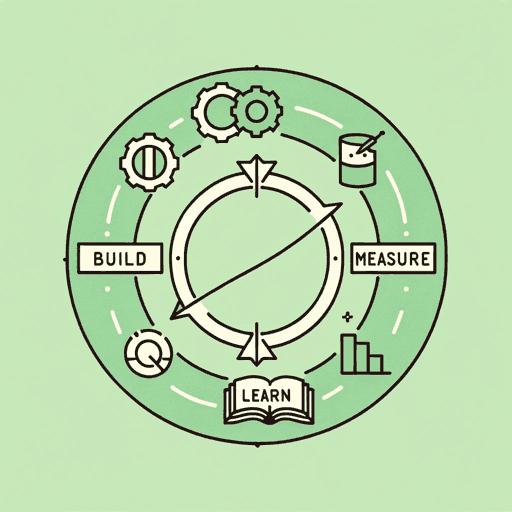
“Instead of making complex plants that are based on a lot of assumptions, you can make constant adjustments with a steering wheel called Build-Measure-Learn feedback loop.”
(Part 1, Chapter 1, Page 22)
One of the key terms for the Lean Startup method, Build-Measure-Learn is a process of testing MVPs through product development and launch. These low-quality products save time and energy, while also helping the company gain valuable insight on their assumptions about a product’s or service’s viability.
“Entrepreneurship is management.”
(Part 1, Chapter 1, Page 24)
Another example of Ries combining entrepreneurship and management, this quote illustrates the claim for significance delivered throughout the book. Not only is Ries advocating for a practice of business, but he is also trying to enhance the theory of business for modern times.
“Validated learning is the process of demonstrating empirically that a team has discovered valuable truth about a startup’s present and future business prospects.”
(Part 1, Chapter 3, Page 38)
Validated learning is a key concept in the Lean Startup method and is the outcome produced from the Build-Measure-Learn feedback loop. This learning strategy is the positive outcome of the Lean Startup’s process of experimentation for product development.
“A true experiment follows the scientific method.”
(Part 1, Chapter 4, Pages 56-57)
Throughout the book, Ries advocates for the use of the scientific method in startup’s product development and business strategy. Both product and strategy can be rigorously tested through empirical research and analyzed using quantitative data.
“The value hypothesis tests whether a product or service really delivers value to customers once they are using it.”
(Part 1, Chapter 4, Page 61)
Ries uses this term to describe the variables that track the rate of growth for a company. By clearly identifying value, Ries believes that waste of time and resources can be reduced and sustainability achieved.
“In the Lean Startup model, an experiment is more than just a theoretical inquiry; it is also a product.”
(Part 1, Chapter 4, Page 63)
Experimentation is a crucial aspect of the Lean Startup method. It enables entrepreneur’s to rigorously test their assumptions using empirical research and quantitative data. Rather than just an abstract strategy, experimentation can be in the form of an MVP that tests a product’s viability.
“I call the riskiest elements of a startup’s plan, the parts on which everything depends, leap-of-faith assumptions.”
(Part 2, Introduction, Page 76)
Assumptions about customer behavior and or product viability need to be tested. But before they can be tested, there must be a hypothesis, or an assumption, that directs the research.
“The MVP is that version of the product that enables a full turn of the Build-Measure-Learn loop with a minimum amount of effort and the least amount of development time.”
(Part 2, Introduction, Page 77)
The MVP (minimum viable product) is the cornerstone of validated learning through empirical experimentation. It characterizes the theme of lean throughout the text because it is meant to reduce waste at all levels of the company.
“Every business plan begins with a set of assumptions.”
(Part 2, Chapter 5, Page 81)
Assumptions are the hypotheses that drive experimentation and validated learning. Thus, Ries advises that entrepreneurs test their assumptions using the scientific method, rather than pure intuition.
“Contrary to traditional product development, which usually involves a long, thoughtful incubation period and strives for product perfection, the goal of the MVP is to begin the process of learning, not end it.”
(Part 2, Chapter 6, Page 93)
In the Lean Startup model, learning is crucial to sustainability and success. However, entrepreneurs should not stop the learning process just because they achieve growth and success. Rather, learning must be a constant driver of the sustainable business.
“MVPs require the courage to put one’s assumptions to the test.”
(Part 2, Chapter 6, Page 109)
The minimum viable product (MVP) is object that drives validated learning. In the Build-Measure-Learn feedback loop, the MVP takes an assumption and produces real-world data about that assumption. The analysis of that data develops the product to suit customer behavior and market viability.
“As you consider building your own minimum viable product, let this simple rule suffice: remove any feature, process or effort that does not contribute directly to the learning you seek.”
(Part 2, Chapter 6, Page 110)
The concept of lean in startup culture means the reduction of waste as much as possible. Therefore, extra features that take effort or time unrelated to the experiment of the MVP must be excluded from the business strategy.
“That change is called a pivot: a structured course correction designed to test a new fundamental hypothesis about the product, strategy, and engine of growth.”
(Part 2, Chapter 8, Page 149)
Whereas tuning the engine refers to small changes in product development, a pivot is a strategic maneuver that drastically alters the strategy of the company. Ries informs readers that the pivot is a risky but rewarding move that should also be subject to the same scientific scrutiny as all other proposed methods in the Lean Startup model.
“The engine of growth is the mechanism that startups use to achieve sustainable growth.”
(Part 3, Chapter 10, Page 207)
Companies need to identify the type of engine of growth—sticky, viral or paid—that generates sustainability. To figure this out, companies run a test based on an assumption in a sandbox experiment that will gain real-world data to analyze without compromising the company’s scarce resources.
“Getting a startup’s engine of growth up and running is hard enough, but the truth is that every engine of growth eventually runs out of gas.”
(Part 3, Chapter 10, Page 222)
Ries warns entrepreneurs that the perception of success can lead to a startup’s failure. Entrepreneurs must be constantly learning, testing, and innovating. This philosophy holds true even when growth occurs. To drive sustainability, entrepreneurs must test their assumptions at every level of the startup’s organization.
“Startups are in a life-or-death struggle to learn how to build a sustainable business before they run of resources and die.”
(Part 3, Chapter 11, Page 227)
Because of the limited money available to a startup, the possibility of failure is extremely high. The Lean Startup model allows entrepreneurs to learn and grow using low quality products produced in small batch sizes, thereby reducing waste.
“The core idea of Five Whys is to tie investments directly to the prevention of the most problematic symptoms.”
(Part 3, Chapter 11, Page 230)
The Five Whys is the process of identifying, addressing, and solving issues using the tiered asking of questions. Each why-question locates a technical issue, operations malfunction, or human error that is disrupting the process under scrutiny. This is another example of Ries advocating for lean concepts outside of product development and into business strategy.
“As startups grow, entrepreneurs can build organizations that learn how to balance the needs of existing customers with the challenges of finding new customers to serve, managing existing lines of business, and exploring new business models – all at the same time.”
(Part 3, Chapter 12, Page 253)
Ries values sustainable growth as the most important outcome for a startup. Every method, strategy, and practice advocated for in the Lean Startup model orbits around this objective.
“Entrepreneur is a job title.”
(Part 3, Chapter 12, Page 266)
Ries believes that entrepreneurs exist in all organizations. The problem is that orthodox organizational management stifles the creativity and potential of these individuals. He recommends that companies start identifying and encouraging entrepreneurial activity so that innovators can make meaningful differences in their organizations.
“Management is human systems engineering.”
(Part 3, Chapter 12, Page 272)
The synthesis of entrepreneurship and management is a theme that persists throughout the text. Ries predicts that management science and entrepreneurial creativity will continue to intersect in the future as new global problems emerge. Knowing the traditional methods of management can allow entrepreneurs to reduce waste and build products that drive sustainable growth.

Unlock every key quote and its meaning
Get 25 quotes with page numbers and clear analysis to help you reference, write, and discuss with confidence.
- Cite quotes accurately with exact page numbers
- Understand what each quote really means
- Strengthen your analysis in essays or discussions