The Medicine Woman of Galveston
59 pages • 1-hour read
Amanda SkenandoreThe Medicine Woman of Galveston
A modern alternative to SparkNotes and CliffsNotes, SuperSummary offers high-quality Study Guides with detailed chapter summaries and analysis of major themes, characters, and more.
Chapters 1-10Chapter Summaries & Analyses
Chapter 1 Summary
Content Warning: This section of the guide includes discussion of mental illness, illness, death, sexual content, sexual violence, rape, ableism, and racism.
In the year 1900, at a factory in St. Louis, Missouri, Dr. Tucia Hatherley witnesses a colleague get her arm caught in a machine. She is transported back to a time when she made a mistake in an operating theatre and accidentally let a woman die. She hears the man’s voice that berated her for her blunder before she is snapped out of her reverie as the factory foreman and physician rush to the woman’s aid in the present. Tucia steps forward to help but the physician declares it is too late, as the woman will die anyway.
Chapter 2 Summary
Disturbed by the return of her “hysterical attacks,” Tucia counts to herself on her walk home, determined to stay anchored to the present. She absent-mindedly plucks one of her hairs and stops, horrified, as soon as she realizes what she has done, and fights the urge to pluck more.
Tucia stops by the store and picks up a piece of penny candy for her son, seven-year-old Toby. At home, she is upset to find Toby playing in the dark by himself, while his babysitter, Mrs. Harsnatch, is fast sleep. Tucia wakes up Mrs. Harsnatch, who reveals the loan sharks had come by earlier that day. After she leaves, Tucia notices an article in the newspaper advertising a lecture by “renowned surgeon” Dr. Archibald Addams at Hamby Hall.
Chapter 3 Summary
After a lot of agonizing, Tucia decides to attend the lecture by Dr. Addams. She pays Mrs. Harsnatch extra to babysit longer that day, fixes a straw hat to cover the new bald spot that her hair-plucking has revealed, and heads to the lecture hall. A man in a silk cape and startling violet eyes holds the door open for her, and Tucia feels unsettled by him.
From one of the back rows, Tucia watches Dr. Addams speak, remembering the times he stood too close for comfort, or insulted her venomously. She is startled when Dr. Addams addresses her directly, and terrified that she has been recognized, she flees the hall.
Outside in the lobby, a man named Mr. Seldon, who once interned with her, stops her and apologizes for how badly he and the other male interns treated her when they worked together. He insists Dr. Addams was wrong to put her in the position he did in the operating theatre, and any of the others could have made the same mistake. Tucia retorts that, nevertheless, she is the one who has to live with the consequences, and leaves.
Chapter 4 Summary
Tucia gets ready for work in the morning, determined not to be late as she has been for the past three days—she is still disturbed by the accident at the factory. She watches a sleeping Toby and reflects on how the doctor who delivered him had uttered a poor prognosis because of his weak heart and congenital condition. However, despite having read Dr. John Langdon Down’s work on the syndrome named after him, Tucia knew Toby would prove them wrong.
At lunch, the factory foreman calls Tucia in and informs her she is being let go. Despite her otherwise stellar attendance, the foreman has been troubled by her lateness over the past few days, coupled with complaints from others about her hair plucking and muttering. When Tucia begs for leniency, the foreman tries to extort sex from her in return for her job; Tucia punches him and flees.
At home, Tucia discovers Mrs. Harsnatch obliviously reading the newspaper while Toby plays messily with the ash bin. Tucia fires Mrs. Harsnatch before heading to bed and falling into a deep sleep.
Chapter 5 Summary
When Tucia wakes up, she discovers she has been asleep for almost 20 hours. Toby greets her with breakfast he has attempted to “cook” for her: Raw oats mixed in water. Touched and overwhelmed, Tucia sets about cleaning and cooking as she thinks about her next step.
Tucia spends the next couple of days unsuccessfully job-hunting with Toby in tow. She receives letters from her creditors, including a denial for an advance from her loan agency and a list of three options available to her: Pay off the loan in full; renew it for a fee; or have her assets liquidated. Tucia has no money for the former and cannot choose the latter, as she will be sent to a “poorhouse” and Toby to an “asylum”; she desperately needs a job to choose the second option.
Chapter 6 Summary
Tucia sells her old medical textbooks for far too little at the pawnbroker’s, keeping only The Principles and Practice of Medicine. She plucks her hair incessantly, an urge that began when she was 12 and was at its worst after Toby’s birth, when she was left to care for him alone. With her father having passed away years prior, her stepmother forbid her from returning to her old home.
As Tucia is about to leave to renew her loan with the little money she has collected, she receives a visit from the violet-eyed man she met at the lecture. He addresses her as “Dr. Hatherley” and introduces himself as Hugh “Huey” Horn, with the stage-name “the Amazing Adolphus” (46).
Huey offers Tucia a job with his traveling medicine show, a show that attracts crowds with entertainments and sells them miracle cures and remedies. Huey needs a licensed physician to give him legitimacy and legal cover, and is ready to assume responsibility for Tucia’s debt if she agrees. To her surprise, he is aware of her financial troubles and her struggles with finding employment. Despite Tucia’s disgust at the fraud Huey is clearly committing, Tucia agrees to the job, desperate to avoid an otherwise inevitable separation from Toby.
Chapter 7 Summary
After Tucia signs a contract Huey draws up, he settles her debt, buys her and Toby some new clothes, and gets them first-class tickets on a train out of town for that same evening.
On the last morning of their journey, the train suddenly jerks to a halt when a telegraph line is discovered on the tracks. Huey surreptitiously knocks Tucia off her seat on the open-air platform in the caboose and loudly proclaims the train almost cost her grievous injury. To Tucia’s bewilderment, Huey presses the matter with the conductor until the latter offers a full refund for their tickets as reparation. Tucia is stunned and unsettled by Huey’s deceit.
Tucia, Huey, and Toby disembark at their final destination. While they wait to be picked up, Tucia notices a flier on a lamppost advertising Huey’s show, claiming “An unrivaled array of AMUSEMENT. Featuring Grazyna the Dancing Giant, Chief Big Sky, Cal Crip Caboo & MORE!” (58).
Eventually, a horse-drawn wagon arrives, driven by a sullen man named Darl with a badly repaired cleft lip, who is surprised to see that the new physician is a woman. Darl loads up their luggage and drives them to their destination.
Chapter 8 Summary
The group arrives at an overgrown field, where some wagons and tents surround a raised stage. Huey gives Darl instructions to finish setting up for the show that night while Tucia observes her new surroundings, surprised to find it more “pastoral” than she had been expecting. A young boy named Al, just a little older than Toby, comes up to them. To Tucia’s relief, he is more curious about Toby’s wariness than his appearance.
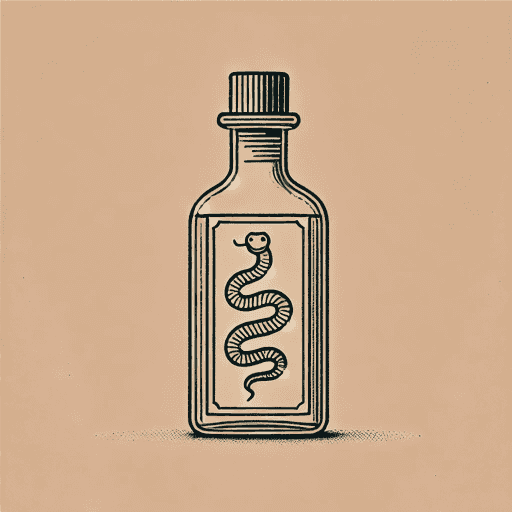
Huey directs Tucia toward one of the wagons to get settled before dinner. Tucia sees Huey take out one of the bottles of “medicine” from a crate before Darl carries her luggage to the wagon; the medicine is labelled, “Revivifying Rattlesnake Oil” (66).
Tucia is dismayed to discover that the wagon she and Toby have been assigned is tiny, dirty, musty, and in a state of disrepair. However, she hides her tears and pretends to like it to lift up Toby’s spirits.
Chapter 9 Summary
When the supper bell rings, Tucia and Toby head to the dining tent. They encounter the other performers in the show: A man with a “bulbous” nose, a woman with gigantism, and a young Indigenous American man. They are shocked to discover that the new physician is a woman, and begin placing bets on how long she will last with the show. Enraged, Tucia adds her own money to the pot, asserting that she will be there for exactly five-and-a-half months—long enough to pay off her debt to Huey. Tucia and Toby eat their meal away from the others. Huey arrives and hurries them along, as the show is about to begin.
Chapter 10 Summary
After finishing their meal, Tucia and Toby join the crowd around the stage, which has been completely set up and decorated. It carries a sign sporting the words, “The Amazing Adolphus and His Traveling Medicine Show” (74). The “big-nosed” man takes the stage first, carrying different musical instruments with him. Noticing his legs bowing out at the knees, Tucia remembers the name “Cal Crip Caboo” from the posters and realizes the cruel meaning of the stage-name. She deduces Cal probably had rickets as a child which had been left untreated.
Despite the audience’s initial mocking response to Cal’s appearance, they are mesmerized by his performance as he demonstrates inordinate skill with the instruments. Following Cal’s performance, Huey takes the stage and introduces himself as “Dr. Adolphus P. Aidenheimer, better known as the Amazing Adolphus” (77). He brings on the Indigenous American man next, claiming “Chief Big Sky” served alongside General Custer at the battle of Little Big Horn. Huey goes on to “translate” Chief Big Sky’s story, although Tucia remembers him speaking perfect English at suppertime. Next, “Grazyna, the Dancing Giant” (78) comes out. The audience is initially awed by Grazyna’s stature, and then by her stunningly graceful ballet performance.
Huey takes the stage again after “Grazyna’s” performance and regales the audience with a story of how he discovered the rattlesnake oil elixir while he was in Siam, where his uncle was an ambassador. He went to live there as a young boy after losing his parents. Huey claims the elixir cured illnesses of all kinds, and that he has replicated the Siamese formula here in the US. The crowd goes wild as Huey offers them each a bottle for $1 each. An incredibly skeptical and now horrified Tucia leaves the show, wondering, “What sort of madness had she agreed to take part in?” (84).
Chapters 1-10 Analysis
The Medicine Woman of Galveston unfolds in a fairly straightforward and linear narrative, with some exceptions. The story is told chronologically and in the third-person voice, though it largely features Tucia’s perspective. The exceptions are flashback moments from Tucia’s past, in which events are often referenced without additional context—the operating theatre being one example—and the interludes that appear later in the book featuring other characters’ backstories. The break in narrative style that appears in these chapters mirrors how traumatic memories impact Tucia’s present, reflecting symptoms that are now often associated with post-traumatic stress disorder (PTSD). The exceptions to the largely sequential narrative in the book are a creative choice, meant to highlight the text’s key ideas and themes.
One of the first themes introduced is The Ethics of Survival. Tucia is drowning in debt, with her stress manifesting itself in various ways: She experiences “hysterical attacks,” and she compulsively plucks her hair. Tucia is also a single mother raising her son, Toby, who has Down syndrome. These various stresses and responsibilities illustrate Tucia’s desperation and socioeconomic vulnerability, which lead her to accept Huey’s offer even though she knows he is a charlatan. Her main motivation is to avoid any separation from Toby, as she knows that if she goes to a “poorhouse,” Toby will be sent to an “asylum” where he will not receive the care he needs. The nobility of a mother’s love is juxtaposed against the unethicality of the enterprise Tucia is set to join, with Tucia deciding to make a moral compromise in the hopes it will only be for a few months. Her choice to join the medicine show thus introduces one of the key conflicts of her character arc: She will have to navigate balancing survival with her own personal morality.
Tucia’s dilemma also introduces the theme of The Workplace Challenges Faced by Women. At the novel’s opening, Tucia is working in a clothing factory and, not long after, it is revealed that she is also a licensed doctor. In both workplace settings, Tucia faces discrimination due to her gender. In the flashbacks she experiences, a man’s voice cruelly berates her for a blunder at work, and when Tucia runs into an old acquaintance, he admits she was mistreated by her male medical colleagues. In the present-day timeline at the factory, the foreman tries to extort sex from her in exchange for her job. Tucia’s past and present both illustrate the prejudices, abuse, and mistreatment she has faced as a woman in the workplace, and she will continue to wrestle with these disadvantages as she becomes more involved in Huey’s traveling medicine show.
The situation of various characters also introduces the theme of Examining and Dismantling Stereotypes and Prejudice, with Skenandore exploring various forms of discrimination that are common during the time period. Toby has Down syndrome, and Tucia exhibits symptoms of PTSD and trichotillomania, or compulsive hair-pulling. Both conditions are poorly understood at the time, and contribute to the obvious isolation Tucia and Toby experience in their lives. They have no friends or support system around, and part of the reason Tucia is fired from the factory is because others complain to the foreman about her “muttering” and peculiar behavior.
The traveling medicine show also embodies the discrimination and exploitation faced by characters who exhibit characteristics different from what society’s prejudices deem pleasant or acceptable: “Grazyna” has gigantism; Cal has bowlegs; and Lawrence Hiya, the young Indigenous American, is reduced to a racialized stereotype by Huey, who pretends Lawrence is “Chief Big Sky” who cannot speak English. Skenandore populates the narrative with characters that are socially discriminated against, and by untangling their individual stories, she examines the prejudices they face and the possibility of dismantling the stereotypes forced upon them.

Unlock all 59 pages of this Study Guide
Get in-depth, chapter-by-chapter summaries and analysis from our literary experts.
- Grasp challenging concepts with clear, comprehensive explanations
- Revisit key plot points and ideas without rereading the book
- Share impressive insights in classes and book clubs