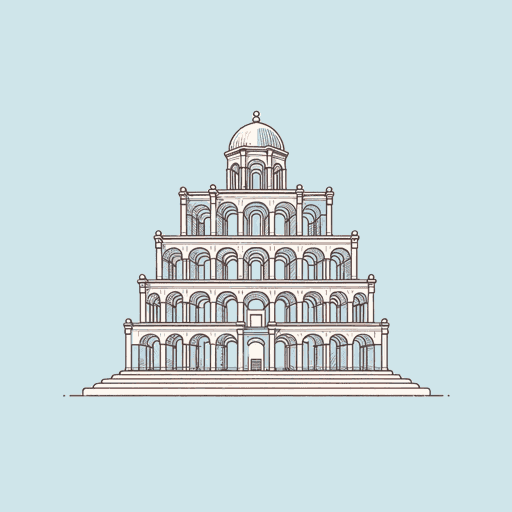
The Memory Palace Of Matteo Ricci
37 pages • 1-hour read
Jonathan SpenceThe Memory Palace Of Matteo Ricci
A modern alternative to SparkNotes and CliffsNotes, SuperSummary offers high-quality Study Guides with detailed chapter summaries and analysis of major themes, characters, and more.
Important Quotes
“In 1596 Matteo Ricci taught the Chinese how to build a memory palace.”
(Chapter 1, Page 1)
The evocative opening line of The Memory Palace of Matteo Ricci sets the tone of Spence’s narrative. The quote establishes the date, introduces Ricci and the concept of a memory palace, and situates the narrative in China.
“In the time of Aquinas, and in the following two centuries, there developed a whole tradition of texts that sought to sharpen Christian devotion through evoking the imagination of believers, some of the most important of which, like William of Paris’s twelfth-century Rhetorica Divina, reached back to Quintilian for inspiration.”
(Chapter 1, Page 16)
The concept of a memory palace dates back to antiquity. In Chapter 1 Spence establishes the history of the memory palace and how it aligns with Christian thought. In this quote Spence draws parallels between the teachings of classical antiquity and Christian theology, a theme that resurfaces in Ricci’s teachings in China.
“As we travel with Matteo Ricci, we should remember one other link between his classical past and his Chinese present.”
(Chapter 1, Page 23)
While The Memory Palace of Matteo Ricci is a work of history and biography, the narrative structure is nonlinear and follows the whims of memory. This quote is typical of Spence’s poetic style and his method of signposting key information to the reader.
“The churches where he prayed were decorated with great tapestries of Scipio’s victory over Hannibal, visually reinforcing those famous speeches which he knew by heart. Perhaps, too, he saw the ingenious mechanical statue of a Roman soldier, holding a sword in his right hand and the head of a Turk—gushing imitation blood—in its left, which some grateful citizens placed in the street. It would not have escaped him that the Virgin Mary was hailed as the Lady of Victory, and that in the subsequent paintings in her honor she was portrayed as standing on the crescent moon, symbol of the vanquished Turkish state.”
(Chapter 2, Page 36)
Images play a central role in the text. In Chapter 2 Spence imagines Ricci observing tapestries, statues, and paintings, and he structures the broader text around images taken from Ricci’s memory palace and Cheng Dayue’s Ink Garden. This serves to highlight the importance of images in missionary work and religious education, as well as in the memory palace recall technique. In Ricci’s time images conveyed complex messages to illiterate audiences and people who spoke different languages, all while reinforcing textual narratives.
“The Japanese mixture of cruelty, dignity, depravity, and hypocrisy was so complex that he despaired of analyzing it accurately: even after conversion they seemed ‘tepid’ in the faith. Perhaps it was ‘better to have no Christians than Christians of that type!’”
(Chapter 2, Page 42)
The Jesuit Alessandro Valignano arrived in Goa in 1574 and spent time in Macao and Japan. This quote describes Valignano’s beliefs on race and examines how they influenced Ricci. Spence documents the beliefs of the 16th-century subjects he writes about without passing judgment on what they believed.
“In this particular letter it is hard to sort out Ricci’s personal views from the views commonly held about China by Europeans. Several of his points—such as those about the elaborate coiffures of Chinese men and their penchant for hair-pulling—had already been made in the earliest reports to be published on China, those by the Italian trader Galeote Pereira, published in Venice in 1565, and by the Dominican friar Gaspar da Cruz, published in Portugal during 1569, either or both of which Ricci had ample opportunity to read before he sailed to the East.”
(Chapter 2, Page 44)
Spence documents how Ricci’s stated views on race reflected opinions that circulated in this period. This serves to situate Ricci within a larger cultural context and demonstrates how Spence uses Ricci’s life story as a lens through which to examine broader world history and culture at the time.
“Shouting, shoving at the crowd, Ricci held them back for a few moments until a blow from an axe caught him on the hand; then he ordered all the members of his group to retreat to their own private rooms and bar their doors. One of the servants clambered onto the roof and began to hurl tiles at the heads of the rowdies; Ricci barred his own door and jumped through the window into the garden to summon help. Twisting his ankle, he lay helpless on the ground, unable to move but still shouting for aid.”
(Chapter 2, Page 58)
In July 1592 Ricci and the mission near Shaozhou were attacked. Ricci’s arm healed, but despite seeking medical care in Macao, his foot never recovered. Violence is a theme that runs throughout Ricci’s life; Chapter 2 opens with the Chinese ideograph of war and uses the theme to chart the violence that marked Ricci’s childhood in Macerata and his time as a missionary.
“A man who has strong faith in the Way can walk on the yielding water as if on solid rock, but if he goes back to doubting, then the water will go back to its true nature, and how can he stay brave? When the wise man follows heaven’s decrees, fire does not burn him, a sword does not cut him, water does not drown him. Why should wind or waves worry him?”
(Chapter 3, Page 60)
To include Ricci’s voice and reflections, Spence quotes Ricci’s writings and letters. This quote is taken from the text he wrote to explain his first image of the apostle Peter on the Sea of Galilee. The first paragraph restates the story, but the second paragraph, from which this quote is taken, introduces Ricci’s own interpretation of the story. To interest Chinese readers, Ricci references the Way, a Chinese spiritual concept, and frames Peter like the sage figures of the Chinese intellectual and spiritual tradition, “who were so purified by their contemplation of the Way that they could withstand the forces of water and fire” (62). Ricci consciously draws from concepts familiar to his readers to make Catholicism more accessible.
“The visual image will have to conjure up the missing text, and every detail matters in this attempt.”
(Chapter 3, Page 64)
Images are not merely decorative but also important pedagogical devices. The first image chosen for Cheng Dayue’s Ink Garden plays an important role in conveying the theological meaning of the story, which features intricate details in place of words, including “the city, from which the hungry came out to be fed. There is the mountain, where Christ retreated to pray. There is the fishing boat, with all the crew at work. Or rather all the crew save one, all save Bo-do-lo, who leaves the comparative safety of the vessel to struggle in his heavy robes among the waves and gazes up anxiously at the calm figure of Christ upon the shore” (64).
“The Jesuits in China knew enough of the sea’s dangers to send each of their letters to Europe in two copies—one via Mexico on the Spanish galleons out of Manila, and one via Goa on the Portuguese carracks leaving Macao. Ricci’s superior Valignano may have been startled that one of his letters to Rome took seventeen years in transit from Macao, but Ricci accepted six to seven years as the norm for receiving an answer to a given letter.”
(Chapter 3, Page 66)
One of the core tenants of the Jesuit faith was to evangelize abroad. In the 16th century this meant extended stays in foreign places with little to no contact with friends and family. The isolation that Ricci experienced reflects the power of his faith and his belief in his mission.
“To present these multifaceted ideas in the form of a memory image that the reader will remember, Ricci first cuts the ideograph in two horizontally. This yields two separate ideographs, the upper one meaning ‘west’ and the lower one ‘a woman.’”
(Chapter 4, Page 93)
The images in Ricci’s memory palace are drawn from clever interpretations of Chinese ideograms. In Chapter 4 Spence introduces the second ideogram and details how Ricci devised the image of “a woman from the Xixia territories, who is a Muslim” or “a woman from the northwest, who is a huihui” (95). In his breakdown of the different layers of meaning that Ricci draws from the ideogram of yao, Spence shows how memory palace images are constructed and convey meaning.
“Here are more than thirty kingdoms which all follow the administration of the ancient kings. No superstitions are allowed here but everyone holds to the religion of the Lord of Heaven, the supreme ruler. There are three classes of those in authority: the highest occupy themselves with religion, then come those who judge temporal affairs, and lastly those who devote themselves to arms. These countries have all the cereal grains, metals, fruits, and wine made from grapes. They study astronomy and philosophy and believe in the five relationships. Kings and people alike are powerful and rich: in all seasons they have relations with other lands, and their travelers and merchants voyage to all the countries of the world.”
(Chapter 4, Page 97)
Ricci’s diverse and unusual life experiences as a missionary provide a fertile site for Spence to write a larger history of Ming China and Counter-Reformation Europe. In this passage Spence cites Ricci’s explanation of regions off the Atlantic Ocean along Europe’s west coast that accompanied a map he made between 1584 and 1602. Ricci’s contributions to producing and sharing knowledge—core tenants of the Jesuit mission—are emphasized.
“We know from other writings that Ricci was upset that the more talented Indian students were denied training in advanced theology by jealous or nervous Western priests within the Goa community, and that the local Indians, ‘however much they know, are rarely given much credit in comparison with other white men.’ From this we can guess that he was sympathetic to Jesuits who had tried to prevent the application of the Inquisition’s rigors to native Christians, at least until they had had a grace period of twenty years in which to try and adjust their differences with Rome.”
(Chapter 4, Page 113)
There is a remarkable amount of information about Ricci’s life. Spence pieces together a variety of sources written by Ricci and his contemporaries to reconstruct Ricci’s travels and opinions. In this section Spence uses two signposting phrases. “We know from other writings” shows how he is constructing the history and the types of primary source material he is using. “From this we can guess” signals that he is analyzing the text and drawing his own conclusions from the source material.
“Ignatius’s terse instruction that the students ‘should commit to memory what their masters have assigned’ was taken literally and was echoed by other Jesuit directors of instruction during the years of Ricci’s schooling.”
(Chapter 5, Page 135)
Memorization was an important part of Jesuit education. In the 16th century books were less accessible than they are today. This was especially true for missionaries who were assigned to remote locations and only able to bring limited numbers of books with them. Mastery of the Bible and other texts was essential for Jesuits to convince scholars and intellectuals of other faiths to convert to Catholicism.
“By impressing the Chinese with his memory skills, Ricci hoped to interest them in his culture; through interesting them in his culture he hoped to draw them to an interest in his God.”
(Chapter 5, Page 140)
Spence clearly summarizes why Ricci decided to teach the memory palace technique. The memory palace is one method Ricci employs to convert people to Catholicism. Ricci saw an opportunity to make himself valuable to someone important by teaching his sons a method of memorization that would help them in their examinations. The memory palace stands in for the larger value of Western knowledge.
“Calculating eclipses, estimating latitudes, constructing integrated and adjustable sundials that would be accurate at any location, even making the large-scale map of the world that brought him such fame in China, adjustable sundials that would be accurate at any location, even making the large-scale map of the world that brought him such fame in China, were not so immensely difficult when he had with him copies of Mercator’s map of 1569, Ortelius’s map of 1570, the immensely detailed tables for estimating latitude that he had in Clavius’s Sfera and Alessandro Piccolomini’s Sfera del Mundo and always carried with him on his travels.”
(Chapter 5, Page 148)
Ricci’s scientific and mathematical knowledge was important in establishing connections in China. Ricci was the first Westerner invited into the Forbidden City in 1602, and he was permitted entrance because of his knowledge. Ricci’s skill at memorization aided his missionary work.
“What is striking about this list of exemplars is their almost total inapplicability to the concerns of the Chinese literate elite, a fact that graphically highlights the shortcomings of such a literalness of approach in translating a European text to Ming China. All three examples are wide of the target in the Chinese context. Going on embassies to foreign courts was not a mark of respect—indeed, it was almost never done by Chinese—and if one did go one would have no reason to want to remember the names of the foreigners; foreign languages were of no concern to a Confucian literatus, who expected that foreigners desiring to communicate with him would, like Ricci, learn Chinese; and few officials sought a military career of any kind—indeed, military service even at the senior level was widely regarded as an inferior occupation, as Ricci knew.”
(Chapter 5, Pages 155-156)
Ricci used the memory palace to entice Chinese people to convert to Catholicism. To demonstrate its effectiveness, he cites a number of prominent leaders in politics and the military who used the technique to memorize important details. However, as Spence notes, Ricci’s examples had very little meaning to the people he sought to impress. Throughout the book Spence highlights several moments where Ricci’s methods miss the mark because of his failure to understand the cultural context of Ming China.
“Needing large houses for his fellow Jesuits, their numerous staff, and various novices, converts, and visitors, but also knowing that purchase of large houses by foreigners was bound to cause anger and resentment, he adopted the device of looking for houses which the Chinese claimed were haunted.”
(Chapter 6, Page 183)
Foreigners had an uneasy status in Ming China. Ricci was welcomed in some scholarly and political communities, but in other areas he encountered resistance. This quote documents the struggles Jesuits faced in establishing missions and the clever ways that Ricci circumvented obstacles.
“The Jesuits themselves in China had to face disquieting charges of sexual misconduct.”
(Chapter 6, Page 221)
theological context. For example, while discussing Ricci’s critique of prostitution and homosexuality in China, Spence introduces scandals that accompanied Jesuit missionaries in China. In doing so, he provides a broader framework within which to situate Ricci’s life while highlighting the biases and omissions in Ricci’s narrative and drawing parallels between it and the historical reality.
“The rhetoric of this piece is astonishingly like the kind of charges that Reformation critics had launched against Rome and its corrupted popes as the ‘whore of Babylon,’ an echo reinforced by Ricci’s charge that the Buddhist church itself represented ‘a Babylon of doctrines so intricate that no one can understand it properly, or describe it.’”
(Chapter 7, Page 217)
Spence quotes Ricci writing about the cruelty of the king and the corruption of the court. After extensively quoting Ricci, Spence analyzes his writings, making a connection between Ricci’s language and the language of Reformation critics who challenged the Catholic church. Using textual analysis, Spence suggests that Ricci was influenced by their critiques.
1. “One can almost hear Ricci murmur the lines that Dante chose to introduce himself and his own quest in the Inferno:
Poi ch’ei posato un poco il corpo lasso,
ripresi via per la piaggia diserta,
si che ’l pie fermo sempre era ’I piu basso.”
(Chapter 8, Page 236)
Spence speculates on what he thinks Ricci might have read and referenced. This section from Dante Alighieri’s epic poem Inferno references the hero of the poem limping as he drags his wounded foot. Spence imagines that this poem resonated with Ricci after his foot was injured. While Spence carefully reconstructs Ricci’s life, at times he introduces speculation or conjecture to draw links between Ricci and his cultural context.
“Certainly when he moved from Macerata to Rome as a schoolboy of sixteen he took up residence literally in a city of relics. In the myriad shrines of the city’s 127 churches could be found, it was believed, the bodies of St. Peter and St. Paul, the heads of St. Luke the evangelist and of St. Sebastian, the arm of Joseph of Arimathea, and Christ’s face imprinted on the linen cloth once held by Veronica. There too were stored the tip of the spear that pierced Christ’s side, a piece of the true cross, the head of an arrow that pierced St. Sebastian, the table on which the Last Supper was served to Christ and his disciples, one of the thirty pieces of silver paid for Christ’s betrayal, the chains that bound St. Paul, part of the five barley loaves with which Christ fed the hungry multitude, the towel with which Christ washed his apostles’ feet, the stairs that Christ ascended to the house of Pontius Pilate, one of the nails that fastened Christ to his cross, and two of the thorns from his crown.”
(Chapter 8, Page 237)
Relics were an important part of Catholic veneration. However, they were hard to translate in a cross-cultural context because the symbols and associations that gave the objects power were not legible in different spiritual traditions. This quote provides insight into some of the key stories and values of the church that Ricci was trained within. The effectiveness of the memory palace technique is partly tied to the importance of visual images in Catholic teachings and the vivid stories that people were taught to identify with symbols.
“Perhaps in part it was the extraordinary realism with which the beauty of her image had been caught—a realism that led Zhaoqing residents to kowtow before her and the prefect Wang Pan to request a copy of her image to send to his aged father in Shaoxing—but the Chinese slowly came to believe that the Christian God was a woman. Her image fused with other visions of benevolent deities from China’s own past, and the very realism with which her long robes were painted made it hard for some Chinese scholars to recognize the humanness of her form. As Ricci’s contemporary, the scholar Xie Zhaozhe, wrote in his book of observations and reminiscences, ‘The image used for the Christian God is the body of a woman, but her appearance is most unusual; she’s like those figures we used to describe as ‘having a human head and a dragon’s body.’”
(Chapter 8, Page 244)
This passages reemphasizes the significance of images, particularly in cross-cultural exchange. While images of the Crucified Christ—an important symbol in the Catholic faith—alarmed many Chinese viewers, images of the Virgin Mary were more popular. Because of the prominence of Marian imagery, there was a mistaken belief that the Christian God was a woman. The challenges of communicating complex theological doctrines in translation is evidenced in this misunderstanding.
“The kind of sophistry [used by Matteo Ricci] is a clever play on words. How can it harm the clear teaching of the Great Truth?”
(Chapter 8, Page 253)
Ricci engaged in heated debate with Chinese scholars around values and spirituality. This quote is taken from a criticism of Ricci’s challenge to Buddhist doctrine by the famed scholar Zhuhong. Zhuhong was very dismissive of Ricci’s arguments, which he saw as “muddling the actual with the merely possible” (253).
“He sees the eunuch Ma Tang, suffused with anger, grasp the cross of carved wood to which the bleeding Christ is nailed. He hears the shouts of warning and the howling of the wind as the boat keels over, flinging both him and Joao Barrados into the water of the River Gan. He smells the incense that curls up around his triptych as he places it reverently upon a pagan altar in the luxurious garden temple of Juyung. He tastes the homely food prepared for him by the poor farmers in their country dwelling near Zhaoqing. He feels the touch of cheek on cheek as the dying Francesco de Petris throws his arms around his neck.”
(Chapter 9, Page 266)
The final chapter opens with a detailed and evocative series of Ricci’s memories. Like human memory, they do not have a logical order but instead are free-associative and very emotional. By closing with Ricci’s recollection of important moments in his life, Spence links the concept of the memory palace with the importance of memory itself.

Unlock every key quote and its meaning
Get 25 quotes with page numbers and clear analysis to help you reference, write, and discuss with confidence.
- Cite quotes accurately with exact page numbers
- Understand what each quote really means
- Strengthen your analysis in essays or discussions