27 pages • 54-minute read
The Monkey
A modern alternative to SparkNotes and CliffsNotes, SuperSummary offers high-quality Study Guides with detailed chapter summaries and analysis of major themes, characters, and more.
Story Analysis
Analysis: “The Monkey”
Content Warning: This section contains references to child abuse.
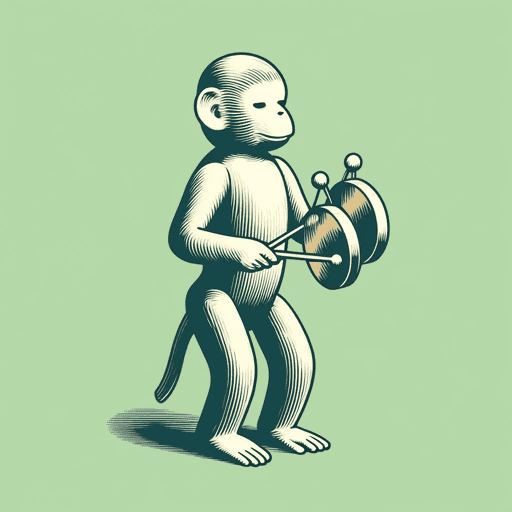
The central conflict in “The Monkey” centers on the supernatural influence of the monkey toy and the deadly consequences of possessing it. Read on the most straightforward level, the story pits its protagonist, Hal Shelburn, against the malevolent presence of the monkey. From the moment Hal discovers the toy in the attic, the atmosphere is one of unease and foreboding. Descriptions of the toy emphasize its eerie appearance and sound: its glass eyes, matted brown fur, and clashing cymbals. The imagery only becomes more sinister as flashbacks reveal Hal’s history with the toy: “It grinned at him with its murky amber eyes, doll’s eyes, filled with idiot glee, its brass cymbals poised as if to strike up a march for some band from hell.” Besides its apparent power to kill, the monkey also seems to have volition and agency, making its way back to Hal first after he throws it away and then after he tosses it down a well. This ability to thwart Hal renders it a more threatening and viable antagonist. Hal’s external conflict is thus rooted in his struggle to understand and confront the monkey to protect himself and his family from its influence.
Key to this is the theme of The Loss of Childhood Innocence. The monkey’s presence meant that Hal experienced a series of painful losses as a young boy, including the deaths of both his mother and friend. This brought home to him the idea that anyone could die at any time; when he found the toy in his aunt’s attic, he heard it say, “I came to you, Hal, I’m your Christmas present, so wind me up, who’s dead? Is it Bill? Is it Uncle Will? Is it you, Hal? Is it you?” (191). While the story’s conclusion—the death of the lake’s fish—suggests that mortality is in fact an omnipresent reality, Hal seeks to shield Petey from the particularly violent introduction to death that Hal himself experienced.
However, Hal’s struggles with the monkey coincide with an internal conflict within Hal. He experiences a mix of fear and curiosity regarding the monkey and its origins, and the story consistently emphasizes that he and the toy are linked in some way. As the monkey says (or seems to say), “I like you, Hal. We were made for each other, just a boy and his pet monkey, a couple of good old buddies” (191). The implication is that Hal secretly wishes to do what the monkey does, and his occasional angry and violent outbursts at his wife and children lend credence to the idea that Hal does have a dark side. The story is less explicit about where that dark side originates, but his father’s abandonment, his mother’s frequent (though involuntary) absence, and the reference to variously neglectful or abusive babysitters suggest that Hal’s childhood was traumatic even before he discovered the monkey. Read as a symbol of Hal’s repressed fear and anger, the monkey becomes a more complex symbol of The Nature of Evil, which the story suggests is neither innate nor inexplicable but rather the consequence of experiencing “something bad” oneself.
The story’s limited third-person point of view facilitates this reading, as readers experience the story’s events only through Hal’s senses and thoughts. This encourages a strong bond between the reader and the protagonist, but it also opens up the possibility that the narrative’s events are not quite what they seem. Even if Hal’s perspective is reliable, the effect is still disorienting and claustrophobic, as the reader’s knowledge is limited to what Hal observes and understands. The story’s physical setting mirrors this claustrophobia, heightening the tension. The narrative primarily unfolds within the confines of the family home and/or hotel room—closed spaces that enhance the feeling of encroaching horror.
Regardless of whether one interprets the monkey as a literal force of evil or as a projection of Hal’s darker impulses, the story suggests that the remedy is the same. The climax occurs when Hal risks his own life to throw the monkey into the deepest part of the lake. Like the rest of the narrative, the scene can be read both literally and figuratively; Hal is either breaking the cycle of fear and tragedy that the monkey perpetuates or symbolically “drowning” a part of himself that he recognizes as destructive. Either way, Hal’s love for his family—particularly his sons—motivates his actions, underscoring The Importance of Family Relationships in confronting evil.

Unlock all 27 pages of this Study Guide
Get in-depth, chapter-by-chapter summaries and analysis from our literary experts.
- Grasp challenging concepts with clear, comprehensive explanations
- Revisit key plot points and ideas without rereading the book
- Share impressive insights in classes and book clubs