The Moose
17 pages • 34-minute read
Elizabeth BishopThe Moose
A modern alternative to SparkNotes and CliffsNotes, SuperSummary offers high-quality Study Guides with detailed chapter summaries and analysis of major themes, characters, and more.
Poem Analysis
Analysis: “The Moose”
Bishop has dedicated this poem to Grace Bulmer Bowers, one of her maternal aunts. Bishop’s aunts Grace and Maude both became mother figures for Bishop when she moved in with them at the age of seven. “The Moose” was inspired by a bus ride that Bishop took from her aunts’ home in Nova Scotia to Boston when business in the city interrupted a family visit.
The poem opens with a description of the area where the journey begins in Nova Scotia, somewhere near the Bay of Fundy. The first several stanzas communicate the physical features of the area and the way of life of its inhabitants. The nostalgic and reflective tone accompanies a reverence for nature and the seemingly peaceful routine of daily life within these seaside provinces.
The third stanza, full of color, describes the sunsets and how they can look different depending on the tide at sunset. The soil in Nova Scotia is a reddish orange, and Bishop mentions this in the letter she wrote to fellow poet and mentor Marianne Moore about the trip that inspired “The Moose.” The light from the sun shines red on a full tide (Lines 13-15), but when the tide is out, the mud in the bay appears purple in the waning light (Line 17) with “burning rivulets” (Line 18) of water reflecting the red of the sunset. This is the last stanza that lacks motion. Up until this point in the poem, the speaker is observing the static, quiet scenery, almost as if taking a mental snapshot of both the physical and psychological atmosphere.
In Stanza 5, the bus appears and eventually traces the natural ups and downs of the roadway until it stops to pick up a single traveler. The single passenger says goodbye to a specific “seven relatives” (Line 35). In Bishop’s prose memoir piece “Primer Class,” which detailed her time in grade school, she explains that numbers often evoke a strong feeling of nostalgia and memory. When these numbers appear in her poetry, then, it often signifies that she is painting a picture of a memory for the reader. In this case, the scene with the collie (Line 36) is also recounted in the letter to Moore. This is not to say that this stanza shows Bishop saying goodbye to precisely “seven relatives” (Line 35) and her collie. In fact, the speaker of the poem is never identified. However, it could be assumed that this “lone traveller” (Line 33) is the speaker because the perspective of the narrative shifts to observing from inside the bus once this individual boards it.
In Stanza 7, there is a noticeable shift in tone. The lines are shorter, almost clipped. The speaker’s “Goodbye to the elms, / to the farm, to the dog” (Lines 37-38) is a farewell to the peaceful comfort of provincial life as the bus heads west toward the city bustle of Boston. The dog especially starts to take shape here as a symbol of the comforts of home, and the speaker will mention a dog two more times before the poem ends. The sun continues to lower, making the light “richer” (Line 40) and the air a bit cooler, which then brings in the fog, “salty” (Line 41) from the sea.
The tone in Stanza 8 practically changes temperature as the speaker describes the “cold, round crystals” (Line 43) of the fog in comparison to the warmth of the browns and reds of the scenery in earlier stanzas. The cold fog represents how memories can both be crystalized into mental images and recalled with clarity, or obscured by time and distance. Here the memories of “white hens’ feathers” (Line 45), “gray glazed cabbages” (Line 46), and “cabbage roses” (Line 47) are clear. However, in Line 48, the speaker creates a simile of two different plants—“lupins,” which are flowering legumes native to the Nova Scotia area (among others) and “apostles,” which are flowering plants native to Brazil. Bishop spent her childhood in Nova Scotia, but she fell in love with Brazil and spent 15 years living there and another several years travelling between there and the US. Therefore, Line 48 blurs the concept of “home” by comparing these disparate plants.
Evening falls in Stanza 9, leaving only the white of the strings supporting the sweet pea plants (Lines 49-50) and the whitewashed fences (Line 51) left visible. Bumblebees (Line 52), tired from a long day’s work will snuggle up inside foxgloves to sleep for the night. In this stanza, nature is preparing for rest.
However, in Stanza 10, the bus continues on without rest. The bus is separate from nature, and the people on the bus are insulated from the outside, like a mobile bubble of civilization, moving through the night. A “woman shakes a tablecloth / out after supper” (Lines 59-60), reminding the reader of the late hour once again. The woman’s actions also symbolize the never-ending cycles of life: Removing the tablecloth from the table signifies the end of the meal, but the shaking out of crumbs is in preparation for laying the cloth out again, clean and ready for the inevitable next meal.
The bus enters the Tantramar marshes as the sun sets (“A pale flickering. Gone.” [Line 61]) in Stanza 11. These marshes are nestled between Nova Scotia and New Brunswick, creating a buffer between the two Canadian provinces. Entering this area, the speaker is no longer home, and the feeling of nostalgia and familiarity are starting to give way to a more objective reality. The speaker is noticing the smells for the first time in the “smell of salt hay” (Line 63), and there is just a hint of danger in the trembling of the “iron bridge” (Line 64) and rattling of the “loose plank” (Line 65), though the safety of the bus is still assured in that the plank “doesn’t give way” (Line 66).
In Stanza 12, the speaker is looking out the window on the left side of the bus (Line 67). There is a boat moving in the opposite direction of the bus because the speaker calls attention to the “ship’s port lantern” (Line 69), which is the light indicating the left side of a water vessel. The speaker listens as a dog “gives one bark” (Line 72). The dog is a symbol of home in Stanza 7; here, home calls back as the bus crosses the border of the speaker’s home province and enters unfamiliar territory. Night has completely fallen as the bus “enter[s] / the New Brunswick woods” (Lines 79-80). The adjectives Bishop uses here become sinister—“hairy, scratchy, splintery” (Line 81). There is no longer any comfort in the scenery.
Stanza 15 brings in the murmurs of the night. The people on the bus are relaxing, and some are falling asleep. There is nothing else to see out the windows because night has fallen and the woods obscure any signs of civilization. Not everyone is sleeping though, and “a dreamy divagation” (Line 87), or a wandering conversation, is heard. It is unclear whether the sound of the conversation is real or if the speaker is experiencing memories of conversations via a half-asleep state. The ellipsis that ends the stanza in Line 90 adds to the sensation of drifting. The line trails off like someone drifting off into a light sleep.
The conversation continues in Stanzas 16-19. The bus’s travels make “creakings and noises” (Line 91) while the speaker tunes into “an old conversation” (Line 92). The conversation is old not because it was spoken long ago but because it continues to be spoken today. The conversation doesn’t involve any of the people on the bus. The speaker finally identifies it as “Grandparents’ voices” (Line 96), evoking a scene where a child might be lazily playing on the kitchen floor while grandparents exchange family or village gossip. This type of conversation about the ebb and flow of life will continue on “uninterruptedly” (Line 97) and “in Eternity” (Line 98).
In Stanza 20, the possibly hallucinatory conversation comes to a pregnant end with the “Yes …” (Line 115 and 116) that often punctuates the end of a conversation when both parties stop to contemplate the bigger picture. The conversation is always about other people and their lives, never about one’s own life. The collective agreement and pause are to reflect on how these matters are universal, and the “half groan, half acceptance” (Line 118) is about the fact that it could just as easily be one’s own tragedy and likely will be eventually. There is comfort in the sharing of the news, even if it is tragic. The rhyming of “death” in Line 120 (spoken softly in parentheses so as not to alarm anyone) with the word “breath” in Line 117 completes the circle and connects the beginning (life) with the end (death).
The speaker is still teetering on the edge of sleep at the beginning of Stanza 22. Wrapped up in the safety of the “Grandparents’ voices” (Line 96), the speaker knows it is safe to surrender to sleep here on the bus just as it was safe to fall asleep back home. However, at this moment, the bus lurches to a stop and the driver “turns off his lights” (Line 132). The stop is unexpected, especially after the lull of the last few stanzas. Lines 131 and 132 are both just four short syllables long, all with monosyllabic words to echo the jerking of the bus and the startling of the passengers.
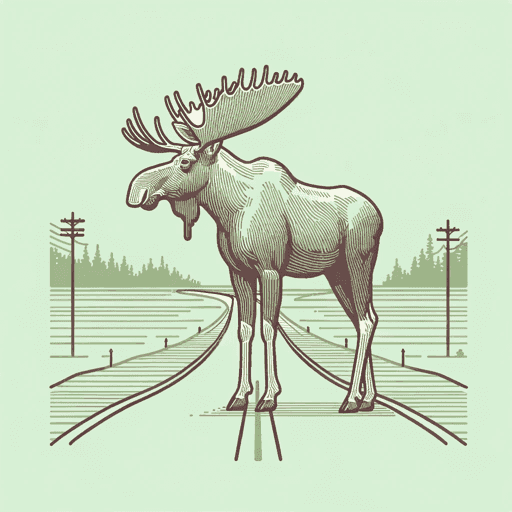
Finally, the moose has entered the scene in the first line of Stanza 23. The “moose has come out of / the impenetrable wood” (Lines 133-134), and its appearance is awe-inspiring as it “looms” (Line 135) in front of the bus. The appearance is shocking for the bus passengers given the “impenetrable” (Line 134) nature of the woods and because they had all been lulled into a sleepy half-awareness of the world around them. The passengers have been encapsulated in this mobile microcosm of civilization; they could observe nature but not interact with it. They were also safe from nature (and it from them). Now, in Lines 137-138, this enormous creature interacts with the bus by sniffing “at / the bus’s hot hood.” This physical connection makes it real and potentially frightening.
Stanza 24 continues the shock and awe of the encounter. The animal is “Towering” (Line 139) and looming so large that the speaker can only compare it to pieces of civilization—“high as a church” (Line 140) and “homely as a house” (Line 141). Note that the word “homely” here isn’t about the moose being unattractive but being simple and without elaborate decoration. It also evokes a sense of home and therefore of safety. This is confirmed by the last line in the stanza, where a disembodied male voice states the moose is “Perfectly harmless …” (Line 144). The phrase “safe as houses” (142) in the parenthetical statement is an idiom that was popular at the turn of the 20th century. It refers to the idea that investing in housing is a safe investment and that anything that is “safe as houses” is equally secure. In this case, though the intimidating size of the creature might be alarming, it poses no threat to anyone inside the bus.
In Stanza 26, the encounter comes to a head. The speaker calls the moose “grand, otherworldly” in Line 153, highlighting the separateness of the people on the bus from the natural world. This moose represents unbridled nature and its accompanying fear and awe. The experience is so unusual that the speaker has trouble articulating emotions and understanding how such a simple moment can be so universally captivating. Instead, the speaker asks “Why, why do we feel / (we all feel) this sweet / sensation of joy?” (Lines 154-156). There is, of course, no answer; there is only the exhilaration that washes over the speaker, content with the moment.
The bus driver, “quiet” (Line 158) up until now, interrupts the moment with a simple statement: “Curious creatures” (Line 157). This line has a double meaning in that he finds the moose a bit odd, and that the moose itself is curious about them. The moose’s curiosity is demonstrated in the previous stanza as “she looks the bus over” (Line 152). This shared curiosity is the connection the wild animal has with the humans on the bus. Line 160, “‘Look at that, would you,’” is a throwaway line from the bus driver, but Bishop uses it here as a declaration—take the time to pay attention to these rare, extraordinary moments. To demonstrate just how fleeting these moments are, the driver “shifts gears” (Line 161), both literally and figuratively, and starts to drive again. The final line in the stanza suspends the experience “For a moment longer” (Line 162) with a pause created by the stanza break. Though the bus is moving on, the speaker wants to savor the moment for as long as possible.
The speaker is even willing to go through a little discomfort “by craning backward” (Line 163) to extend the moose experience. There is a coming together of the civilized world and the natural world as the moose is seen “on the moonlight macadam” (Line 165)—“macadam” being another word for asphalt. The majestic animal existing for a moment on a manmade surface in the light of the moon is the union of both worlds. Inside the bus there is the same mixture of nature and machine as “a dim / smell of moose” (Lines 166-167) lingers with the “acrid / smell of gasoline” (Lines 167-168).

Unlock all 17 pages of this Study Guide
Get in-depth, chapter-by-chapter summaries and analysis from our literary experts.
- Grasp challenging concepts with clear, comprehensive explanations
- Revisit key plot points and ideas without rereading the book
- Share impressive insights in classes and book clubs