The Narrow Road Between Desires
46 pages • 1-hour read
Patrick RothfussThe Narrow Road Between Desires
A modern alternative to SparkNotes and CliffsNotes, SuperSummary offers high-quality Study Guides with detailed chapter summaries and analysis of major themes, characters, and more.
Chapters 1-3Chapter Summaries & Analyses
Chapter 1 Summary: “Dawn: Artistry”
Early in the morning, Bast attempts to sneak out of the Waystone Inn without drawing any attention. As a member of the Fae, his superhuman grace allows him to move soundlessly when he wishes. However, the clever Bast thinks of himself as an artist, and he knows that complete silence would be suspicious, so he deliberately makes a few boards creak. When he thinks that he has succeeded in escaping detection, he grins mischievously like “a naughty child who ha[s] stolen the moon” (3). However, his master, a redheaded innkeeper called Kote, hears the apprentice and calls him back inside. Kote gives Bast a leatherbound book and asks him to pick up some carrots and eggs while he’s out. He also mentions that a young boy came looking for Bast yesterday but didn’t leave a message. The boy’s name is Rike Williams, and Bast tries to conceal his reaction to this news. The apprentice says, “I haven’t the slightest idea what he wants” (5). He hurries outside.
Chapter 2 Summary: “Morning: Embril”
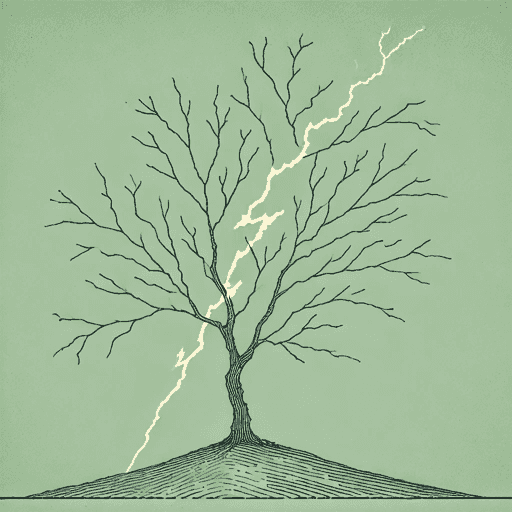
Bast climbs a hill to a dead tree that was struck by lightning years ago. Resting his hand on the bone-white trunk, he walks around the tree three times counterclockwise. This direction is associated with destruction. Then, Bast walks around the tree three times clockwise, the direction of creation. With this done, he reclines against the tree and tosses stones into a nearby stream to pass the time.
A nine-year-old girl named Brann, the daughter of Newarre’s baker, comes up the hill. She cut her hand while playing with her mother’s knives and asks Bast to help her think of a lie so that her parents won’t hit her. He advises her to say that a child told her frightening stories about rats that gave her nightmares, so she threw a knife when she thought she saw a big rat in the kitchen. When Brann asks whom she should blame for telling her the scary story, Bast tells her to pick a child she dislikes. He also advises the girl to bolster her tale by putting fresh blood on the knife before she throws it and by using salt and pepper to make herself cry.
In exchange, Bast asks Brann for a secret, but the girl doesn’t know any fresh gossip. She empties her pocket, producing a piece of string, a button, two pieces of iron, and a flat green stone with a carving of a woman’s face on either side. Bast is surprised to see the stone, which he calls an embril. Bast grows suspicious when Brann says that Rike gave it to her, but he claims the stone as part of his payment. He also barters with the girl for two maple sweet buns that are still warm from the oven. When she asks what will happen if her parents beat her anyway, he replies, “If you want me to haul you out of trouble personally? That’s a different deal entirely” (13).
Next, a 10-year-old boy named Kale Alard climbs the hill and asks for help avenging himself upon his brother, who kissed his crush. Bast advises him to pour stale urine in his brother’s shoes so that everyone, including the boy’s crush, will think that he’s incontinent. Kale praises the plan as “the most bastardy thing [he’s] ever heard” (16), and he repays Bast by giving him the locations of a wild beehive and a hidden still owned by a man named Martin. Kale tells Bast that Rike wants to see him, but Bast refuses.
After his meetings with the children, Bast meanders about the countryside. He pokes a hornets’ nest with a stick and tears his pants while fleeing from the insects. He keeps a collection of embrils in a leather sack inside the hollow of a holly tree. He tosses handfuls of them into the air and examines the patterns in which they fall to tell the future. He hides the leatherbound book that Kote gave him in the hollow. Next, Bast crafts a set of pipes from reeds and a piece of string. As he plays a beautiful melody, a handsome shepherd named Dax takes off his shirt and reclines on a blanket. Bast trips on his way toward the shepherd, who averts his eyes and stifles a laugh.
Chapter 3 Summary: “Mid-Morning: The Narrow Road”
When Bast returns to the tree, he is a little sweaty and disheveled. The tear in his pants has been mended with stitches in the shape of a shepherd’s crook, and a fluffy sheep has been embroidered near the knee. A cheerful, freckled boy named Kostrel climbs the hill and says that he has a gift for Bast. As a rule, Bast doesn’t accept gifts because they carry obligations. However, “against his wit and will, but following his heart” (31), he accepts the mysterious present. The moment when Bast touches the teardrop-shaped piece of brass, he feels as if there is “an iron shackle wedged tight around his heart” (34). Bast considers killing the boy for binding him but soon realizes that Kostrel has no idea what’s happened. The boy doesn’t hold any power over Bast because the gift is actually from Rike. The object is a penance piece and is used during religious observances at midwinter. It can also be used as currency and exchanged for a loaf of bread. Kostrel explains that Rike hopes the gift will help him reconcile with Bast. When Bast scorns the gift, the boy reminds him that not everyone in the town has enough to eat. Bast feels relieved that Kostrel didn’t knowingly betray him and that Rike didn’t intend to bind him.
Kostrel trades the location where a pretty girl named Emberlee bathes for secret information about the Fae. The boy’s curiosity makes Bast anxious because he’s been driven from towns before when people learned his secret, but he resolves to answer his questions honestly. At the same time, part of him exults in talking about the Fae and their remarkable abilities. Bast tells Kostrel that it would be just as difficult to give a short, simple assessment of the Fae as it would be to sum up humanity. Many Fae look almost indistinguishable from humans but tend to have one quality or trait that gives them away, such as their smile or eye color. While not all Fae like to visit the mortal realm, they all are drawn to places marked by the elements of fire, water, stone, and air. When they are among humans, the faen folk use magic called glamourie to appear human. Glamourie only alters appearances, but a form of magic called grammarie changes an object by amplifying the properties it already possesses. For example, grammarie could make a fire burn hotter. Kostrel deduces that the faen folk can make spells more powerful by using both glamourie and grammarie at the same time, and Bast feels a mixture of pride and alarm at the boy’s cleverness. Kostrel asks if the Fae enchantress Feluirian used grammarie when she made the cloak of shadows worn by the legendary Kvothe, not realizing that the hero is the Waystone’s innkeeper. Bast confirms his hunch, inwardly fretting that his master has been brought up. Bast tricks Kostrel into squandering his last question by mentioning that he’s met one of the Fae before. The boy stomps off angrily while Bast struggles to rein in his laughter.
Chapters 1-3 Analysis
In the novella’s first section, The Tension Between Freedom and Obligation shapes the protagonist’s characterization and accelerates the plot. Bast’s primary obligation is to his master, Kote, whom he calls Reshi as a sign of respect. For much of his life, Bast was free to pursue his desires. However, during his time in Newarre, he must conceal his Fae identity as well as the truth that Kote is the legendary figure Kvothe: “[H]is secrets were all tangled in his master’s lies, so much he feared that one loose thread might cause the whole thing to unravel” (54). As a result, Bast feels disconnected from himself at the start of the story. Although he cherishes his relationship with Kote, he feels that this bond requires him to sacrifice the freedom that he considers essential to his true nature. The self-restraint that this relationship demands helps to explain Bast’s wariness of placing himself in others’ debt: “Even a thimbleful of obligation rankled him” (28). Chapter 3 marks a turning point for the theme and the novella’s structure because it introduces the other major obligation in the story: the debt that Bast accidentally incurs when he accepts the penance piece. As the story continues, much of the plot focuses on Bast’s efforts to fulfill his responsibility to Rike and extricate himself from the bonds on his freedom.
Rothfuss uses Bast’s careful self-construction to examine The Influence of Perception on Identity. His Fae magic and outsider perspective on human nature help him solve the children’s problems, but his acceptance within Newarre is contingent on his ability to pass as a human:
Bast knew how fast a town could turn. He’d seen it. One day everything was kisses and cake, but let one little secret slip and suddenly the only choice was fire and iron, or flee and leave it all behind. But here and now? He did not want to leave (54).
This passage reveals that Bast has experienced rejection from humans who knew the truth of his identity, explaining his reticence to take risks and share his truth with the townspeople. A need for secrecy governs many of his day-to-day choices, as seen when he slows his pace in Chapter 1 because a pair of children are watching him. Bast desires intimacy, as shown by his tryst with the shepherd, but his need to carefully moderate which aspects of his identity others perceive limits his ability to experience closeness. He continues to navigate this delicate balance throughout the story.
The Narrow Road Between Desires celebrates The Beauty of Childhood Innocence. Bast’s low-stakes bargains with Brann, Kale, and Kostrel develop the theme and give the first chapters a lighthearted, humorous tone. Kostrel is an especially important character for this theme because Bast is closest to him out of all Newarre’s children: “There was a reason Kostrel was his favorite. He was a perfect mix of cleverness and fool” (31). Although the boy is crafty and clever, he is innocent and guileless in a way that Bast appreciates. Indeed, Kostrel’s youthful authenticity reminds Bast of a purity that he has lost: “But this boy sat here being nothing but himself. His heart a harp that played no tune except his pure desire. It made Bast want to weep and howl. It made Bast wonder where he’d lost his way” (50). Bast’s admiration for children’s innocence helps to explain why he later becomes a protective figure toward a child who has been abused.
The novella’s symbols and motifs offer further insights into the themes and characters. For example, the tree where Bast strikes his bargains serves as both a prominent setting and a symbol of desire. Because lightning struck and killed the tree, the symbol offers a reminder of the power and danger of desire. One of the story’s most important objects is the penance piece that Bast accepts from Kostrel in Chapter 3. The brass piece functions as a motif of obligation because it binds Bast to Rike. Ironically, Rike sent the gift to express his repentance, and he didn’t realize that it would trap Bast because he doesn’t know that Bast is one of the faen folk. As the story continues, the obligation created by the gifting of the penance piece becomes an opportunity for both Rike and Bast to experience liberation. Embrils, objects used in fortune-telling, serve as symbols of fate. Chapter 2 introduces three embrils of particular importance—a “piece of pale horn carved with a crescent moon,” “a piece of tile painted with a dancing piper,” and “something that look[s] like half an iron coin, but wasn’t” (19). These objects are later connected to Rike, Bast, and Kote, respectively.
The author’s usage of foreshadowing offers clues about the characters’ identities and motivations. In Chapter 3, Bast tells Kostrel that the faen folk are drawn to “[p]laces that are touched with fire and water. Places that are close to air and stone” (50). Thus, Bast’s attachment to the lightning tree is a hint that he is Fae because it stands near a large stone and a stream and caught fire when it was struck by lightning. Rothfuss provides foreshadowing and humanizes his protagonist by allowing him to make missteps in these early chapters. For example, he stumbles on a stone on his way to the shepherd, and he tears his pants while fleeing from hornets he provoked. These moments foreshadow when Bast metaphorically stumbles and falls by accidentally placing himself in Rike’s debt. Although Rike does not appear in these chapters, other characters repeatedly tell Bast of his great desire to speak with the man, and his persistence foreshadows the urgency of his request. In a seemingly minor moment, Kale informs Bast of the location of a “wild bee hive” in Chapter 2 (16). This foreshadows when Bast helps Rike’s mother revive her apiary, an event that contributes to the novella’s happy ending.

Unlock all 46 pages of this Study Guide
Get in-depth, chapter-by-chapter summaries and analysis from our literary experts.
- Grasp challenging concepts with clear, comprehensive explanations
- Revisit key plot points and ideas without rereading the book
- Share impressive insights in classes and book clubs