The Narrow Road Between Desires
46 pages • 1-hour read
Patrick RothfussThe Narrow Road Between Desires
A modern alternative to SparkNotes and CliffsNotes, SuperSummary offers high-quality Study Guides with detailed chapter summaries and analysis of major themes, characters, and more.
Chapters 10-12Chapter Summaries & Analyses
Content Warning: This section of the guide includes discussion of child abuse.
Chapter 10 Summary: “Twilight: Carrots”
Bast hurries toward the Waystone Inn, but he realizes that he has misplaced the carrots when he is about halfway there.
Chapter 11 Summary: “Night: Demons”
By the time that Bast arrives at the inn, the usual patrons are already eating dinner. Jessom Williams is the subject of the latest gossip. Jake heard that a cougar chased the man over a little cliff. Old Cob says that there’s no way a cougar chased him for two miles and that the man fell simply because he was drunk. Graham mentions that the injured Jessom was found by two children who were playing near a waterfall. According to the smith’s apprentice, someone discovered and damaged Martin’s hidden still. The men suspect that Jessom is responsible and worry that Martin will murder him because he’s attacked other men and animals in the past with far less provocation.
A man named Carter joins his friends in the inn and informs them that he just drove Jessom to Baedn. Jessom looked as though he’d been “beat by seven different demons” and enlisted in the king’s army that night (189). Everyone breathes a sigh of relief because an officer of the Crown would have been sent to Newarre to investigate if Martin murdered Jessom, and Martin likely would have resisted arrest, bringing grave trouble on the town. Old Cob shares a story about Martin that he’s never told his friends before. Once, a tinker attacked him, and Martin intervened by punching the tinker. Martin could have hurt the tinker much worse, but he acted with restraint, as if he was “setting up accounts in his head” (194). Some of the men wonder what will happen if Jessom either deserts from the army or returns after his eight-year tour of duty ends. Bast says that the man won’t come back, and he says it with such conviction that the other people in the inn look at him, but he simply laughs and says that no one would risk Martin’s wrath.
Chapter 12 Summary: “Midnight: Lessons”
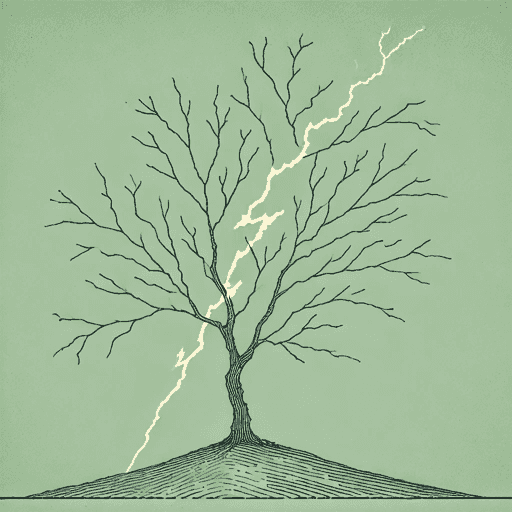
Bast returns to the lightning tree and asks Rike who he is and who he wants to be. The boy sees many faults in himself, including deceit, anger, and a tendency to quickly form negative judgments of others. He begins to cry when he says that he wants to be the person he was when his father was away. Bast reminds the boy that, according to the terms of their bargain, he owns every part of the boy. He declares that he’s taking the damaged and damaging parts, such as his self-loathing and the piece of his “father that lives in [his] shadow” (200). The Fae man casts a spell on Rike that uses both glamourie and grammarie. As Bast circles the tree counterclockwise three times, he instructs Rike to say that he isn’t a liar or a bad person. Bast tells the boy that he is precious, not worthless. Then, Bast circles around the tree three times clockwise and reminds Rike that he has shown courage and love through all he’s done to protect his family. He hugs the boy close and whispers something to him that is “so true only the boy c[an] hear” (201). As they walk toward Rike’s home, the boy takes his hand. Bast watches from a distance as Rike reunites with his mother.
All the patrons are gone when Bast returns to the Waystone Inn. Over a late dinner, Kote asks what his apprentice learned that day. Bast makes the man smile with his youthful enthusiasm as he waxes poetic about Emberlee’s beauty. However, Kote’s world-weariness soon descends again. He notes Bast’s skinned knuckles, and Bast implies that he hurt himself while falling out of a tree without directly lying. When Kote observes that his apprentice should devote more time to his studies, Bast indignantly retorts that he learned many things that day. For example, Nettie Williams found a wild beehive and caught the queen.
Chapters 10-12 Analysis
Rothfuss gives the novella a happy ending full of healing and humor. Chapter 9 addresses weighty subjects like child abuse, and Chapter 10, which is only a single sentence, provides comic relief by moving from the main plot with Rike to the subplot about the errands that Bast is meant to run for Kote: “Bast was halfway back to the Waystone Inn when he realized he had no idea where his carrots were” (179). In Chapter 11, the author uses the gossip shared by the inn’s regular patrons to provide information about Jessom’s decision to flee from the town without having him appear within the scene. Through his decision not to depict Rike’s father directly, Rothfuss keeps the story’s focus on Rike’s healing rather than on Jessom’s abuse.
In the final chapter, Rike’s dynamic characterization offers encouraging signs that he is already mending: “Bast was surprised when Rike hesitantly reached up and took hold of his hand. Surprised but not displeased” (202). Additionally, Nate Taylor’s illustrations support the happy ending. The drawing on page 204 depicts a heartwarming homecoming as Rike hurries toward his mother, who is framed by the light of the house’s doorway. The illustration on page 209 depicts Rike helping his mother tend to the honeybees. Both characters are drawn with joyful smiles, and Nettie wears the river stone charm necklace that her son made for her, offering a visual reminder of the boy’s growth and love for her.
The spell that Bast casts during the novel’s climax draws power from The Influence of Perception on Identity. Perception and identity parallel glamourie and grammarie, forms of Fae magic that affect appearance and reality, respectively. Bast’s spell uses both glamourie and grammarie, allowing him to shift the boy’s perception of himself as well as change his reality. Significantly, the novella defines grammarie as “making something into more of what it already is” (55). This means that Bast’s magic magnifies the boy’s innate qualities, such as love and courage, rather than turning him into someone else. During the ritual, Bast changes how Rike sees himself by making vital distinctions between the boy’s actions and his identity: “‘Say it.’ ‘I just lied,’ Rike said softly. ‘I en’t a liar.’ ‘You’ve done bad things,’ Bast said. ‘But you aren’t bad’” (201). The ritual supports the theme of identity by reframing Rike’s negative actions as mistakes that he can learn from rather than proof that he is doomed to become like his father.
Initially, Bast sees his obligation to Rike as a trap and a dire threat to his freedom, but the bond between the two characters ultimately liberates them both. Rike’s family is saved from Jessom’s destructive presence, and the boy begins to heal from the mental and emotional effects that his father’s abuse has had on him. As a result, Rike is free to reclaim his innocence and his belief in himself. Fulfilling his bargain with Rike liberates Bast in a literal sense by breaking the binding that Rike’s gift placed on him. Additionally, the day’s events teach Bast to worry less about what fate might have in store and to place more confidence in his ability to shape events instead. This novella takes place before Chronicler comes to Newarre. Thus, Bast’s experience with helping Rike find healing and restoration can be interpreted as a factor that inspires his plan to remind his master of his former glory. By the end of the story, Rike and Bast both find the freedom they need.
Rothfuss adds to the satisfaction of the ending by resolving the foreshadowing throughout the story. Many of these clues support Bast’s self-image as an artist by showing the care with which he crafts his schemes out of seemingly minor and disconnected details. For example, Chapter 11 reveals that a “couple kids found [Jessom] while they were playing by the falls” (183), meaning that Bast sent Wilk and Pem to the waterfall with this purpose in mind in Chapter 8. Similarly, Rothfuss omits the scene in which Bast damages Martin’s still but later reveals that this was part of his plan for ensuring that Jessom never returns to Newarre. At the very end of the novella, Bast informs Kote that “Nettie Williams discovered a wild hive of bees today” (208), meaning that Bast showed her the hive that Kale told him about in Chapter 2 at some point between the end of Chapter 7 and the start of Chapter 8. Capturing the wild queen bee allows Nettie to revive her apiary, which supports the happy ending’s focus on healing and restoration.

Unlock all 46 pages of this Study Guide
Get in-depth, chapter-by-chapter summaries and analysis from our literary experts.
- Grasp challenging concepts with clear, comprehensive explanations
- Revisit key plot points and ideas without rereading the book
- Share impressive insights in classes and book clubs