The Narrow Road Between Desires
46 pages • 1-hour read
Patrick RothfussThe Narrow Road Between Desires
A modern alternative to SparkNotes and CliffsNotes, SuperSummary offers high-quality Study Guides with detailed chapter summaries and analysis of major themes, characters, and more.
Chapters 7-9Chapter Summaries & Analyses
Content Warning: This section of the guide includes discussion of child abuse.
Chapter 7 Summary: “Moonrise: Sweetness”
While Rike is busy across town, Bast goes to the boy’s home. Although the fields have been left unplowed for a long time, the small house is tidy with a well-tended garden. Rike’s mother, Nettie, is at home with her two young daughters, Tess and Bip. Bast asks about her husband, and she tells him that Jessom will likely be in his trapping shack all night. Somewhat sheepishly, Bast inquires if there’s any work that he can do in exchange for carrots. Nettie smiles in a way that eases the weary lines on her face and tells him that she has some wood that needs chopping. She gives him six carrots in exchange for half an hour’s work. Nettie gives Bast some water, and the shirtless man pours half over himself and then asks if there’s anything else he can help her with. He notes the apiary near the house and mentions that he’s good with bees. Nettie explains that only two of the hives are in use due to a series of economic misfortunes and natural disasters. When she says that maintaining the hives might not be worth the trouble, he replies, “A little sweetness is all any of us have sometimes. It’s always worth it. Even if it takes some work” (151). Bast tells Nettie that he has something to show her.
Chapter 8 Summary: “Evening: Riddles”
When Bast returns to the lightning tree, he is limping slightly, and his knuckles are bloodied. A 10-year-old boy named Wilk and his five-year-old sister, Pem, are waiting for him. When the children ask how he was injured, he claims that he was attacked by four bears. Wilk asks for a riddle that can stump one of his friends in exchange for a favor. Bast tells him, “Show me something that’s never been seen before and will never be seen again” (154). When the boy asks for the answer, Bast replies that their current bargain is only for the riddle itself and that the boy will owe him something else if he wants the answer. Bast immediately calls in his favor by asking Wilk to fill a small bottle with water from a waterfall. He offers Pem a piece of honeycomb in exchange for 21 perfect acorns. Bast goes to his usual bathing spot and washes away the dirt, sweat, and honey sticking to him. Then, he takes a nap on a large, sun-warmed rock.
Chapter 9 Summary: “Sunset: Lies”
By the time that Bast awakens, the sun is starting to set, leaving the land cold and shadowy. He gets dressed and returns to the lightning tree, where he eats the honeycomb he promised Pem. Rike signals him with a whistle. The light is fading, so Bast allows himself to move in a supernaturally swift and graceful way as he goes to meet the boy. He examines the river stone and the needle that the boy found, telling him that they are components for a go-thither charm that will drive away anything that wants to hurt him. Some of what Bast tells Rike about charms is true, but much of it serves only to indulge his own sense of artistry. Unbeknownst to the boy, Bast has already ensured that Jessom will go far away by beating the man up. When Bast says that the charm will only protect one person, Rike insists that Bast make the charm work for his mother instead of him: “What if sending him en’t enough? What if I grow up like my da?” (166). Bast embraces the sobbing child and tells him that he is a good person.
As Rike washes tears and dirt from his face in the nearby stream, Bast sees that the boy is covered in bruises. Bast tells Rike that he must give the river stone to his mother and tell her that he loves her every day for the charm to work. Then, he directs the boy to say his father’s name, prick his finger on the needle, and let three drops of blood fall on the stone. Suddenly, Bast sees that the way the crescent moon and the lightning tree appear above and behind Rike resemble some of the embrils he drew that day, such as a bowl and a crown. He laughs in wild elation, realizing that the world is offering him the chance to do something powerful and beautiful. Bast pricks his thumb on the needle so that a drop of blood falls through the hole in the river stone. He tells Rike to take the charm to the lightning tree and keep vigil: “Think on who you are, and who you want to be. And when you’ve thought on that, you think on how you love your ma” (175). Bast says that they need to wait until the moon is higher to complete the third part of the ritual. As Rike climbs the hill to the lightning tree, Bast hurries into the forest.
Chapters 7-9 Analysis
The novella’s third section provides suspense and humor as Bast’s plan takes shape and the climax approaches. Rothfuss chooses to omit certain key events, and this authorial decision provides intrigue and shapes the story’s structure. For example, convincing Rike’s father to leave town is one of the most important actions that Bast undertakes, but this occurs in the time jump between the end of Chapter 7 and the start of Chapter 8. The details of the altercation, including any dialogue between the characters, are not provided. The author doesn’t directly state that Bast confronts Jessom, but he provides hints that the characters fought by noting that the Fae man bears minor injuries when he returns to the lightning tree: “Bast was surprised to see a few dark streaks of blood dripping from his hand. He brought out his handkerchief and daubed at his knuckles as elegantly as a duchess brushing away crumbs at dinner” (154). Having this moment of violence take place off the page helps to preserve the story’s overall light tone and keeps the focus on Rike and his healing rather than on Jessom. At the end of this section, the author builds suspense by waiting to reveal the charm’s purpose. Because Bast already ensured that Jessom will leave town, the goal of the ritual that he and Rike begin in Chapter 9 remains a mystery.
These chapters mark an important shift in Bast and Rike’s relationship as their shared goal brings them closer. At the start of the story, the two are angry at one another due to an undisclosed dispute they had about a year ago. However, their efforts to free the boy’s family from his father’s abuse lead to greater openness from the two characters. For example, the guarded boy shows an unprecedented level of vulnerability when he weeps and embraces Bast in Chapter 9. Likewise, Bast allows himself to show kindness and gentleness as he consoles the child: “‘Rike,’ Bast said softly. ‘You’re a good boy. Do you know that?’” (167). Bast often plays the role of the playful trickster, but he becomes “uncharacteristically silent” upon seeing the bruises that Jessom gave Rike (168). These moments highlight how Bast’s efforts to help the boy lead to changes within the characters and in their relationship.
Rike’s distorted self-image lends urgency to the novella’s examination of The Beauty of Childhood Innocence and The Influence of Perception on Identity. His uncertainty that his mother will wear the charm if he gives it to her reveals that he doesn’t understand that he’s worthy of love and that he is already cherished. Rike’s low self-esteem weaves together the two themes because his innocence and sense of identity are both damaged by his father’s actions: “I’m not good. I know it. I know better than anyone. Like you said. I got his blood in me” (166). Rike’s self-loathing sets up the novella’s ending by making it clear that Bast must do more than banish Jessom from the town for Rike to find healing.
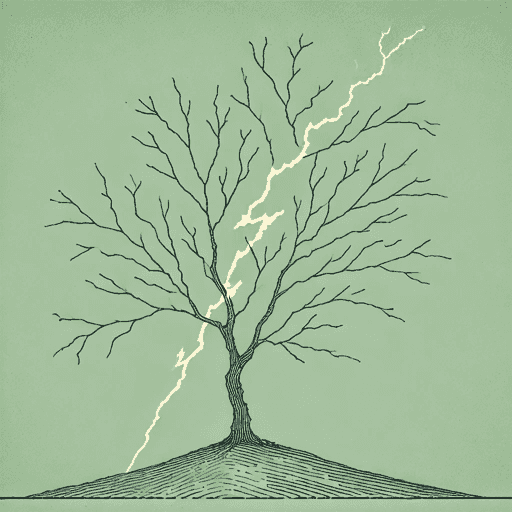
The lightning tree and embrils add layers of meaning to Bast and Rike’s actions in Chapter 9. The two symbols intersect as they prepare the charm:
Standing stark against the vibrant twilight sky, just over the boy’s shoulder, stood the black-tipped finger of the lightning tree. Rising just above Rike’s head, the crescent moon. It hung there like a sickle blade. A bowl. It hung above the boy’s head, bright as iron. It rested like a crown, like horns. Of course (172).
This description combines some of the embrils that Bast draws throughout the day, indicating that this is a fateful moment. He feels ecstatic and free as he observes these signs, but the narrator doesn’t reveal what the protagonist is thinking in this moment, which raises the suspense. Notably, Bast originally sent Rike to gather the ingredients for the charm to satisfy his own sense of artistry and to keep the boy busy while he confronted his father. Thus, Bast’s new plans for the charm add intrigue. The author reinforces the lightning tree’s symbolic link to desire by making it the setting of Rike’s reflections on who he wants to be and whom he wants to protect: “Think on who you are, and who you want to be. And when you’ve thought on that, you think on how you love your ma” (175). The instructions that Bast gives Rike regarding his vigil offer a clue about the novella’s conclusion, in which the protagonist’s magic helps Rike become more like his ideal self.

Unlock all 46 pages of this Study Guide
Get in-depth, chapter-by-chapter summaries and analysis from our literary experts.
- Grasp challenging concepts with clear, comprehensive explanations
- Revisit key plot points and ideas without rereading the book
- Share impressive insights in classes and book clubs