The Other Valley
62 pages • 2-hour read
Scott Alexander HowardThe Other Valley
A modern alternative to SparkNotes and CliffsNotes, SuperSummary offers high-quality Study Guides with detailed chapter summaries and analysis of major themes, characters, and more.
Important Quotes
“Odile who stands by herself. Never spoken to and seldom spoken of. Staring at nothing with eyes like carved wood, as motionless as an effigy.”
(Part 1, Chapter 1, Page 3)
In the first lines that introduce Odile, she refers to herself in the third person, describing her isolation and detachment from the rest of the class. She uses two similes, comparing her eyes to “wood” and herself to an “effigy,” both of which emphasize her lack of animation and desire to participate in the world around her. This introduction establishes who Odile is innately, standing in contrast to the person she becomes as she connects with Edme and the others.
“I would advise petitioners to seek whatever closure they needed here in their own valley, which is to say, in the safer pastures of ordinary grief. If that was enough for my mother, then it was enough for me, and so it ought to be for anyone.”
(Part 1, Chapter 1, Page 8)
Odile’s description of her essay underscores her immaturity and ignorance with regard to The Lasting Impact of Grief. She asserts that living with grief is “enough” for her mother, a fact which she later realizes is untrue. She also insists that it is “enough” for herself, despite the fact that she acknowledges how little grief she truly has from her father’s death. As the text unfolds, she will be forced to acknowledge what true grief is and how impactful it can be.
“Sickeningly, I began affecting a distant smile as they hooted at me, as though I was in on the joke.”
(Part 1, Chapter 2, Page 12)
As Odile is bullied by Henri and Tom at the wall during lunch, her reaction highlights two important characteristics. First, bullying is commonplace for her, as she knows to just smile and bear it until it ends. More importantly, however, it underscores her intelligence, as she acknowledges that she is being bullied and recognizes that passivity is her best weapon in response.
“It surprised me, the force that could be released in the limpest of actions, and in spite of the day’s troubles, I pointed my toes.”
(Part 1, Chapter 2, Page 17)
The swing set at the school is an important source of escape for Odile, metaphorically representing her desire to be freed from what she is experiencing. She acknowledges that the “limp” action of pumping her legs has a transformative effect on her, allowing her to escape the bullying, failure of her essay, and the fear of her mother’s disappointment.
“Their presence was unsettling: the swim of daily life interrupted by looming, expressionless faces against the glass. Inevitably you worried that it boded ill for you.”
(Part 1, Chapter 3, Page 22)
Odile acknowledges the impact that the masked visitors have on the ordinary civilians. Although she is not yet able to articulate it herself, this moment underscores the theme of Authoritarian Control Versus Individual Freedom. The anonymity of visitors is allegedly to conceal who will die; although this is partially true, it also serves as a source of control for the Conseil. They instill fear in the valley, reminding them of both impending death and their dominion over who has the freedom to see it.
“For nights afterward I would return to this memory, in which nothing special occurred. Alain and Edme are below, ferrying things into my hands. I’m balancing on shale fragments, keeping my feet light, trying not to trigger a rockslide.”
(Part 1, Chapter 4, Page 31)
Odile’s narration of her first interaction with her new friends at the fort underscores the value that they play in her life. For the first time, Alain, Edme, Jo, and Justine give Odile a sense of belonging. Although she acknowledges that it was “nothing special,” it still has a profound impact on her character due to the inclusivity of the moment for the first time in her life.
“What gave me a strange feeling was [Ivret’s] parting request that I supply her with information about Edme. I realized that the feeling was a small, guilty thrill of importance.”
(Part 1, Chapter 6, Page 43)
Odile’s admission that Ivret’s trust in her gives her a “thrill of importance” emphasizes the duality of knowledge, developing the theme of The Burden and Moral Responsibilities of Knowledge. Odile’s reaction to Ivret’s trust shows how eager she is to earn approval and validation from authority figures. However, the use of the word “guilty” highlights the other aspect, as this trust also comes with knowledge that jeopardizes her newfound feelings for Edme.
“There was an unrealness to his future, a gap between my knowledge and the simple presence of him. Whatever would one day close that gap, it felt unfair. He offered me a grape and said his father grew them. It tasted bright, with tiny bitter seeds.”
(Part 1, Chapter 7, Page 54)
In this simple interaction between Odile and Edme, the diction is important in its reflection of how Odile feels about this moment. Odile’s acknowledgement that there is a “gap” between them underscores the burden and moral responsibilities of knowledge, as she feels that she can never truly connect with Edme when she knows what will happen to him. At the same time, Edme is carefree, simply offering her a grape as she has this profound realization. The fact that the grape is both “bright” and “bitter” emphasizes the juxtaposition between their feelings, highlighting how it is both a happy moment of connection and an upsetting moment of bitter realization for Odile.
“The subject of folklore, the ancient tales about the valleys. Most were fables with an obvious message, and the message was usually the same: never leave, never meddle.”
(Part 1, Chapter 8, Page 65)
As Odile reflects on the folklore of the valley that they discuss in the classroom, it introduces another component of authoritarian control versus individual freedom. From childhood, the villagers are indoctrinated with stories of what happens when one goes against the rule of the Conseil. These fables create a sense of danger tied to breaking the rules, while establishing a mythological quality surrounding the Conseil and its power over the valley.
“[Ivret] made a gesture like a stone splashing into water, and rippled her hands outward until they were wide apart. Now, she said, wiggling her fingers, are even the souls at these outer edges, far from the site of interference, wholly undone and replaced?”
(Part 1, Chapter 10, Page 82)
Ivret uses a metaphor to explain the impact of interference in the timeline to the students in the vetting program. She compares an action to a stone landing in water, with that action’s effects being compared to the ripples that the stone creates. She uses this metaphor to instill fear in the students, emphasizing the importance of following the Conseil and its rules.
“The idea slipped through my body like warm water. His face swam into my mind. Our complexions would make for a similar contrast. I fought this off with a blush so intense that it sparked my forehead. But even my shame rippled with excitement.”
(Part 1, Chapter 11, Page 86)
When Odile sees Alain and Justine having sex in the fort, she acknowledges that it is the first time that sex was not an “abstract” concept for her, as it occurred between two people she knows. In turn, she thinks of the possibility of a romantic relationship with Edme for the first time, a thought that gives her both “shame” and “excitement.” This moment reminds the reader both of Odile’s young age and her innocence, a fact which underscores the complexities of her relationship with the burden and moral responsibilities of knowledge.
“It was mostly made of horizontal wires. I had caught sight of it before—a hard unnatural shine through distant trees. But none of us, with the apparent exception of Lucien, had ever gotten this close. Its height was more imposing than I’d expected, at least twenty feet tall. Our class cowered by the mess hall door.”
(Part 1, Chapter 12, Page 94)
The first time Odile sees the border fence in person, its role as a symbol of institutional control is emphasized through the diction she uses to describe it. She notes how it is “unnatural” as it stands starkly against the natural trees, while nothing its height, “imposing” nature, and the fact that it makes the students “cower” before it. This moment emphasizes authoritarian control versus individual freedom, as the children are taken to the border and shown the fence as a fear tactic to deter them from ever trying to escape.
“I vacillated between helplessness and determination and hoped for an answer to present itself.”
(Part 1, Chapter 13, Page 104)
As the possibility of Edme’s death gets closer and Odile’s feelings for him continue to grow, she acknowledges that it makes her feel a strange combination of being incapable of helping him but also determined to find a solution. These juxtaposing feelings emphasize the burden and moral responsibilities of knowledge. At the same time, however, it is important that Odile notes she is “hoping” that a solution will “present itself”; the passivity of this phrase conveying that she is not searching for a solution and will not act on her own, instead hoping for the situation to somehow rectify itself.
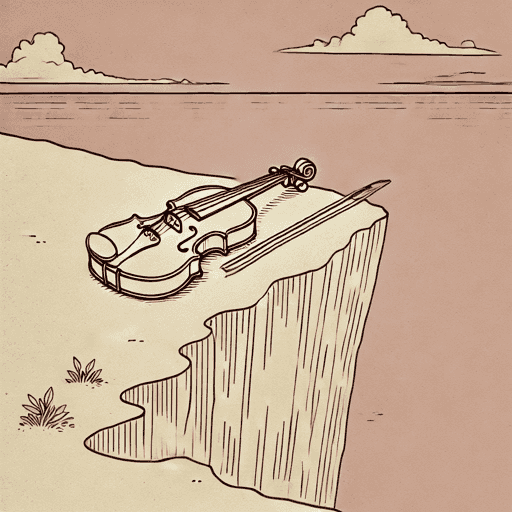
“Then I put the violin case into the hole and buried it, covering his stenciled name with dirt. […] When it was finished I climbed back to the path and looked down. It was indistinguishable from an anthill, it was hardly there at all.”
(Part 1, Chapter 17, Page 133)
When Odile buries Edme’s violin after his death, she compares this unmarked grave to an “anthill.” This fact underscores the way that Edme is viewed in the eyes of the Conseil and its authoritarian control: The villagers are simply ants whose deaths mean little in comparison to their desire to maintain control.
“I stopped only when I saw the fence rise from the mountain ahead, silver wires glaring sharply in the sunlight, a sky made out of knives.”
(Part 1, Chapter 18, Page 137)
After Odile loses Edme, she is both emotionally and physically trapped. Her description of the border fence as “glaring” and “sharp” and her metaphorical comparison of it to “knives” emphasizes her feelings of helplessness. These lines lead into Part 2 of the text, underscoring her feelings of helplessness that will inform the 20 years of her life between both parts, reflecting the lasting impact of grief.
“It was more exhausting, certainly, but like my mother in the archives, I showed up for work each day to carry out the wishes of the Conseil, unburdened by ambitions, and mostly alone with my thoughts.”
(Part 2, Chapter 20, Page 150)
Odile acknowledges that her job in the gendarmerie is not much different than her mother’s: They are both part of the machine that allows for the Conseil to maintain authoritarian control. Although she uses this as justification for her decision to become a gendarme, it nonetheless evokes a sense of loss, as Odile has regressed from the personal connections she gained through Part 1 to being “mostly alone” again.
“She was on her knees with a sponge, her spine curved like an animal’s. But she could not be my mother. A gendarmerie uniform hung from her bones, her jaw was wrong, and her hair, though shorter and duller, had the same curls I knew from the mirror. As my eyes fought it, the woman’s shape became my own.”
(Part 2, Chapter 24, Page 173)
In Odile’s description of her future self, the diction she uses underscores her fear and disgust at what she becomes. Her comparison of herself to an “animal,” her “curved” back from years of labor, and the way that her “uniform hung” from her thin frame convey a tone of dread. Through these words, Odile conveys disappointment in who she becomes, lending insight into her motivation for finally seeking to go against the Conseil and alter her future.
“The horror of seeing myself had not worn off; instead, as the season darkened, the memory had compacted into a denser, harder dread. No day went by that I forgot what lay ahead, although how it would happen, I couldn’t think.”
(Part 2, Chapter 25, Page 179)
Odile’s obsession with her future self reflects the burden and moral responsibilities of knowledge. Now, Odile cannot stop thinking about what she knows, allowing it to consume her thoughts and instill fear in her every day. These thoughts evoke Odile’s earlier feelings toward Edme’s fate, drawing a parallel to how dangerous knowledge can be.
“It was startling to be seen as anything other than my job, to be recalled back into being, and I found I was enjoying myself.”
(Part 2, Chapter 28, Page 201)
Odile’s reunion with Alain represents a fracture in her character and the life that she has built over the last 20 years. She has convinced herself that she is happy as a gendarme or at least pacified, spending her days on patrol in isolation. However, after she meets Alain, she remembers the version of herself that she once was, happy with human connection and developing valuable friendships. Her acknowledgement that she is “enjoying” these interactions foreshadows her future decision to try to change her path in life by revisiting the past.
“When I closed the notebook, I realized that the impression it gave, the personality it evinced, was one of unexpected fortitude. The voice was impersonal but authoritative, confident, even slightly imperious in its remarks.”
(Part 2, Chapter 29, Page 209)
Just as Odile feels happier than she has in years by visiting Alain, she similarly notes how rereading her notebook from her time in the vetting program reminds her of the person she once was. She initially argues that she is happy in isolation, content to follow orders, and willing to live her life as a soldier. However, her acknowledgement that she now lacks “fortitude” and “authority” in her character again foreshadows her decision to try to change her past.
“[Alain] didn’t remember going to the fort, only waking up there. Some of the wall of foliage was still standing, and the main log hadn’t moved. So I made this lousy lean-to, Alain continued, and then who knows how many nights I got wasted in the backwoods. Mornings I’d wake up with my shirt full of pine needles and our initials unblurring in front of my nose.”
(Part 2, Chapter 31, Page 226)
The fort is revisited for the first time since childhood through Odile’s conversation with Alain. Its symbolic representation of escape rings hollow in Alain’s reflection of it, emphasizing the deep impact that authoritarian control has over their lives. While Alain used it as a temporary home, he was constantly reminded of Edme’s death through his missing initials in the wood.
“Holding it like a talisman, I concentrated on remembering him: how he had really looked, how it had felt when he looked at me. He was sitting in the music room at school. I watched him pluck two strings, listen, and tighten a peg.”
(Part 2, Chapter 33, Page 242)
In this scene, Odile exhumes Edme’s violin and holds the tuning peg, an act which brings back memories of her childhood with Edme. Her comparison of the peg to the “talisman” evokes the magical existence of time travel in the novel, foreshadowing the fact that Odile is so moved by her memories of the past that she will use this moment as motivation to change it.
“The black masks that had so frightened me as a child lay in the raked dirt with vacant eyes.”
(Part 2, Chapter 35, Page 256)
As Odile sees the Piras visitation from a new perspective, her description of the masks makes it clear that they no longer hold power over her as they did when she was a child—and as they still do for many villagers. Now, Odile recognizes them as a tool for authoritarian control, their power coming from the stories surrounding them and the soldiers who don them. Now, as one of those soldiers, she has a new sense of control in her life as she makes the decision to finally subvert the Conseil’s rule.
“I was in a grid of unmarked graves. The bodies collected from the lake in the summer, Lucie in January: all ended up here. Hastily I fixed my footing, avoiding standing on the crude plots.”
(Part 2, Chapter 36, Page 268)
As Odile crosses between valleys and into the past, she comes across a vast graveyard. These unmarked tombstones belong to those who have tried to escape. The fact that they are kept in the liminal space between valleys and are “unmarked” emphasizes the theme of authoritarian control versus individual freedom. Instead of memorializing those who try to escape, the Conseil removes them from the valley and refuses to allow anyone to remember them, asserting their control while diminishing human lives to nothing but dirt.
“Yet for the first time, the horror of her diminished. Her existence seemed baffling, pitiful. I had a feeling of overwhelming loneliness.”
(Part 2 , Chapter 38, Page 287)
When Odile discovers her future self’s belongings that were left in the crawlspace, for the first time she is forced to confront what would lead her to return to the past and destroy her own valley. As she acknowledges, her future self initially instilled “horror” in Odile, making her believe that she turned into some kind of monster. Now, however, she notes the “loneliness” of the life that version of her lived. This moment provides a sense of hope for her character as does the fact that she immediately visits Edme: She will likely value her friendships and continue to build human connection, rather than slipping back into isolation and detachment as the other version of herself did.

Unlock every key quote and its meaning
Get 25 quotes with page numbers and clear analysis to help you reference, write, and discuss with confidence.
- Cite quotes accurately with exact page numbers
- Understand what each quote really means
- Strengthen your analysis in essays or discussions