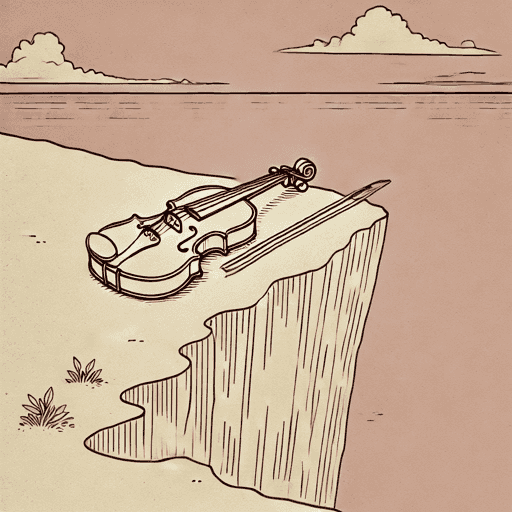
The Other Valley
62 pages • 2-hour read
Scott Alexander HowardThe Other Valley
A modern alternative to SparkNotes and CliffsNotes, SuperSummary offers high-quality Study Guides with detailed chapter summaries and analysis of major themes, characters, and more.
Part 2, Chapters 34-38Chapter Summaries & Analyses
Content Warning: This section of the guide includes discussion of alcohol dependency, sexual content, child death, and death.
Part 2, Chapter 34 Summary
On September 1, Odile knows that Edme’s parents are arriving at the border for the visit. On the western border, she is a new recruit and will always be one, with no chance of promotion after her punishment for Alain’s actions. She spends her days cleaning, cooking, and doing other janitorial duties.
Odile is consumed by the events from her past and by how she is slowly turning into the version of herself she saw in the future. She briefly considers escaping to Ouest 1, but has no way of getting information about the border to even try.
Odile’s cabin is old and rickety, the last one in the row of gendarme cabins. She sits outside at night, drinking a bottle of liquor. As she knows that the past version of her in Ouest 1 is drunkenly rewriting her essay for Pichegru, she retrieves a pair of scissors and cuts off most of her hair.
Part 2, Chapter 35 Summary
The next day, the visiting party returns. Odile watches from a distance with another guard, Bellamy, who offers her a cigarette. She sees the guard with the Piras signal to Manduca that the trip was a failure. Odile’s mind races, wondering if her spotting them at the lake caused the guard to cancel the visit.
When crows begin to land among their cooking fire, Bellamy forces Odile forward to scare them away, moving her closer to the visiting party. Mme. Pira is too distraught to comply with the search, so a frustrated Gagne calls to Odile. He makes her come help. Reluctantly, Odile goes to them, searching Mme. Pira and apologizing to her. When Mme. Pira looks into Odile’s eyes, she desperately asks if Odile was the one who saw them at the school. Odile ignores them. Manduca forces them to continue. When Mme. Pira looks back at Odile, Odile first feels guilt for ruining their trip, then anger, blaming them for how her life has turned out.
One night, the Friday when Jo in the past valley is dismissed from the vetting program, Odile swims in the lake near her cabin. Near dawn, she sees Gagne and two others come to her cabin. She moves deeper into the water, hiding in the dark. Gagne unlocks her door and goes in. Seeing Odile isn’t there, he searches nearby. Eventually, he leaves.
Once Gagne is gone, Odile sees she is by the border fence. She knows that, if she could find the right spot, she could swim under it. She briefly considers what she would do on the other side, knowing that she would be seen by the guard tower and hunted down. She submerges herself, waiting underwater until she runs out of oxygen, then resurfaces and returns to shore.
Part 2, Chapter 36 Summary
The next night, Odile serves food to the guards. She sees Gagne among them, holding the chisel her mother gave her. She hears them talking about a letter from the Conseil. Alain filed a petition to visit Edme before he died, but his request was denied. The Conseil considers Alain an escape risk. The men bet on who will get to kill him when he reaches the border.
Manduca calls Odile over and displays her in front of the other men. He tells them that Alain used to be her lover and that he is the reason she was demoted. He tries to dismiss Odile, but she stays. She tells them that she wants to be part of their betting pool. She takes her chisel back from Gagne, claiming that she will kill Alain with it. Manduca laughs but allows her to bet all the money she has on her. However, he then gives her the letter, telling her that she will be the one to deliver it to the exchange post beyond the border.
Odile is cleared to pass through the border. She makes her way to the cabin in the space between valleys. As it begins to rain, she veers off course, going to a space where she knows the border is poorly guarded. She is forced to hike through rough terrain in the mountains. At one point, she falls and injures her leg. She realizes that she is among the unmarked graves of past escapees, buried in a field between the valleys.
Odile comes to the fence and sees a guard turning around in his patrol. After he is gone, she runs to the fence. Due to the softened ground from the rain, she lifts the fence and squeezes under it. She then makes her way into the village. Standing outside her home, she looks up at her own bedroom window. She suffers from vertigo, knowing how close she is to her past self and that anything she does could change her future. She hides in the forest and falls asleep immediately.
Part 2, Chapter 37 Summary
Odile wakes up in the afternoon and goes into her house. She hears alarm bells in the distance, signaling an escapee. She finds food, then hides in the crawlspace where she used to keep Edme’s violin. She hears someone enter her home. Looking through a knothole in the floorboard, she sees an officer above her. She silently takes Edme’s violin tuning peg out of her pocket and puts it into the hole to plug it.
Once the officer is gone, Odile goes into the street. She sees trucks of soldiers and boats out on the lake, searching for her. She hides until nightfall, knowing that the search will have to disappear near the lake or it will risk impacting Edme’s death.
As it nears the time that Edme will die, Odile goes up the bluffs, hiding from the guards and the lights from the boats. At the cliff, she hears Edme playing his violin. She starts to call out to him to be careful, but he falls at that moment. Odile jumps into the lake after him. She searches desperately for him, finding him unconscious in the water. She pulls him onto the shore, then performs CPR, causing him to spit up water and recover.
Odile expects her life to be undone, having saved Edme and changed the future. However, it does not happen. After a moment of surprise, she hears the soldiers nearby. She flees up into the woods behind the school, planning to hide in the fort. When she gets there, however, she finds her past self is already there.
As Odile looks at herself, she can feel her past changing. She experiences a strong sense of vertigo as she both lives the memory of seeing herself and remembers it at the same time. As she struggles to talk to herself, she hears her past self call out to the soldiers to tell them where she is.
Part 2 , Chapter 38 Summary
The first-person narration shifts to Odile in the past. After she calls out to the guard, she falls to the ground, covering herself as she hears bullets. When she looks up, she sees her future self dead from the gunshots. Jean-Savile grabs her and leads her to the Hôtel de Ville.
Odile is put in a room. Eventually, Ivret comes to ask her questions. Odile insists that she does not know why her future self was there and that she called out to the gendarme to stop her, doing nothing wrong. Ivret explains that her future self was there to intervene in Edme’s death. He was saved from drowning in the lake by her. Odile struggles to hide her happiness at Edme’s survival. Ivret notes that, in changing the future, she destroyed her home valley, causing it to be “swept away” and replaced by a new future. Future Odile only survived because she was outside the valley.
Ivret leaves, then comes back a while later to let Odile go home. She tells her that the Conseil decided that Odile did nothing wrong and acted honorably. Odile’s mother appears and begs Ivret to let Odile stay in the vetting program. Ivret insists that Odile is still her best candidate.
Odile returns home. Her mother goes to the school to tell Pichegru that Odile is sick. Odile notices small things that mark the intruder’s presence, like her drawer being askew and mud on the floor. When she walks over the crawlspace, she hears something fall. Inside, she finds the violin peg, a bag, and a gendarme uniform. She is shocked to see that she becomes a soldier in the future, wondering how it happens.
Inside the bag, she finds the prints of her woodcarvings. She flips through them, marveling at their detail, the changing seasons within, and the fact that none of them feature another person. She is overwhelmed by a sense of pity at the loneliness of her future life. She puts the things back in the crawlspace but her narration notes that, in the future, she takes them out nightly to look at them.
At noon, Odile goes to Edme’s house. She finds Alain, Jo, and Justine there, jokingly arguing with Edme’s parents about not getting to see him. His father insists that he needs to rest. As Alain goes to leave, he whispers to Odile that she should go to the back window if she wants to see him.
Odile sneaks around the back of the house. She looks in through Edme’s window where she sees him sleeping, a bandage on his head. She notes how, in the future, she will consider how to tell Edme everything; right now, though, it had not yet occurred to her, as she was just grateful to see him alive.
Just as Odile decides that she is going to leave, Edme wakes up and spots her. She awkwardly waves to him, and he waves back, signaling for her to open the window.
Part 2, Chapters 34-38 Analysis
In these final chapters, Odile reaches her moral breaking point, trapped by her awareness of both past and future selves. Stationed on the western border, she is demoted to janitorial labor, mirroring the submissive version of herself she previously saw in Est 1. Just as her foreknowledge previously offered her a strategic advantage and a semblance of moral clarity, it now produces paralysis and self-loathing, emphasizing The Burden and Moral Responsibilities of Knowledge. Odile’s act of cutting off her hair is a metaphorical representation of what her character has become, attempting to change herself physically beyond recognition. Odile is no longer merely shaped by her knowledge of the future, she is consumed by it, pushed toward an increasing need to intervene regardless of the cost.
The novel’s structure throughout the last section of the text reflects the increased burden that Odile’s knowledge has on her. As she lives in the present, completing her duties on the western border, she becomes increasingly overwhelmed by her memories of the past. The alternating narratives clash at the moment when the Piras return, forcing Odile to physically interact with them for the second time in her life. This moment visually represents the collapse of linear time and Odile’s identity, merging them into one. At the same time, this narrative structure emphasizes The Lasting Impact of Grief in a fantastical sense. Odile’s grief over Edme’s death has been repressed within her for over two decades. Now, it makes both an emotional and a physical return in the form of her relived memories and the Piras at the border, forcing her to finally act on her loss.
Throughout this section of the text, Odile’s identity also becomes increasingly interconnected with the symbolism of the border fences, invoking Authoritarian Control Versus Individual Freedom. Although her life revolved around the fence in the east, it was part of her job and her duty to surveille and remain by the fence. Now, as she is demoted within the gendarmerie, she begins to question the border fence’s role and pushes back against it for the first time. Her hut is located directly next to it, rundown and vulnerable, as revealed by Gagne’s forced entry into it and attempt to attack her in the early morning. Then, she swims out to the fence and crosses under it. The fence, once a symbol of absolute authority, is instead shown to be physically vulnerable and morally hollow. By passing under it, Odile fully rejects the Conseil’s control for the first time and takes autonomy for herself.
Although Odile’s actions represent a small victory for individual freedom over the Conseil, her ultimate fate in the novel reaffirms the strength and danger of authoritarian control. The confrontation between future and past Odile is a physical representation of this conflict: Odile in the past is still loyal to the Conseil, while Odile in the future has broken free from it. The fact that this confrontation occurs at the fort—once a symbolic representation of escape—emphasizes the Conseil’s long reach and seemingly unlimited control. Although Odile briefly subverts their rule, it requires her to sacrifice her life and destroy her home valley in exchange for saving Edme.
The novel’s final moments, where the narration shifts back to Odile’s childhood, bring together each of the novel’s themes as Odile’s character completes both her physical and emotional arc. While Odile stepped outside of authoritarian control by going to the past and saving Edme, her past self then realigned herself with it, confirming with Ivret that she would be allowed to stay in the vetting program and change her future. At the same time, the thing which drives Odile to assert her freedom is her grief over both Edme’s death and how her life turned out.
Edme’s survival allows a different future to take root, one where grief does not dictate every choice. As Odile stands at Edme’s window, simply grateful rather than burdened by what she knows, the novel suggests that healing does not come from mastering time or having foreknowledge, but from choosing presence, personal connection, and empathy. Without the burden of knowing her future, Odile is free to explore her relationship with Edme fully for the first time, even if she is forced to do so within the confines of the novel’s authoritarian control.

Unlock all 62 pages of this Study Guide
Get in-depth, chapter-by-chapter summaries and analysis from our literary experts.
- Grasp challenging concepts with clear, comprehensive explanations
- Revisit key plot points and ideas without rereading the book
- Share impressive insights in classes and book clubs