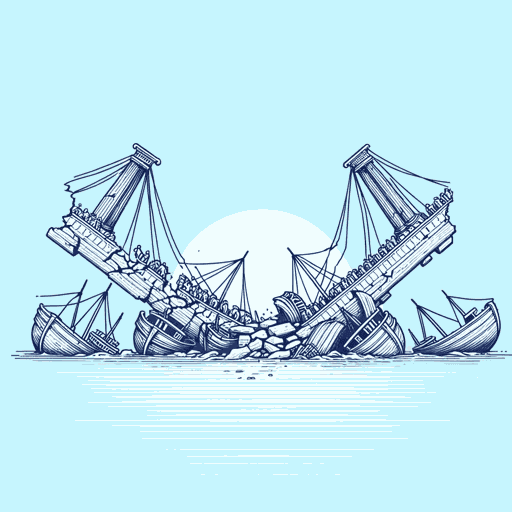
The Persians
44 pages • 1-hour read
AeschylusThe Persians
A modern alternative to SparkNotes and CliffsNotes, SuperSummary offers high-quality Study Guides with detailed chapter summaries and analysis of major themes, characters, and more. For select classroom titles, we also provide Teaching Guides with discussion and quiz questions to prompt student engagement.
During Reading
Reading Questions & Paired Texts
Reading Check and Short Answer Questions on key points are designed for guided reading assignments, in-class review, formative assessment, quizzes, and more.
LINES 1-245
Reading Check
1. Where is the play set?
2. Who makes up the chorus?
3. Who is Xerxes’s father?
4. Why didn’t the chorus accompany Xerxes to Greece?
5. Who is Atossa?
Short Answer
Answer each question in at least 1 complete sentence. Incorporate details from the text to support your response.
1. How did Xerxes cross into Greece? Why does this trouble the chorus?
2. Why are the chorus and Atossa so anxious at the beginning of the play?
3. How does Aeschylus contrast Persian government with Greek government?
4. What was Atossa’s dream?
5. What does the chorus think of Atossa’s dream and the omen she sees? What do they advise Atossa to do?
Paired Resource
“Ancient Persia and the Achaemenid Empire”
- This 15-minute video introduction to the Achaemenid Empire from the World History Encyclopedia offers details on the development of the region and resulting conflicts.
- This information connects with the themes of Contrasting Modes of Leadership and Athenian and Greek Nationalism.
- What role did the Achaemenid Empire play in the ancient Mediterranean?
LINES 246-1077
Reading Check
1. How do the chorus and Atossa find out about the Persian defeat?
2. Where do the Persians and Greeks fight their naval battle?
3. How many ships did the Greeks have?
4. How many ships did the Persians have?
5. Where was Xerxes when the Persians were defeated by the Greeks?
6. What does Atossa decide to do when she hears of the Persian defeat?
7. How does Atossa summon Darius?
8. Whom does the chorus blame for the ruin of Persia?
9. Whom does Xerxes meet when he arrives in Persia?
10. What does Xerxes do when he arrives in Persia?
11. Why do Xerxes and the chorus sing a ritual lament at the end of the play?
12. What is the only thing that survived the battle, according to Xerxes?
Short Answer
Answer each question in at least 1 complete sentence. Incorporate details from the text to support your response.
1. What news does the messenger report?
2. How were the outnumbered Greeks able to defeat the Persians at sea?
3. What are the Greeks fighting for? How does this differentiate them from the Persians?
4. What is the significance of Marathon?
5. What does Darius mean when he says that Greece as a “country itself fights as [the Greeks’] ally” (Line 790)?
6. What advice does Darius’s ghost give the chorus and Atossa?
7. Why does Darius’s ghost believe the gods are going to destroy the army that Xerxes left behind him in Greece?
8. Describe Xerxes’s appearance when he arrives on stage.
Paired Resource
- This site represents the text of Plutarch’s biography of Themistocles, the mastermind behind the Battle of Salamis.
- This text connects to the themes of Contrasting Modes of Leadership and Athenian and Greek Nationalism.
- Despite his important role in the Battle of Salamis, Themistocles is never mentioned in Aeschylus’s Persians. Why do you think that is?
- This article discusses the Delian League, the Athenians’ attempt to leverage their success in the Second Persian War into an empire of their own.
- This resource connects to the themes of Contrasting Modes of Leadership and Athenian and Greek Nationalism.
- Why did the Athenians create the Delian League? How did Persian expansionism influence Athenian politics and foreign policy throughout the fifth century BCE?
- This brief article focuses on the role of oracles in the Second Persian War.
- This information connects to the theme of Foreshadowing, Omens, and Prophesy.
- In what way did oracles and prophecies play an ambivalent role in the Second Persian War?
Recommended Next Reads
Agamemnon by Aeschylus
- Aeschylus’s tragedy tells the story of the violent murder of Agamemnon, king of Mycenae who, in the Trojan War, led the Greeks.
- Shared themes include Contrasting Roles of Leadership and Foreshadowing, Omens, and Prophesy.
- Shared topics include war, prophecy, and tragedy.
- Agamemnon on SuperSummary
Octavia by Seneca
- Aside from The Persians, Octavia is the only historical tragedy from the classical period that survives.
- Shared themes include Contrasting Modes of Leadership.
- Shared topics include tragedy and politics.
Reading Questions Answer Key
LINES 1-245
Reading Check
1. The Persian capital at Susa (Lines 1-159)
2. Elderly Persian advisors (Lines 1-159)
3. Darius (Lines 1-159)
4. The individuals who comprise the chorus are too old for war. (Lines 1-159)
5. The widow of Darius and mother of Xerxes (Lines 1-159)
Short Answer
1. Xerxes crossed into Greece using a pontoon bridge of boats tied together. This concerns the chorus because they fear Xerxes’s actions might be seen by the gods as a challenge to their own power. (Lines 1-159)
2. The chorus and Atossa are anxious because they are waiting for news of Xerxes’s invasion in Greece, which had set out some time ago. (Lines 1-159)
3. Aeschylus represents the Persians as ruled by authoritarian kings who are treated like gods by their subjects, while the Greeks (especially the Athenians) prefer to give the people a stronger say in their government. (Lines 1-159)
4. In Atossa’s dream, Xerxes attempted to place a yoke on two tall women, one representing Asia and one representing Europe. The Asian woman submitted to Xerxes, but the European woman smashed his yoke and knocked him to the ground, leaving him to be comforted by his father Darius. (Lines 160-245)
5. The Chorus interprets Atossa’s dream and the omen favorably, but they advise her to start by asking the gods for an accurate interpretation and to seek the spirit of Darius to bless Xerxes. (Lines 160-245)
LINES 246-1077
Reading Check
1. From a messenger (Lines 246-596)
2. Salamis (Lines 246-596)
3. 300 ships (Lines 246-596)
4. 1000 ships (Lines 246-596)
5. Watching from a cliff (Lines 246-596)
6. Consult Darius’s ghost (Lines 246-596)
7. By pouring libations on his tomb (Lines 597-850)
8. Xerxes (Lines 851-1077)
9. The chorus (Lines 851-1077)
10. He joins the chorus’ mourning (Lines 851-1077)
11. Because so many Persians were killed in Greece (Lines 851-1077)
12. His empty quiver (Lines 851-1077)
Short Answer
1. The messenger reports that the Persians were defeated at sea by the Greeks, though Xerxes himself survived the battle. (Lines 246-596)
2. A saboteur sent by the Greeks led Xerxes to believe that the Greeks were retreating, luring Xerxes into a pincer maneuver. (Lines 246-596)
3. The Greeks are fighting for their homeland, their gods, and their families, while the Persians are fighting for imperial conquest. (Lines 246-596)
4. Marathon is the city in Greece where the Athenians defeated Darius in 490 BCE. Darius’s defeat at Marathon should have taught Xerxes that it would be foolish to invade Greece. (Lines 246-850)
5. By saying that the land fights as the Greeks’ ally, he means that the Greeks know how to use their own country’s terrain and geography against invaders like the Persians, who do not have this knowledge of the land. (Lines 597-850)
6. Darius warns the chorus and Atossa that the Athenians are very strong and that they must never again attempt to invade Greece. (Lines 597-850)
7. Because Xerxes’s army in Greece destroyed religious sanctuaries and sacred sites, Darius says the gods will destroy them as punishment. (Lines 597-850)
8. When he arrives on stage, Xerxes is on foot and in rags, cutting an unlikely image for the ruler of such a powerful empire. (Lines 851-1077)

Unlock all 44 pages of this Study Guide
Get in-depth, chapter-by-chapter summaries and analysis from our literary experts.
- Grasp challenging concepts with clear, comprehensive explanations
- Revisit key plot points and ideas without rereading the book
- Share impressive insights in classes and book clubs