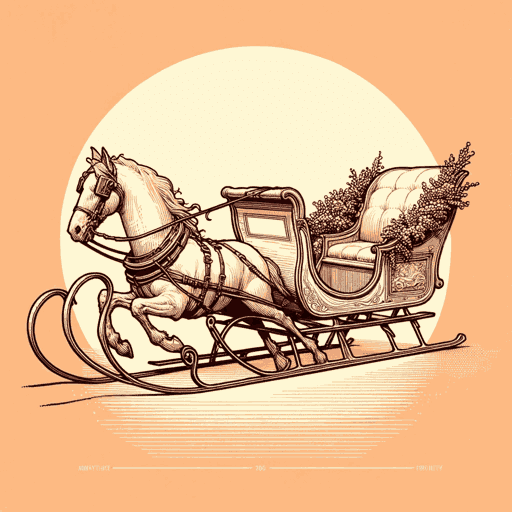
The Pioneers
The Pioneers
A modern alternative to SparkNotes and CliffsNotes, SuperSummary offers high-quality Study Guides with detailed chapter summaries and analysis of major themes, characters, and more.
Summaries & Analyses
Quizzes
NEWReading Tools
Chapters 1-5Chapter Summaries & Analyses
Chapter 1 Summary
The story begins on Christmas Eve, 1793, seven years after the founding of the village of Templeton. The widowed Judge Marmaduke Temple, wealthy landowner, is returning to the town with his young daughter, Elizabeth, who has recently completed her schooling in New York. As they travel, they hear the cry of a pack of dogs, and Temple orders his slave, Agamemnon (“Aggy”) to stop the sleigh. Temple readies his shotgun, and a deer bounds across the road. Temple shoots, seemingly missing with both shots, and two more shots ring out from in the forest, killing the deer. Out of the woods emerges Nathaniel “Natty” Bumpo (or Leatherstocking), an aging but talented woodsman, and his young companion, Oliver Edwards.
Leatherstocking criticizes the Judge’s choice of a shotgun, rather than a long rifle like he uses, saying it is not suitable for killing deer. Temple insists he dealt the fatal blow, and they argue over who has the right to keep the deer, as game is becoming harder to find in the area. Leatherstocking says that he did not kill the deer either, but rather Oliver. He shows Temple where each of his pellets landed: four in the trees, and one in Oliver’s shoulder. Upon learning he accidentally shot Oliver, Temple is horrified and offers to bring him to the village for medical care. Oliver refuses, saying he would rather remain with Leatherstocking, and only asks for the right to the venison. Temple offers him $100 dollars to buy the deer from him (an amount that would buy many deer), but Oliver refuses.
Elizabeth, having watched everything unfold, finally convinces Oliver to come to town for treatment. Leatherstocking recommends that they seek out “Indian” John Mohegan to help the doctor, saying that his knowledge of medicinal herbs far surpasses the doctor’s foreign instruments.
Chapter 2 Summary
120 years before the start of the story, Temple’s ancestor came to America a wealthy man, but subsequent generations led the family into poverty. Temple’s father finally turned the family fortunes around, and his marriage into a wealthy family allowed the Judge get an education. While in school, Temple forms a close friendship with Edward Effingham, who is from a wealthy aristocratic English family. Edward is the only son of Oliver Effingham, a Major in the British army in America who becomes a prominent citizen in New York after his retirement from the military. Edward, as his only child, is given a large estate and his father’s wealth.
Because Major Effingham hates Quakers (of which Temple is one) and disdains commerce, Edward secretly places his wealth in a trust that is under Temple’s control, and they agree to split any profits. However, as the troubles preceding the American Revolution grow, Edward finds himself divided between his loyalty to the crown and his fondness for the American people, which he learned from Temple. He gives his papers and valuables to Temple, and leaves America, returning to fight for the British. Through the Revolutionary War, Temple increases his wealth by buying up cheaply the lands seized from royalists, which makes him one of the wealthiest and most important Americans. After the war, he turns his attention to settling the lands which he now owns (the Temple Patent), and when Templeton becomes sufficiently large, he is selected to be its highest-ranking Judge. Temple becomes a respected and just leader, as he “not only decided right, but was generally able to give a very good reason for it” (25).
Chapter 3 Summary
Returning to contemporaneous narrative, as the sleigh approaches Templeton, Elizabeth reflects on how much it has changed in the short time she has been away. Templeton now consists of about 50 buildings, most of which were built hastily and economically; the “nobles of Templeton” (30)—the lawyers, shopkeepers, and the doctor—occupy the few well-constructed and well-tended houses.
Temple’s home, the Mansion House, towers above all the others, and his estate contains several old trees in contrast to the saplings planted by his neighbors. Richard Jones–Temple’s cousin and secretary–and Richard’s assistant, Hiram Doolittle, have guided the design and construction. Richard and Hiram are not particularly skilled in architecture or construction, and though the Mansion House is grand, it is a mix of several architectural styles, tempered by the demands of the harsh environment. The roof proves to be the most notable element; trying and failing to conceal it, Richard and Hiram instead gaudily ornament it, paint it yellow, and build four large chimneys. Though Richard is at first mortified by his failures, he becomes accustomed to it and praises the beauty of the house. Wanting to follow the wealthy and powerful Judge, the locals imitate the style for their own homes.
As the sleigh comes down the mountain and out of the forest towards Templeton, Temple contemplates with pleasure the expansion of his wealth and comfort which has resulted from his own hard work and industriousness. However, his peace is interrupted as another sleigh comes rushing up the mountain and nearly runs into their own.
Chapter 4 Summary
Unlike their own, the approaching sleigh is covered with a needlessly large number of bells. Richard drives, and his sleigh contains several prominent citizens come to meet Temple: Monsieur Le Quoi, a French shopkeeper; Major Frederick “Fritz” Hartmann, a German ex-solider; and Mr. Grant, the newly arrived pastor. Richard stops and theatrically greets Temple.
Because the path is narrow, the only place that Richard can turn his sleigh around without ascending to the top of the mountain is the nearby quarry, located in the side of the mountain. Aggy offers to help him with the difficult and dangerous task of turning around his four-horse sleigh, but Richard treats the suggestion with disdain and brags about his abilities. Richard attempts to turn the sleigh, but his horses stop in the deep snow and refuse to move. Richard begins whipping the horses continually, confusing them and causing them to move backwards instead of forwards, and by the time Richard realizes the danger, the sleigh is hanging halfway off the side of the mountain, 100 feet in the air.
Oliver leaps out of Temple’s sleigh and grabs the reigns of the precariously balanced sleigh. Oliver gives a powerful pull on the lead horses, and they yank the sled forward to safety. The passengers are thrown through the air, but land safety in the snow. Richard brags about how his quick thinking saved the sleigh, but Temple corrects him, pointing out that Oliver saved everyone. Temple unloads the deer and much of the baggage from his sleigh, so that he can bring Le Quoi, Grant, and Hartmann back to Templeton, telling Richard and Aggy to repair the damage to the other sleigh. Temple promises Aggy that Santa Claus is coming to visit him tonight, which Aggy understands as a bribe to keep silent about the accidental shooting.
Richard, his pride insulted, brags again about his skill with the horses and instead blames Mohegan for improperly training them. Instead of helping Aggy with the repairs, he goes over to inspect the deer. Aggy initially lies, telling Jones that Temple shot the deer, but Richard is eventually able to get the true story out of Aggy after threatening to beat him.
After Aggy repairs the sleigh himself, they return to Templeton. Along the way, Richard brags about his skill in medicine, and volunteers himself to assist the doctor. He continues to brag to Aggy about his skill with horses, and his plans to expose Temple as a liar.
Chapter 5 Summary
The group arrives at the Mansion House. Entering, they are greeted by the Judge’s servants: Benjamin Penguillan (or Ben Pump) and Remarkable Pettibone. Ben is a short, oddly dressed man from Cornwall, Britain who worked in the mines before leaving to become a smuggler, where he quickly was caught and pressed into naval service and served as a cook and steward. Though Ben claims this allowed him the opportunity to see the world, “he had in reality seen no more of mankind, however, than if he had been riding a donkey in one of his native mines” (51-2). After being discharged, Ben decided to travel to America, where he eventually found his way into the employment of Temple as his major-domo. He earned the nickname Ben Pump due to his habit of reciting a tale where he had to pump out his ship to keep it from sinking. Pettibone, the housekeeper, is a middle-aged spinster with ugly facial features and no teeth whom Elizabeth has not met before, as she started her employment after Temple’s wife’s death.
Richard then enters, complaining to Ben that Elizabeth has not been welcomed properly and that the room is too dark and cold, and the servants see to his demands. As Elizabeth removes her winter clothes, Pettibone examines—“with an air of curiosity, not unmixed with jealousy” (56)—the woman who is to supplant her in the management of the household.
Elizabeth, noticing that everyone has forgotten Oliver, points out that they still need to give him medical attention. Upon hearing this, Richard tells everyone that the Judge missed the deer and shot Oliver instead. Richard then brags that he has ‘medical blood’ in his veins and that he will assist the doctor, while Temple gently mocks his so-called skills. Oliver says he’d rather wait for the doctor than allow Richard to start on his own, and an insulted Richard starts bragging again that he was the one who saved the sleigh.
Chapters 1-5 Analysis
The Pioneers is split into four sections, each corresponding with a different season. This set of chapters begins the novel in the winter of 1793, specifically Christmas Eve, and introduces the reader to the setting, characters, and tone of the novel. This section also introduces the reader to the conflicts which recur throughout the novel, namely the mystery of Oliver’s past (and his antipathy towards Temple) and the conflict between Leatherstocking and Temple over matters of the law. Cooper wrote the novel in 1823, 30 years after the novel is set, and based the environment on his own experiences. Templeton is based on the real-life Cooperstown, which was founded by Cooper’s father, Judge William Cooper. Many of the town’s buildings, and the surrounding natural environment, are drawn directly from the real-life early days of Cooperstown.
This section introduces the primary characters of the novel, namely Leatherstocking, Temple, Oliver, and Richard as well as several of the side characters which are used by Cooper for comedic effect and social satire throughout the rest of the novel. Important here is the relationship between Leatherstocking and Temple. Leatherstocking immediately demonstrates his considerable skills by showing Temple exactly where every one of his (missed) shots landed, before dramatically revealing that Temple instead shot Oliver by mistake. We also see the conflict between the two men over the matter of the deer. Leatherstocking criticizes Temple because the settlers have made game scarce, and Temple grants Oliver the right to shoot deer in his forests–a right that Leatherstocking does not believe is Temple’s to grant. Here we see the conflict between Leatherstocking’s belief in individualism and natural law and Temple’s belief in society and manmade law. This conflict over the deer also evokes the classic story of Robin Hood, where the King prevented his subjects from killing any animals in the royal lands. In other words, Leatherstocking is criticizing Temple from bringing the same kinds of oppression that drove people to immigrate to the New World in the first place.
This chapter also introduces Oliver (though his name is not revealed until the next section) and his antipathy towards Temple, a plot line that is crucial to the novel, although how and why is not revealed until the climax. Though Temple seems to be a good man and leader, we also begin to get a sense here of some of his faults. For instance, Temple keeps a slave, Aggy, despite it being against his Quaker beliefs. However, he gets around this religious proscription by having Richard legally own Aggy, though for all intents and purposes he is Temple’s slave. This is another example of Temple’s adherence to the letter of the law, rather than the spirit of natural law

Unlock all 67 pages of this Study Guide
Get in-depth, chapter-by-chapter summaries and analysis from our literary experts.
- Grasp challenging concepts with clear, comprehensive explanations
- Revisit key plot points and ideas without rereading the book
- Share impressive insights in classes and book clubs