58 pages • 1-hour read
The Poppy Fields
A modern alternative to SparkNotes and CliffsNotes, SuperSummary offers high-quality Study Guides with detailed chapter summaries and analysis of major themes, characters, and more.
Prologue-Chapter 15Chapter Summaries & Analyses
Content Warning: This section of the guide includes discussion of illness, death, and mental illness.
Prologue Summary
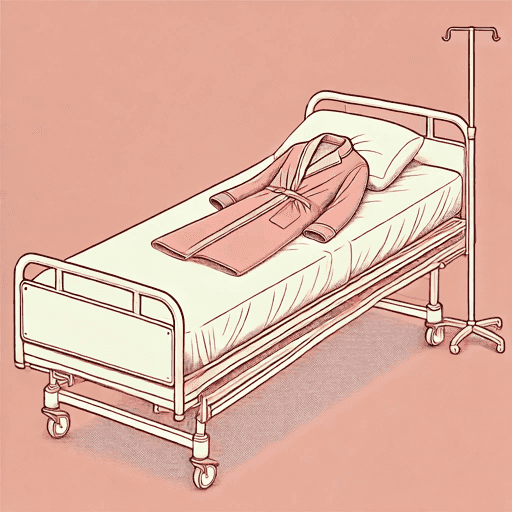
In a southern desert, there is a place where the rocks appear as one, unbroken red patch, but the color is not sand, stone, or soil. It is actually thousands of people, each asleep in a hospital bed in a set of identical red pajamas. They are part of an experiment that places individuals into a medically induced state of sleep in order to escape grief. The hope is that by the time they awake, their brains will have processed their losses, and they will be healed.
Chapter 1 Summary
Ava Jones wakes up after having fallen asleep while working. She is an illustrator/artist who both draws and crafts ceramics, and half of her face is now coated in charcoal after resting on her drawing. She has anxiety and has not been sleeping well lately, so she is not surprised that she fell asleep at her desk.
She feeds her dog, PJ, his breakfast, makes tea, and prepares to leave for the airport. She is on her way to find her missing sister, Emmy. Emmy is at some sort of medical facility called the “Poppy Fields,” and no one is truly sure what goes on there. Ava is not even sure if she will be able to enter the facility and see her sister. Still, she feels that she must try. She packs PJ into his carrier and begins her journey from Topeka, Kansas, to LAX.
Chapter 2 Summary
Ray takes part in a training program for the firefighters in his squad. He is negotiating an obstacle course that he is supposed to complete according to a protocol. When things begin to go awry, he knows that the protocol is to issue a mayday call: If a firefighter gets injured or encounters an especially dangerous situation, it is imperative to call for help immediately.
Ray cannot make himself issue the call and fails the training. He has been distracted and upset ever since his brother, Johnny, died. He is about to take some time off. He told the other guys that he’d be fishing, but the truth is more complicated.
Chapter 3 Summary
Ava’s grandmother Granny Mae suggested that she try drawing as a way to manage her anxiety as a child. It had worked as a calming technique, but Ava fell in love with artmaking. She loved creating new worlds on paper. Ava always felt as though she was in the shadow of her older sister, Emma, who had many talents and was also assertive and brave. Ava was shier and less sure of herself, but she was a gifted artist.
Now, she draws at the airport to soothe her nerves, but she still feels her nerves jangling. PJ also seems anxious. Ava wonders if he is trying to tell her something. Moments after he begins stirring, a tornado touches down.
Chapter 4 Summary
Sasha is in the Topeka airport, looking at a shelf of romance novels and feeling lonely, when the tornado strikes. She was supposed to be on her way to her honeymoon, but her engagement did not have the kind of happy ending depicted on these book covers. She makes her way to a designated tornado shelter, sure that the weather is a sign of more impending doom in her life.
Chapter 5 Summary
Ray hears the tornado warnings and instructions on the Topeka airport’s loudspeakers. He helps a pregnant woman and an elderly man get to the designated shelter area and then assists the staff in directing more people. Even when he is not in his fireman’s gear, Ray has noticed that people instinctively follow him. His father and brother shared this quality, and it is difficult for Ray to think about his own competence and leadership ability without feeling a pang of loss. He helps a younger boy and then reflects that a “tornado of sorts” had also torn through his life (17). That “tornado” is why he’s headed to the Poppy Fields.
Chapter 6 Summary
Sasha and Ava are in the same tornado shelter, and Sasha strikes up a conversation. Tornadoes are not common in Boston, Massachusetts, where she lives, and she asks if Ava lives nearby and is more accustomed to this kind of weather. Ava tells Sasha that she is from Topeka, so she has seen her fair share of tornadoes before.
Sasha thinks that she would love to give Ava a few hair, makeup, and wardrobe tips, but something about Ava strikes her as dependable. She also thinks that Ava’s dog is adorable. Perhaps because she implicitly trusts Ava, Sasha begins explaining why she is in Topeka in the first place. She tells Ava the story of her broken engagement and her flight to California to check into the Poppy Fields. She is shocked to find out that Ava is on her way there too.
Chapter 7 Summary
The tornado passes. Sasha, Ava, and Ray all find out that the storm has wreaked so much havoc on the airport’s schedule that there are no available flights out of Topeka for at least 24 hours. Sasha is normally empathetic, but she is frustrated at the news. Ava seems to take it in stride.
Ray reflects that his father probably would have been able to talk his way onto a flight and is disappointed in himself. His mother was always grateful that Ray was “gentler” than his father, but Ray had always known that his father judged him for it. Making their peace with the situation, Ava, Ray, and Sasha all separately make their way toward the rental-car station.
Interlude 1 Summary: “San Francisco Gazette: Why Have 100,000 People Chosen to Sleep for a Month?”
A newspaper offers an overview of the Poppy Fields. It is an experimental treatment center run by reclusive startup mogul Ellis Jones. The startup uses the power of sleep to restore people’s happiness and well-being after grief, loss, or trauma. The exact criteria for admission are not known, but the center’s popularity has steadily grown among people looking for a non-traditional “cure” for grief. The center’s success comes in spite of the treatment’s potential side effect: In some people, it creates a “deadening” of emotions, and people report feeling “neutral” toward loved ones (28).
Chapter 8 Summary
Ellis now lives full-time at the Poppy Fields and rarely leaves. Most of her staff live in one of the small, neighboring desert towns, but Ellis has chosen to completely seclude herself at the facility. She is work driven and has never been able to sustain a romantic relationship for long; she doesn’t even enjoy sleeping next to anyone and has always been averse to the idea of sharing her life with a partner.
She does not miss restaurants, social events, or any of the other pieces of her old life. She does miss swimming laps in the morning, however, and wants to include a lap pool in the center’s next location. She doesn’t spend much time thinking about herself these days; she thinks of her “sleepers,” as she likes to call them. “Patients” sounds too clinical. She knows that not everyone shares her vision, but she believes in her work.
Chapter 9 Summary
Sasha and Ava are in a large group of stranded passengers. Sasha suddenly has an idea: What if she and Ava drove to California together? She asks if Ava would be open to that plan, and Ava shyly admits that she does not know how to drive. Sasha tells Ava that she’s happy to do all the driving, and Ava considers the offer. She found Sasha’s story of a broken engagement vague but admits to herself that she also has secrets.
She decides that driving will be faster, and although she is anxious, she agrees to go with Sasha. When they find out that the rental-car center is out of cars, Sasha yells out that she and Ava are willing to split the cost of driving if someone is going to California and is willing to take them. Against his better judgment, Ray agrees.
Chapter 10 Summary
Chapter 11 Summary
Sky wanders through the Topeka airport, taking the busy place in. She has not spent much time in airports. Her parents spent their early years living in a van, traveling, and surfing, and they settled in Kansas before having Sky. She just graduated from high school and intends to follow in her parents’ footsteps, hitchhiking out west. While waiting for a rental car, she meets a girl named Clara who is waiting for her parents to drive her to Oklahoma City. Sky thinks that Clara’s parents might just be her first ride.
Chapter 12 Summary
Ava, Sasha, and Ray get to know one another in the car. Ava is relieved to know that Ray is a fireman and that Sasha is an occupational therapist. Both have care-oriented jobs, and that fact allays some of her worries about cross-country travel with strangers. Ray is struck by how much each woman reminds him of his brother, Johnny. He finds Johnny everywhere these days, and it is unsettling.
Interlude 2 Summary: “The Poppy Fields FAQs for Prospective Patients”
The narrative introduces the “FAQ” page for the Poppy Fields website. It says that patients can expect the treatment to feel like falling asleep. They will be properly nourished while sleeping and will receive natural chemicals and hormones that the body produces on its own, but in intentional doses. They will age normally. They are required to attend therapy prior to the treatment and encouraged to do so afterward.
In approximately 25% of patients, there is some degree of “emotional moderation,” meaning that they wake with a neutral feeling toward their lost loved one and cannot recall the love they felt for them. In the other 75%, however, patients still feel love but not the pain of loss.
Chapter 13 Summary
Everyone on the staff at the Poppy Fields is ready for the second phase of the project. The treatment, in spite of the “emotional moderation” that happens to a quarter of the sleepers, has been popular. The center needs to expand to serve more sleepers, but Ellis is cautious. She knows that some patients actually welcome the emotional moderation, but it still bothers her.
She offers this treatment free of charge because she believes so much in its power to heal, and she would like to be able to do so without the risk of side effects. There was also one sleeper who had an aneurysm shortly after leaving the Poppy Fields. It was determined that the treatment did not cause it, but Ellis has not been able to forget the young man. His name was Johnny.
Chapter 14 Summary
Ava begins to worry that she is developing blood clots, so she requests a stop. She worries that the restroom will be filthy, but she urgently needs to use it. It is as disgusting as she feared, and she does her best to avoid germs. Sasha comes in and notices both the bathroom’s state and Ava’s reaction to it. She produces a tiny bottle of Lysol so that they can at least clean the surfaces they will need to touch.
Back in the car, Ray asks about PJ’s name. Ava explains that he is named for a famous 19th-century dolphin, Pelorus Jack, who used to accompany ships to safety during storms. She admits that she adopted PJ during a tough time and hoped that he would guide her through it.
Chapter 15 Summary
Ava, Sasha, and Ray talk about the Poppy Fields. Ava explains that she is going there not for treatment but to find her sister. She isn’t sure if she wants to tell them the whole story, so she just shares that she and Emmy drifted apart and that she isn’t really sure why her sister sought treatment. She decided to go to her because she knew that Emmy would never return to Kansas. Sasha is enthusiastic about the prospect of treatment, and she is slightly confused when Ray seems overly focused on its risks.
Prologue-Chapter 15 Analysis
The novel begins with an introduction to its most overt symbol, the poppy. Although Erlick does not yet clarify its exact meaning, the imagery in the Prologue foreshadows the connection between poppies and the “sleepers” who seek out Ellis’s controversial treatment. The novel’s first image is of thousands of patients quietly sleeping in beds, dressed in identical red pajamas. Because these sleepers evoke the poppy fields that Ellis will later associate with the first bloom after the horrors of World War I, they already hint at rebirth and renewal, even if the novel itself has yet to make that clear. This passage speaks directly to the interlude in which Ellis explains that, for her, poppies do not have a narcotic association but one of resilience and regeneration. She argues that treatment will become the means to achieve that rebirth: Ellis’s sleepers will rise from their beds, still clad in their red pajamas, and find that they have a newfound will to live. However, Ellis’s single-minded focus only on one interpretation of the poppy doesn’t negate the poppy’s other associations with narcotic sleep and the avoidance it facilitates. Erlick’s choice to use this specific flower resists Ellis’s easy interpretation, creating a tension that drives both narrative development and Ellis’s character arc. Her resistance to other interpretations of her choice in this matter illustrates her larger resistance, at the beginning of the novel, to engage in deeper thought about the ethical implications of the sleep treatment.
The Poppy Fields is a character-driven novel, and these chapters establish each character’s most important qualities, along with why they are headed to the Poppy Fields. Ava is introduced initially through the framework of her art, but also by her anxiety: “Ava had taken up drawing as a child, at her grandmother’s suggestion, to keep her hands busy when she felt overwhelmed, welding her fingers around a slim colored pencil to keep them from attacking each other” (9). Ava is a gifted artist, but her introduction to art was via therapy. This is an important introduction to the way the novel will come to approach grief and healing: The broader argument at work in The Poppy Fields is that individuals should feel comfortable using any therapeutic tools available to them in order to heal from grief, be it friendship, therapy, medication, or a more radical treatment like the sleep cure. Family is also important to Ava, and with her relationships with Granny Mae, Emmy, and even PJ, Erlick characterizes Ava as an emotional being who values connection. Ava’s initial characterization establishes The Impact of Family Relationships on Identity Development as a key theme early on, and Erlick continues to explore it through her introduction to the novel’s other main characters.
Family is also important to Ray’s early characterization. He is initially introduced through his work as a firefighter, and he is stereotypically decisive, normatively masculine, able to take control in stressful situations, and strong. Yet he also struggles to ask for help and is mired in grief. Ray has just lost his brother, Johnny, and it becomes evident that their relationship shaped him and was one of the most important bonds in his adult life. Although Erlick has framed him as the “strong, silent” type, she also notes his extreme preoccupation with Johnny, a trait that is at odds with how Ray perceives himself. He finds traces of Johnny everywhere and is often lost in thought when someone or something causes him to think of his brother. He has encountered a loss so great that it has thrown him out of emotional equilibrium, leaving him to question everything.
Sasha, too, is framed by grief and loss, although the reason for her sadness is not yet defined. She is drawn to romance novels and notes her own self-isolation, implying that she is dealing with the loss of love. Yet Sasha is also an extroverted, friendly character. She herself notes the ease with which she befriends strangers, and she shows herself to be a good judge of character when she correctly identifies Ava as dependable. Sasha’s ready acceptance of Ava and interest in getting to know her and Ray will become instrumental in the novel’s depiction of The Formation of Surrogate Families Through Shared Trauma, offering an early hint at how important their relationship will become.
Ellis’s early characterization is also important. She is framed through her work at the Poppy Fields and through her self-isolation, and she emerges as a character who is, in her own way, struggling. Ellis’s preoccupation with the sleep treatment’s side effect is a key aspect of her characterization, and this side effect will become an important point of engagement with The Individual Nature of Grief and Healing. It also connects with the speculative-fiction subgenre that interrogates the relationship between grief and memory. Memory loss and memory manipulation are important tropes within the world of science fiction, and many titles that engage with these ideas also depict the pitfalls of forced memory erasure and memory manipulation.
This novel also introduces a key formal element, the interlude, as a way of conveying additional information to the reader. In asides set at the end of certain chapters, Erlick includes snippets of magazine and newspaper articles, interview transcripts, and other texts that exist outside of the main narrative. Through these additions, Erlick provides context and background information about the sleep treatment, the Poppy Fields facility, the side effect, and the burgeoning anti-sleep-treatment protest movement whose goal is to shut down the center. Interludes like this allow the narrative’s primary focal point to remain its characters, the narrative itself, and its engagement with each of the novel’s key themes, while still painting a broader picture of the sleep treatment itself.

Unlock all 58 pages of this Study Guide
Get in-depth, chapter-by-chapter summaries and analysis from our literary experts.
- Grasp challenging concepts with clear, comprehensive explanations
- Revisit key plot points and ideas without rereading the book
- Share impressive insights in classes and book clubs