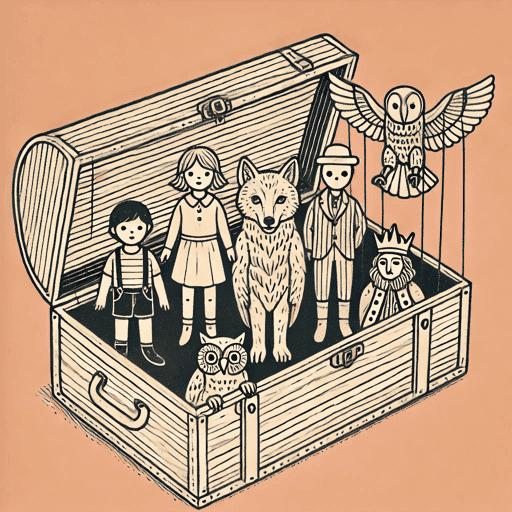
The Puppets of Spelhorst
46 pages • 1-hour read
Kate DiCamilloThe Puppets of Spelhorst
A modern alternative to SparkNotes and CliffsNotes, SuperSummary offers high-quality Study Guides with detailed chapter summaries and analysis of major themes, characters, and more.
Summary
Background
Chapter Summaries & Analyses
Character Analysis
Themes
Symbols & Motifs
Important Quotes
Essay Topics
Tools
Symbols & Motifs
Violet
One of the motifs in The Puppets of Spelhorst is the color violet. Most notably, the eyes of both Annalise and the girl puppet who resembles her are a violet color. Both characters (the puppet explicitly) have the gift of seeing things as they really are—e.g., both recognize the value of love, and Annalise sees Emma for the intelligent and empathetic storyteller she is. When the color violet is mentioned in the book, it is therefore typically a precursor for a truth that will be revealed.
For example, in the moments before the play, the sky changes: “‘The sky is violet,’ said the girl. ‘Soon it will be dark,’” (101). This symbolizes that truth will be revealed during the play, and the audience is indeed enlightened by Emma’s narrative analysis of life, love, and loss: The play gives Jane courage to explore the world, the puppets the feeling that they have a purpose, and Annalise closure regarding her love of Spelhorst. For the reader, the play also of course reveals that Spelhorst’s lover, Annalise, and the girl from the story are all one and the same. The author makes this clear when “Emma look[s] up at the old woman. Her eyes [are] violet. They [are] filled with light” (138)—a description that echoes descriptions of the puppet.
It is important to note that the truths associated with the color violet are often not the pragmatic realities that characters interpret as the truth. This distinction emerges in Jane’s discussion of her mother’s reasons for naming her Jane rather than Violet: She believed the latter was an impractical name for a hard world, yet the path Jane pursues—becoming a wandering storyteller—is both “truer” than her work as a maid and more in keeping with the romance and beauty connoted by the name “Violet” than with her given name. The rarity of violet as an eye color underscores this point, associating the color with wonder and mystery as well as with truth.
Songs
The motif of songs supports the theme of The Transformative Power of Stories. The songs serve as miniature stories, and each has an emotional impact on the characters. In particular, the puppets and human characters utilize the power of song to communicate their feelings and build community.
Throughout the book, the character most drawn to songs is the king. He envisions his future kingdom as being filled with songs that both heal and break people’s hearts. He asks the girl puppet to sing to him when he is missing his friends, and her song reminds him he is not alone. Finally, when he is the last puppet on the mantel, he learns to sing to himself and finds emotional strength from it.
The girl puppet feels the power of song most when she sings with Jane during the play. Even after the play is over, “In the body and soul of the girl puppet, the song she had sung with Jane Twiddum still reverberate[s]. She [can] feel each word of it, each note; and she [can] see, in her mind’s eye, the stars in the night sky and, too, each face in the audience” (128). The girl puppet gets a great amount of joy not only from the act of singing but also from sharing that song with others.
This is what all the puppets learn to love most. They worked together to tell a story and transform an audience. Now that they have had a taste of that, they want to continue telling stories and singing songs. Moreover, songs serve as a way to remember that feeling of shared purpose and thus to preserve their commitment to it. For instance, the wolf asks the girl puppet to “Sing them all, […] And then we can remember it all, everything that has happened to us” (140). Songs are a way of keeping stories alive in the collective memory.
The Lights in the Sky
Celestial bodies symbolize the beauty and wonder of life, as well as the dreams that these qualities inspire in humans. The bodies of light are remote and mysterious, just as life can be hard to understand, yet they are also majestic and beautiful, giving rise to awe and curiosity in those who behold them. Part of the wizard’s blessing is, “May you always look upon the moon and the stars and the sun with wonder. May you journey out into the great wide world” (135). At the end, Jane does this, taking the puppets with her to tell stories across the world and reinforcing the novel’s message about embracing life’s splendors to the fullest.
The sun, moon, and stars are also closely associated with love, as the novel identifies this as one of life’s most wondrous and mysterious aspects. It is notable in this respect that the lights are described as being always present, such as in the play: “And the girl and the boy were together under the sun, beneath the moon, below the stars. Whenever they looked up, they saw light shining down on them” (114). The constant of the lights in the sky is as constant as the love between the girl and the boy in the story, or the love that the puppets have for each other.

Unlock the meaning behind every key symbol & motif
See how recurring imagery, objects, and ideas shape the narrative.
- Explore how the author builds meaning through symbolism
- Understand what symbols & motifs represent in the text
- Connect recurring ideas to themes, characters, and events