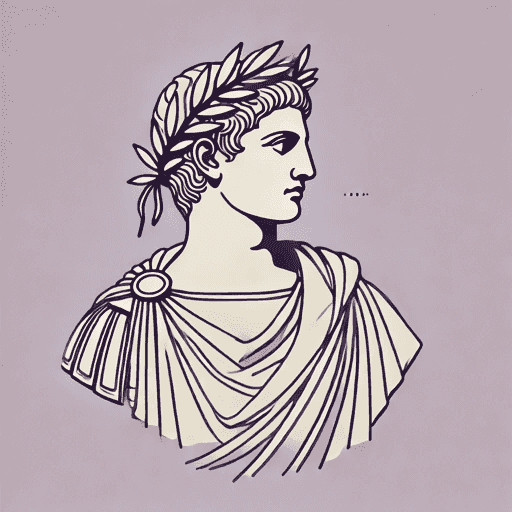
The Rise of the Roman Empire
49 pages • 1-hour read
PolybiusThe Rise of the Roman Empire
A modern alternative to SparkNotes and CliffsNotes, SuperSummary offers high-quality Study Guides with detailed chapter summaries and analysis of major themes, characters, and more.
Key Figures
Polybius
Polybius was a Greek historian who was born in Arcadia, a Greek city-state, at the end of the 3rd century, when the city was a part of the Archean League. His father was a politician, meaning that Polybius was expected to follow suit. As a young scholar, Polybius enjoyed reading historical works and examining them critically. Polybius’s father, Lycortas, argued for neutrality during the Roman war against Macedon, influencing the young historian’s approach to his work. As an adult, Polybius was a well-respected member of Greek political life and was elected calvary leader during a time of political and military turmoil.
Perseus, the son of Philip V and the king of Macedonia, was embroiled in war with the Romans that his father had started as he sought to take over all of Greece. The king was defeated by the Roman general Scipio, who then rounded up 1,000 prominent Achaeans to be killed or imprisoned. Polybius was among them.
However, his intelligence and privilege afforded him a unique opportunity. After the hostages were released in 150 BCE, the Romans allowed Polybius to return home. While under Roman capture, he had developed a relationship with a young man named Publius Scipio who was the son of a Roman commander. Polybius became Publius’s mentor and was granted access to leading families in Rome. While in Rome and traveling with Publius, Polybius gathered information and testimonies to support the writing of his Histories. While many of these books are lost, they offer valuable insight into the ancient Mediterranean. Polybius continued to work with Romans to influence the lives of the Greeks and to organize the new government after the Archean League’s fall.
Archimedes
Archimedes was a Greek scientist and inventor who lived in Sicily from 297 to 212 BCE. Little is known about the life of Archimedes, but his contributions are detailed in Polybius’s The Rise of the Roman Empire and other works. Considered one of the greatest mathematicians of all time, Archimedes introduced concepts that would later become building blocks for calculus and modern analysis.
Archimedes appears in Polybius’s work during the siege of Syracuse and is praised by the Greek historian for his cunning and creativity. The mathematician defended his city in Sicily by using advanced war machines: Catapults, cranes that lift ships, and hidden defensive devices. Polybius acknowledges Archimedes’s scientific intellect and strategic effectiveness, using him to highlight discipline as a form of strength. Like Scipio, Archimedes embodies the idea that preparation, precision, and intellectual command are often more powerful than brute force. Though not a soldier, Archimedes represents the same values Polybius prizes in a leader: Control over timing, adaptability, and imagination.
Demetrius
Demetrius, son of Seleucus IV Philopator, was the king of the Seleucid Empire from 162-150 BCE. As a young boy, he was sent to Rome as a hostage. When Rome emerged as the dominant power after the Second Punic War and the death of his father, Demetrius began to long for his rightful position and to return to his homeland. He petitioned the Roman Senate to allow him to return, but they denied his request.
He then quietly began to plan his escape, involving trusted allies, including Polybius. The Greek historian admired Demetrius’s composure and courage and helped him strategize a way out. Demetrius secured passage on a Carthaginian ship and escaped. When he returned home, he had military support and a noteworthy reputation. He deposed Antiochus V and seized the throne.
Hannibal Barca
In his study of the Carthaginian general Hannibal Barca, Polybius praises the military leader’s discipline, adaptability, and ingenuity. Hannibal oversaw the Carthage army against the Romans during the Second Punic War. He and his brother Hasdrubal were allied against the Romans, influenced by their father Hamilcar who had battled Rome during the First Punic War. When Hannibal was a young boy, his father made a sacrifice to the gods and instructed his son to never befriend a Roman, a moment that had a lasting effect on Hannibal’s life.
Hannibal launched the Second Punic War in an attack on Saguntum in Spain. His army was fierce and included many elephants. While Hannibal was a successful general, he was ultimately defeated by Scipio Africanus at the Battle of Zama in 202 BCE. Polybius writes that Hannibal’s downfall was facing the Romans too early. The historian argues that Hannibal should have focused on defeating smaller enemies and building power and strength before challenging the mighty Roman military.
Hasdrubal Barca
Hasdrubal was a Carthaginian general who was defeated by the Romans in the Second Punic War. On his way to unite his forces with the army of his brother Hannibal, Hasdrubal was attacked by the Roman allies. In The Rise of the Roman Empire, Polybius praises Hasdrubal for both how he managed his military during a time of power and how he faced defeat in his final moments.
Hasdrubal considered carefully what he would do when it became clear that he was about to be defeated. Rather than retreating, he stayed with his men and chose to fight until the end. Hasdrubal dies fighting, and Polybius pauses in his text to honor the leader—not for winning, but for dying well, showing courage and dignity even in defeat. Polybius cites Hasdrubal’s brave action as a marker of a strong and disciplined leader.
Philip V of Macedon
Philip V of Macedon was the king of Macedon from 221 to 179 BCE. His son Perseus was the last king of Macedon. Philip came to power as a young king after the chaotic reigns of previous monarchs, inheriting a powerful but politically fragile kingdom. Polybius initially presents Philip as an energetic, promising, and politically astute young ruler with the potential to restore Macedonian greatness. The Greek historian praises Philip for his boldness and strategic clarity during the Social War.
However, as Philip gained more power, Polybius identifies a moral and political deterioration in his rule. He became ruthless, tyrannical, and paranoid, turning to violence and betrayal, which Polybius sees as moral failings and examples of poor leadership. He was also ungracious after battle: Violating sacred sites, plundering temples, and executing allies out of fear that they might turn on him. Polybius uses Philip’s decline as a warning about unchecked power and corrupted virtue.
Polybius juxtaposes Philip’s downfall with Rome’s inclining institutional strength. While Rome’s leaders were held accountable by law, Philip’s behavior became increasingly impulsive without a system in place to check his power.
Scipio Africanus
Publius Cornelius Scipio Africanus, referred to in the text as Scipio, was a Roman general and statesperson who lived from 236 to 183 BCE. Scipio was well-known for his victory over Carthage during the Second Punic War, outlined in The Rise of the Roman Empire. In tribute to his most famous victory at the Battle of Zama in Africa in 202 BCE, Scipio was given the honorary name of “Africanus,” which was meant to indicate that he was the conqueror of Africa.
Scipio was born into a powerful Roman family and served as a young officer until he was elected to lead Roman forces in Spain in his 20s, following the death of his father and uncle. His capture of New Carthage in 209 BCE was won against Hasdrubal in a surprise attack, giving the Romans control over Spain. He later invaded Africa, luring Hannibal away from Italy and defeating him at Zama.
Polybius deeply admires Scipio. In Books 10 and 11, Polybius presents the general as a rare fusion of military genius, moral clarity, and political intelligence. Rather than winning battles by chance or brute force, Scipio exhibited three qualities that Polybius sees as important components to effective leadership: Timing, planning, and the element of surprise. Scipio’s capture of New Carthage involved detailed geographical knowledge and careful calculation.
Polybius also champions Scipio for how he handles his successes, which the Greek historian argues is just as important as how a leader handles a loss. Scipio divided the spoils of war evenly among his soldiers and returned captured women to their families. Polybius sees Scipio as someone virtuous and clever, proof that individuals with discipline, vision, and self-restraint can guide history.
Timaeus
Not to be confused with other ancient intellectuals with the same name, Timaeus of Tauromenium was a Sicilian historian who lived between 356 and 260 BCE. Timaeus was a highly influential historian whose work covered the Western Mediterranean, including Sicily and Italy. He was best known for being meticulous in chronology, introducing the practice of dating events by Olympiads. Although his work was popular in the ancient world, only fragments survive today. Much of what scholars know about Timaeus comes from the detailed account of him provided by Polybius.
However, the Greek historian did not share his peers’ favorable opinion of Timaeus. Polybius eviscerates Timaeus, accusing him of undermining the entire discipline of historical analysis. He condemns Timaeus for never having participated in public affairs or military campaigns, and for relying on secondary sources over firsthand experience. For Polybius, good history requires direct knowledge and rigorous investigation, and he feels that Timaeus relied too heavily on gossip, mythology, and speculation. Polybius also accuses Timaeus of filling his histories with invented speeches that were entirely detached from real events. Finally, Polybius believes Timaeus showed malice and exaggeration due to his bias and unbalanced assessment of historical events. He accuses Timaeus of character assassination, turning complex figures into oversimplified renditions of vice without acknowledging their accomplishments or historical importance.

Unlock analysis of every key figure
Get a detailed breakdown of each key figure’s role and motivations.
- Explore in-depth profiles for every key figure
- Trace key figures’ turning points and relationships
- Connect important figures to a book’s themes and key ideas