61 pages • 2-hour read
The Romance of the Forest
A modern alternative to SparkNotes and CliffsNotes, SuperSummary offers high-quality Study Guides with detailed chapter summaries and analysis of major themes, characters, and more.
Important Quotes
Content Warning: This section of the guide includes discussion of illness and death.
“When once sordid interest seizes on the heart, it freezes up the source of every warm and liberal feeling; it is an enemy alike to virtue and to taste—this it perverts, and that it annihilates.”
(Part 1, Chapter 1, Page 1)
This opening sentence of the novel establishes a prevailing conflict between passions, which are self-interested, and qualities like generosity and attentiveness to others, which are considered higher virtues. The consequences of acting on baser passions rather than nobler sentiments are the book’s chief subject, theme, and moral argument. Radcliffe employs metaphor to liken sordid interests to “an enemy” capable of freezing “every warm and liberal feeling” the heart contains. Further, she uses personification, attributing human-like qualities of perverting and annihilating to abstract concepts like virtue and interest. This quote develops the theme of Self-Interest, Self-Preservation, and the Insistence on Virtue.
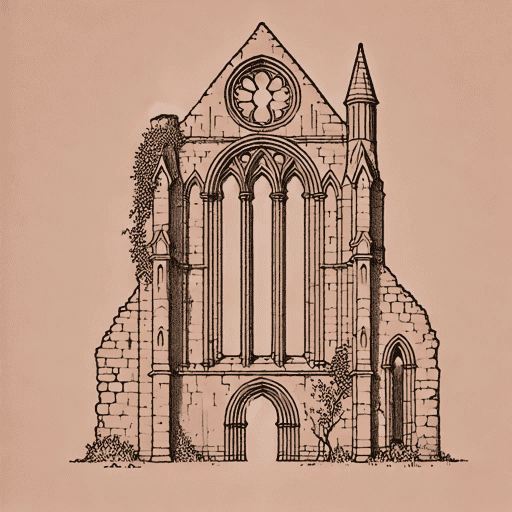
“La Motte paused a moment, for he felt a sensation of sublimity rising into terror—a suspension of mingled astonishment and awe! He surveyed the vastness of the place, and as he contemplated its ruins, fancy bore him back to past ages.”
(Part 1, Chapter 2, Page 15)
La Motte’s first sight of the ruined abbey stirs in him the emotions embraced and celebrated by Romanticism, demonstrating The Effect of Landscape on Emotion. His ability to feel his imagination stirred by the sight of this grand ruin is evidence of his sensibility, a virtue to many 18th-century thinkers. Radcliffe frequently introduces sublime landscapes, using the term as defined by Burke and demonstrating how these emotions can provide grounds for philosophical contemplation or aesthetic debate.
“Adeline’s mind had the happy art, or, perhaps, it were more just to say, the happy nature, of accommodating itself to her situation.”
(Part 1, Chapter 3, Page 34)
Adeline’s resilience is one of her defining characteristics. She can endure affliction and adapt to the most reduced circumstances. Calling this part of her nature rather than an art or affectation shows it is more authentic to her character. One ongoing concern of Romanticism is the distinction drawn between the natural or “real” and the artificial or contrived.
“The operation of strong passion confuses the powers of reason, and warps them to its own particular direction.”
(Part 1, Chapter 4, Page 46)
The power of strong emotion to impede reason or lead to unvirtuous action is a consistent argument of the novel, which is slightly ironic considering that the use of suspense, terror, and pathos in the Gothic is designed to excite emotion. There is a clear distinction between, and consequences for, characters who rise above or control their emotions, exhibiting the virtues of self-control and logic, and characters who give in to their passions, play villainous roles, or are otherwise led into error.
“‘It must be a sentiment more powerful than gratitude,’ thought she, ‘that could teach Adeline to subdue her fears. What, but Love, could influence her to a conduct so generous!’”
(Part 1, Chapter 5, Page 63)
This thought by Madame La Motte shows she believes that self-interest is the primary motive for human behavior. Her suspicions that her husband and Adeline are having an affair provide conflict during their time at the abbey and foreshadow Adeline’s attractiveness to all those around her. Madame’s conclusion reflects one of the novel’s larger arguments that love can prompt a person to truly generous and noble behavior. It was a convention of 18th-century literature to capitalize certain common nouns for emphasis, and the convention is preserved in most editions to emphasize the importance of Love as both feeling and principle.
“Self-love may be the center, round which the human affections move, for whatever motive conduces to self-gratification may be resolved into self-love; yet some of these affections are in their nature so refined—that though we cannot deny their origin, they almost deserve the name of virtue.”
(Part 1, Chapter 5, Page 82)
This passage, a bit of philosophizing inserted by the omniscient narrator, speaks directly to the novel’s argument about the proper motivations for action. Adeline, in her innocence, demonstrates how self-love can act as a virtue when the outcome benefits another, as opposed to being entirely self-directed. The organizing principles of human nature were questions of great interest to 18th-century European philosophers, and the foundations of virtuous character are of particular interest in this book.
“La Motte seemed agitated by impatient fear, yet the sullenness of despair overspread his countenance. A certain wildness in his eye at times expressed the sudden start of horror, and again his features would sink into the gloom of despondency.”
(Part 1, Chapter 6, Page 92)
La Motte’s excitability and disordered emotions suggest something is haunting him. In keeping with the Gothic genre, there are strong hints that the source could be supernatural, connected to the rumored imprisonment and murder that took place at the abbey. Later, it is disclosed that his agitation stems from guilt over his intentions to encourage the Marquis’s pursuit of Adeline, which he knows is a dishonorable act. This aligns with Radcliffe’s use of the seemingly paranormal to illustrate The Power of Imagination and emotion.
“‘You forget you have left Paris,’ said La Motte to his son […] ‘such a compliment would there be in character with the place—in these solitary woods it is quite outré.’”
(Part 1, Chapter 7, Page 104)
In suggesting that Louis’s gallant compliment to Adeline is out of place in a situation like the abbey, La Motte observes the common distinction that the city is a civilized place, ruled by manners and law, while the countryside is more rustic, wild, and unsophisticated. The Romantics turned this distinction around to suggest that cities were rather places of artifice and deceit, and the natural landscape was more in harmony with a person’s natural state of being. This is the association borne out in the novel as the countryside provides peace and safety, even though the forest functions variously as a site of refuge or threat.
“Impossible! A countenance so noble, and a manner so amiable, could never disguise a heart capable of forming so despicable a design.”
(Part 2, Chapter 8, Page 112)
It is a fixture of Romantic literature that a person’s character showed in their face; though a manner could be feigned, the convention went that habitual thoughts would show on one’s features. Though questioned at certain points, this distinction tends to hold through Radcliffe’s novel as those of heroic or virtuous bent appear so on sight. Adeline expresses this belief when she is certain Theodore’s kind expression could not—unlike the Marquis—mask villainy. This continues to develop self-interest, self-preservation, and the insistence on virtue.
“Adeline paused. Here the wretched writer appealed directly to her heart; he spoke in the energy of truth, and, by a strong illusion of fancy, it seemed as if his past sufferings were at this moment present.”
(Part 2, Chapter 9, Page 132)
Adeline’s reading of the manuscript that she discovers remarks on the power of literature to excite emotion and make an imagined scenario feel real and immediate, emphasizing the power of imagination. This is a self-conscious, almost metafictional move on Radcliffe’s part as she intends her narrative to have the same effect. Her responses to the manuscript prove Adeline’s sensibility, while her sense of identification with the narrator is foreshadowing for the later revelation of her identity.
“It appears to exhibit a strange romantic story; and I do not wonder, that after you had suffered its terrors to impress your imagination, you fancied you saw spectres, and heard wondrous noises.”
(Part 2, Chapter 10, Page 144)
While the Gothic relies on the power of imagination and the reader’s susceptibility to excitement and terror, La Motte ironically scoffs at Adeline’s fear that her bedchamber is haunted and blames the manuscript for exciting her fears. That they find nothing to account for the sounds she heard is in keeping with Radcliffe’s tendency to suggest the supernatural and use illusion to arouse terror. However, later, she exposes a human or natural explanation for the phenomenon.
“The scene around exhibited only images of peace and delight; every object seemed to repose; not a breath waved the foliage, not a sound stole through the air: it was in her bosom only that tumult and distress prevailed.”
(Part 2, Chapter 11, Page 165)
Adeline’s abduction by the Marquis and her subsequent wandering through the gardens of his estate are moments when the landscape does not provide ease or solace for her troubled mind, complicating the effect of landscape on emotion. Her turmoil represents that she is in the wrong setting, and the gardens, though beautiful, are a kind of prison.
“The graceful form, the noble, intelligent countenance, and the engaging manners which she had at first admired in Theodore, became afterwards more interesting by that strength of thought, and elegance of sentiment, exhibited in his conversation.”
(Part 2, Chapter 12, Page 178)
Theodore, as the romantic hero of the novel, exhibits all the finest qualities that Radcliffe can bestow on him, from physical attractiveness and good manners to intelligence and taste. The novel’s interest in virtuous character shows that a combination of morals, decorum, and discernment is most deserving of admiration.
“Adeline, sensible to the attachment he had so nobly testified, and softened by the danger he had encountered, no longer attempted to disguise the tenderness of her esteem, and was at length bought to confess the interest his first appearance had impressed upon her heart.”
(Part 2, Chapter 12, Page 189)
While the “romance” of the title indicates a tale of adventure and draws on the original meaning of the term, there is also a central love story. The predominance of the love story in 18th and 19th century romances led the genre to be defined exclusively by that premise. While some romances defer a declaration of love until the conclusion, Adeline and Theodore admit their love at the midpoint. Thereafter, external obstacles keep them apart until the end. Notably, Theodore’s noble character and sacrifice for her sake contribute to Adeline’s feelings of love.
“She saw him in a prison—pale—emaciated, and in chains:—she saw all the vengeance of the Marquis descending upon him; and this for his noble exertions in her cause.”
(Part 2, Chapter 12, Page 194)
Adeline, who is susceptible to emotions, frequently adds to her distress by imagining scenarios of despair and suffering. This heightened emotion adds pathos to the scene, inviting the pity and horror that the Gothic effects are meant to stir. Her fancies also illustrate the power of imagination to agitate or soothe.
“La Motte, meanwhile, experienced all the terrors that could be inflicted by a conscience not wholly hardened to guilt. He had been led on by passion to dissipation—and from dissipation to vice; but having once touched the borders of infamy, the progressive steps followed each other fast, and he now saw himself the pander of a villain, and the betrayer of an innocent girl, whom every plea of justice and humanity called upon him to protect.”
(Part 2, Chapter 14, Pages 208-209)
La Motte’s character arc is a study in temptation and cultural attitudes about vice. Throughout the book, he serves at different times as Adeline’s rescuer, protector, and the instrument by which she is put in harm’s way. Radcliffe uses his example to draw a moral about the workings of self-interest and how a weaker character like La Motte will respond to conflicts in contrast to a strong-willed character like Theodore or La Luc. This continues to develop self-interest, self-preservation, and the insistence on virtue.
“He saw himself entangled in the web which his own crimes had woven. Being in the power of the Marquis, he knew he must either consent to the commission of a deed, from the enormity of which, depraved as he was, he shrunk in horror, or sacrifice fortune, freedom, probably life itself, to the refusal.”
(Part 3, Chapter 15, Page 226)
When the Marquis enjoins him to kill Adeline, La Motte confronts the dilemma to which his choices have led him. The metaphor of La Motte being “entangled in the web” describes the inescapable, morally entrapping consequences of La Motte’s actions. The strong moral compass of this novel provides virtuous behavior with reward and rewards villainous behavior—when unrepentant—with punishment. La Motte has departed from the moral path by his lack of control—a point the novel makes several times—and now he must choose between self-interest and self-preservation and doing what he knows is morally correct. His internal conflict continues to display self-interest, self-preservation, and the insistence of virtue.
“His native village […] was an exception to the general character of the country, and to the usual effects of an arbitrary government; it was flourishing, healthy, and happy; and these advantages it chiefly owed to the activity and attention of the benevolent clergyman whose cure it was.”
(Part 3, Chapter 16, Page 240)
Setting plays a symbolic role in the novel, providing symmetry with character and action. Adeline leaves the forest and comes to Leloncourt, Peter’s village in Savoy. She leaves the wild isolation of the abbey, where her fate is always in danger, for the order and comfort of La Luc’s house. The health of the residents reflects the charity and wisdom of his just rule, in opposition to the income equality in the rest of the Duchy of Savoy, which is ruled by a king and thus a more “arbitrary” mode of government. Radcliffe shows the influence of the French philosopher Jean-Jacques Rousseau in the theories the novel expresses about proper education, the social order, moral conduct, and the pleasures of rural life.
“From this point the eye commanded an entire view of those majestic and sublime alps whose aspect fills the soul with emotions of indescribable awe, and seems to lift it to a nobler nature.”
(Part 3, Chapter 18, Page 273)
Monsieur Verneuil’s appreciation of the alpine landscape reflects Adeline’s sentiments, who is deeply impressed by the majesty of the view and experiences the effect of landscape on emotion. The use of the adjective sublime refers to the concept that Edmund Burke discusses in his 1756 essay, A Philosophical Enquiry Into the Origin of Our Ideas of the Sublime and Beautiful. Burke’s argument that sublimity had the power to uplift and ennoble human character was a tenet of Romanticism, which placed high value on the emotional influence of natural settings.
“The chearfulness [sic] and harmony that reigned within the chateau was delightful; but the philanthropy which, flowing from the heart of the pastor, was diffused through the whole village, and united the inhabitants in the sweet and firm bonds of social compact, was divine.”
(Part 3, Chapter 18, Page 277)
The philosophical discussions in the first chapters of Volume III include several topics of interest to late 18th-century writers, one of which is appropriate systems of government. La Luc’s influence on his village, which is benevolent and just, leads to prosperity. This stands in direct opposition to the tyrannical will of the Marquis, which results in misery for many.
“Now she had found affectionate friends—a secure retreat—and was delivered from the terrors she then suffered—but still she was unhappy. The remembrance of Theodore—of Theodore who had loved her so truly, who had encountered and suffered so much for her sake, […] was an incessant pang to her heart.”
(Part 3, Chapter 19, Page 294)
While Adeline experiences safety, comfort, and the stimulation of travel with the La Lucs, her loyalty to and love for Theodore still present a source of distress. Radcliffe employs the metaphor of “a secure retreat” to portray the safety and refuge Adeline feels through having affectionate friends. Further, “an incessant pang to her heart” displays the emotional agony Adeline feels, portraying her longing for Theodore as a persistent, physical sensation that demonstrates the depth of her attachment to him. Her ruminations keep the love story in play and keep Theodore present, preparing one for his reentry into the narrative with the revelation that he is La Luc’s son.
“Young as I am, and held by such strong attachments, I cannot quit the world with resignation. I know not how to credit those stories we hear of philosophic fortitude; wisdom cannot teach us cheerfully to resign a good, and life in my circumstances is surely such.”
(Part 3, Chapter 21, Page 324)
Theodore’s fortitude and “manly composure” in prison reveal the Romantic ideals of the masculine character (321): capable of deep feeling but too strong-minded to give in to vice or despair. The novel renders the power of the will to curb emotion and discipline as a virtue throughout the novel, while self-indulgence or the inability to control one’s impulses is a sign of weakness or villainy. This continues to develop self-interest, self-preservation, and the insistence on virtue.
“She who had been so lately sinking under the influence of illness and despair, who could scarcely raise her languid head, or speak but in the faintest accents, now reanimated with hope, and invigorated by a sense of the importance of the business before her, prepared to perform a rapid journey of some hundred miles.”
(Part 3, Chapter 23, Page 335)
Adeline’s delicacy of constitution, demonstrated by her frequent fainting and the physical illness she experiences in response to emotional distress, is an indication that she adheres to her culture’s literary ideals of femininity, in which sensitivity—called at the time sensibility—is admired. Also admired are fortitude and force of will, qualities that circumstances compel her to display without compromising her femininity. The “sudden heir” is a popular trope of the English sentimental novel and operates here to accomplish the last reversal of Adeline’s fortunes through her final trial, this time a literal one.
“When a retrospect is taken of the vicissitudes and dangers to which she [Adeline] had been exposed from her earliest infancy, it appears as if her preservation was the effect of something more than human policy, and affords a striking instance that Justice, however long delayed, will overtake the guilty.”
(Part 3, Chapter 23, Page 343)
Throughout the novel, the omniscient narrator will occasionally take an opportunity to remark more generally on the action or a character, emphasizing a particular interpretation for the reader. This observation confirms the moral framework girding the sensational action of the novel, concluding that justice prevails in the end. This addition of a moral to the story answers a prevailing concern among 18th-century critics that literature ought to advise and instruct and not simply entertain.
“The remembrance of the circumstances under which they had last met, and of their mutual anguish, rendered more exquisite the happiness of the present moments, when […] they looked forward only to the smiling days that awaited them when hand in hand they should treat the flowery scenes of life.”
(Part 3, Chapter 25, Page 355)
In what will become a convention of the romance, the lovers are happily reunited at the end of the book. The trials that they have endured before heighten their joy in one another. The rise in Adeline’s fortunes, as well as the satisfying conclusion to the love story, reflect the story pattern of the romance as it evolved in European literature, bearing out the distinction of the title.

Unlock every key quote and its meaning
Get 25 quotes with page numbers and clear analysis to help you reference, write, and discuss with confidence.
- Cite quotes accurately with exact page numbers
- Understand what each quote really means
- Strengthen your analysis in essays or discussions