61 pages • 2-hour read
The Romance of the Forest
A modern alternative to SparkNotes and CliffsNotes, SuperSummary offers high-quality Study Guides with detailed chapter summaries and analysis of major themes, characters, and more.
Character Analysis
Adeline
Content Warning: This section of the guide includes discussion of illness, death, and death by suicide.
Adeline is the chief protagonist of the novel and its heroine. She is 19 when the story opens. She is very beautiful, with a slender figure, dark auburn hair, and a graceful manner. The narrator describes her looks and manner as very affecting to those around her; “The languor of sorrow threw a melancholy grace upon her features, that appealed immediately to the heart; and there was a penetrating sweetness in her blue eyes, which indicated an intelligent and amiable mind” (9). She also has “a good understanding and an amiable heart” (29).
Her resilient spirit complements this combination of beauty, intelligence, and pleasant manner. Despite all her troubles, “[h]er mind had not lost by long oppression that elastic energy, which resists calamity” (9). Even in affliction, Adeline has a generally happy nature that can adapt to her circumstances. She is sensitive to beauty as well as suffering, and events tend to deeply affect her. For example, she weeps when Madame La Motte is unkind to her, and she falls ill several times due to her affliction of mind, but she demonstrates fortitude and always manages to recover. She has an active imagination, and her sympathies are easily stirred, but she is usually able to control her emotions through activities such as walking in nature, composing poetry, reading, or sleeping.
At the beginning of the story, Adeline believes her father is a man named Louis de St. Pierre. Her mother is dead, and Adeline has been raised and educated in a convent. She longs to see the world, a wish that is later granted when she falls in with La Luc and his family. Adeline is a compassionate person who is generally kind to others, and so she is greatly grieved when others are unkind to her. She is grateful to the La Mottes for giving her protection and allowing her to join their household, and later she is grateful to La Luc for the same kindness. As a young woman without a clear skill, Adeline has no way to earn an income and support herself, and she realizes, to her dismay, how dependent this makes her. Additionally, her near-orphaned state deprives her of the family she might otherwise turn to for help. This precarious state troubles her, and she often bemoans it.
Adeline is modest and chaste, and she does not encourage affection from men that she does not intend to return, as in the case of Louis La Motte. Nor does she wish to be the Marquis’s mistress; this is because she dislikes him and because marriage is the more respectable option. Her determination to flee when the Marquis has imprisoned her in his chateau, along with her later flight from the forest at La Motte’s urging, shows her strong instinct for self-preservation. When Adeline falls in love with Theodore, it is due to a combination of things. He strikes her as handsome and charming but not threatening; rather, he risks harm to himself to protect and rescue her. This moves her to tenderness that becomes a loyal love.
Adeline’s modesty and humility, which Radcliffe especially stresses in the last chapters when she attends the trials in Paris, are meant to show that she is worthy of the turn of fortune that various testimony will reveal. The man she thought was her father is actually Jean d’Aunoy, who was employed by the Marquis to murder her birth father, Henry, the previous Marquis de Montalt. Adeline’s mother was a woman of noble birth who was related to Monsieur Verneuil. When Adeline inherits all the properties and income of the Marquis, her future is financially secure. Her real happiness, however, rests in her marriage to Theodore and their life together, when she achieves a family of her own at last.
Pierre La Motte
Pierre La Motte is a second protagonist of the novel, though not its hero. He is a round, dynamic character. His character arc is eventually one of redemption, but for much of the novel, he is a study in the consequences of wrongdoing and an example of a character easily led astray by temptation.
La Motte is described as a gentleman descended from “an ancient house of France” but a “man whose passions often overcame his reason, and, for a time, silenced his conscience” (2). He is intelligent and has an impressionable nature that, as the narrator notes, could be influenced: “his mind was active, and his imagination vivid, which, cooperating with the force of passion, often dazzled his judgement and subdued principle” (2). When put to a moral test, in most cases, La Motte “was not a man of very vigorous resolution” (52).
La Motte’s flaw is that he enjoys a life of comfort but is not careful about his spending. When he loses money gambling, he attempts to cheat to win money back. When he’s caught at this, he agrees to join a group of men to defraud others. He’s aware this is both an error and a crime, but he cannot resist the temptation. The need for money will lead La Motte into further trouble when he chooses again to commit a crime and rob a wealthy man traveling through the Forest of Fontanville. La Motte’s sense of guilt over stealing from him and leaving the man for dead shows that he is not entirely absent of a sense of what is right. His sense of self-preservation is strong, but his moral code is still present. While this sense of self-preservation spurs him to take charge of Adeline when she is given to his custody, a sense of compassion moves him to take her into his household. He tells himself it is in Adeline’s best interests to become the mistress of the Marquis, as she will be taken care of, and he uses this reason to justify abetting in her kidnapping. When he is pressed to commit a greater crime of murder, however, La Motte’s conscience surfaces. Rather than challenge the Marquis, which he is too weak-willed to do, La Motte enables Adeline’s escape.
By the end, after his trial and sentence are announced, the narrator suggests that La Motte has reviewed his errors, repented for his actions, and resolved to live a more honest life in the future. This suits the novel’s overall ethos that characters can be redeemed. La Motte provides an example of the power of self-interest. When he thinks he can profit by a situation, he does, but when he realizes that living an honest life is more in his interest, he resolves to do so.
The Marquis de Montalt
Philippe, the Marquis de Montalt, is first introduced as a benefactor to the La Mottes but quickly reveals himself as the antagonist in the novel. The conclusion discovers that his villainy has been behind most of the major events. He is an example of the extremes of self-interest, and his actions are the actions of a man who lacks the qualities that the world of the novel considers virtues.
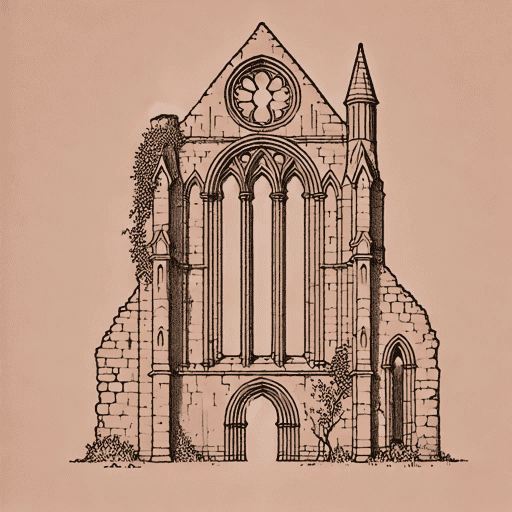
Philippe is the half-brother of Henry, the rightful Marquis de Montalt, which suggests they shared a father but had a different mother. Both of the brothers marry an heiress who brings wealth and property into the family. Philippe’s wife brings him the Abbey of St. Clair, the Gothic ruin standing in the Forest of Fontanville, which Philippe finds a convenient place to have his brother imprisoned and murdered. His motives for this, the narrator says, are ambition and greed; he wanted the title and income.
Philippe thereafter sends the rightful heir, his brother’s daughter, away with Jean d’Aunoy, the man he paid to murder Henry. When d’Aunoy’s wife dies, Adeline is sent to a convent. When she refuses as a young adult to take vows, which means she would reside at the convent for life, the Marquis asks Du Bosse to isolate the girl and do away with her, as he wants no rival. Now the Marquis, Philippe has no idea that Adeline is his niece when he pursues her and tries to make her his mistress. Though his wife is alive, his offer to marry Adeline merely shows his lack of scruples.
The Marquis is initially introduced as a noble-seeming man. He “was polite, affable, and attentive: to manners the most easy and elegant, was added the last refinement of polished life. His conversation was lively, amusing, sometimes even witty” (99), the narrator says. But a suggestion emerges that his assumption of manners does not reflect intelligence; the narrator goes on to say, his “acquaintance with the higher circles, and with the topics of the day” was not a substitute for “great knowledge of the world” (99). Later, the narrator admits, “The elegance of his manners […] effectually veiled the depravity of his heart” (338). The Marquis is motivated by his passions, greed, and lust, and feels no remorse for his crimes. Rather than face the justice of the punishment of the legal system, he decides to end his life by taking poison. Unlike La Motte, the Marquis is not the type to repent of his actions.
Theodore Peyrou
Theodore is the romantic hero of the story and the model of the virtuous young man, an appropriate match for the novel’s virtuous heroine. He is handsome and courteous, and in him, good manners are a reflection of his intelligence and moral nature. The narrator describes him as “a person, in which elegance was happily blended with strength, and [he] had a countenance animated, but not haughty; noble, yet expressive of peculiar sweetness” (87).
Theodore is the son of La Luc, a cleric who lives in the village of Leloncourt, in Savoy. He was brought up according to his father’s ideals of education, which taught him to value justice. The narrator says, “Theodore had received from nature many of the qualities of genius, and from education all that it could bestow; to these were added, a noble independency of spirit, a feeling heart, and manners, which partook of a happy mixture of dignity and sweetness” (190). He is modest about his accomplishments and sensitive to Adeline’s wishes and feelings. Theodore chose to be a soldier rather than a cleric like his father, and he is both protective and loyal. He falls in love with Adeline quite early, for she is very beautiful, but, unlike the Marquis, he treats her with respect and tenderness. Theodore has strong and loving relationships with his father and sister, and he develops a friendship with Louis, who has a similar temperament. Overall, Theodore is the heroic exemplar and models the qualities the novel considers virtues. He is a static character.

Unlock analysis of every major character
Get a detailed breakdown of each character’s role, motivations, and development.
- Explore in-depth profiles for every important character
- Trace character arcs, turning points, and relationships
- Connect characters to key themes and plot points