61 pages • 2-hour read
The Romance of the Forest
A modern alternative to SparkNotes and CliffsNotes, SuperSummary offers high-quality Study Guides with detailed chapter summaries and analysis of major themes, characters, and more.
Part 1, Chapters 5-7Chapter Summaries & Analyses
Content Warning: This section of the guide includes discussion of death.
Part 1: “Volume I”
Part 1, Chapter 5 Summary
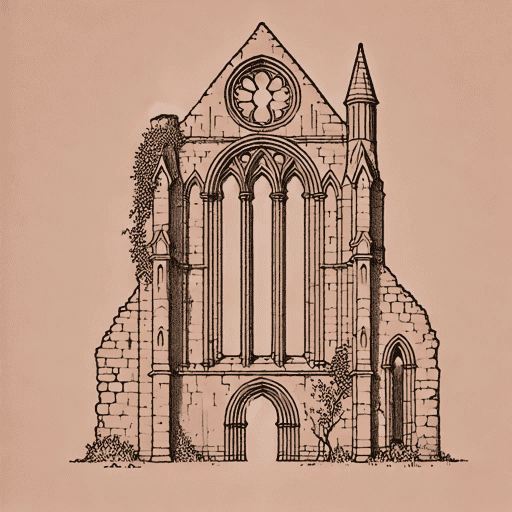
The next morning, when he peeks upstairs, La Motte is upset to see a stranger in the abbey. They pass another day in hiding but need food. Adeline agrees to venture out and walks throughout the ruin, exploring the sunny and shadowed parts. One of the deer she has made her pet comes to her. Suddenly, the soldier appears, asking for La Motte. Adeline tries to impede his search, but La Motte recognizes his son, Louis. Madame La Motte is overjoyed and feels, “This spot, so lately the mansion of despair, seemed metamorphosed into the palace of pleasure, and the walls echoed only to the accents of joy and congratulation” (66). Louis explains how he learned of his father’s departure from Paris and tracked him; Louis was the stranger inquiring after them in the village. He mentions the rumor that someone was murdered in the abbey, which the villagers now believe is haunted.
Louis notes his father’s gloom. He takes an interest in Adeline, which makes his mother treat Adeline with coolness. Trying to follow his father one day, Louis finds a small tomb in the forest and thinks he sees someone moving within it. Adeline finds the forest a pleasant place and one day, “[T]he beauty of the hour invited her to walk, and she went forth into the forest to taste the sweets of morning” (75). She composes a sonnet to the flowers, and when she speaks it aloud, she hears a voice answer. A young man, dressed like a hunter, is watching her. He approaches but does not pursue her when she rushes back to the abbey. When Madame La Motte scolds her, Louis questions his mother’s behavior, and La Motte rebukes them all.
Louis asks his father the reason for his solitary walks, which La Motte attributes to low spirits over his misfortunes. Adeline feels hurt by Madame La Motte’s coldness but resolves to bear her displeasure with fortitude. She takes refuge in reading books and that evening goes outside to walk, where she composes a sonnet on the night. Louis, joining her, suggests he could intervene with his mother on Adeline’s behalf. Adeline wonders if he is beginning to care for her.
Part 1, Chapter 6 Summary
One stormy night, a group of men on horses approaches the abbey. When La Motte refuses to answer the door, the men break it down. Adeline faints, and their leader, a man of rank, regards with interest her beauty and disheveled state. A young chevalier joins them, and Adeline, when she revives, recognizes the stranger she saw in the forest.
The nobleman identifies himself as the Marquis de Montalt. He owns the abbey but lives in a chateau a short distance away. La Motte and the Marquis appear to recognize one another. Madame La Motte overhears a discussion in which La Motte begs compassion of the Marquis. She wonders why her husband “seemed agitated by impatient fear” and “a certain wildness in his eye at times expressed the sudden start of horror” (92), but he will not explain. Adeline spends time with the young chevalier, whose name is Theodore, and she is eager to see him again.
Part 1, Chapter 7 Summary
Adeline wonders if the Marquis is the owner of the abbey to whom the murder of the prisoner is attributed. La Motte says that it was “a romantic tale to excite wonder” (99). The Marquis visits again, and Adeline joins in the lively conversation. She walks in the forest later, feeling sad and alone, and Theodore joins her. He hints that Adeline is in danger and asks her to meet him in the forest the next evening. La Motte sees them together.
Louis departs to rejoin his regiment. Before he goes, he tells Adeline how he feels and asks if there is any hope she will reciprocate. He is moved to see the fawn come to her and saddened that Adeline wishes him to think of her as a sister.
Theodore does not appear for their meeting, and Adeline is confused and disappointed. She wonders what dangers he meant to discuss. That night, she has a harrowing dream in which she is wandering through the ancient part of the abbey. She sees a dying man on a bed and is pursued through the passages by a man in a black cloak. In the next dream, she stands beside the coffin of the man she saw die. Blood gushes from the coffin to fill the room, and Adeline wakes with a sense of horror.
Part 1, Chapters 5-7 Analysis
The Gothic narrative relies for effect on a dilation of suspense by building hints at a terrifying occurrence or ominous event. There is sometimes a lull or a moment of reversal before the reveal, which is intended to excite a response from the reader, whether of fear, surprise, or pleasure. This pattern unfolds several times across these chapters, beginning with Louis’s appearance. Radcliffe leads up to this discovery with long scenes of agitation, particularly on La Motte’s part, and then the suspense of waiting overnight in fear of being discovered by soldiers. Adeline’s volunteering to investigate emphasizes that the heroine’s virtuous beauty can have the power to subdue a threat or conquer danger. Her innocence is symbolized by the tame deer that greets her while she explores the abbey. This leads to a moment of tranquility when she supposes they are safe, followed by the sudden shock for Adeline when a strange man addresses her.
Radcliffe then draws out his search for La Motte, increasing Adeline’s agitation along with the suspense, until the next surprise, which excites astonishment and pleasure: this is Louis, the La Mottes’s son, whom they welcome with joy. Radcliffe enacts this pattern of threat and reversal again when the group of horsemen breaks down the abbey door, only to reveal the Marquis, who, at this point, appears to be a gentleman and a man of nobility. The suspense over the other stranger who approaches Adeline is deferred a while longer, but he turns out to be Theodore, a seeming ally and possible love interest. In a last reversal, Theodore does not appear for their appointment, leaving Adeline to question what danger he believes she is in. The pattern of suspense, surprise, and reversal functions to maintain interest by varying the tension and tone.
The increasing hints of danger in this section darken the mood, and several indications are made toward some lurking but unknown threat. Adeline and Louis remind of the rumors of murder and supernatural activity at the abbey, which foreshadow a paranormal encounter of some sort. Louis, thinking he sees a figure rise from the tomb, and Adeline’s bloody dreams continue the hints that the violence committed on the property has left a ghastly residue. This is not only a favorite device of the Gothic; revenge has long served as a literary motive for supernatural appearances. The play Macbeth, from which the epigraphs to Chapters 6 and 7 are drawn, casts a thematic parallel in that the ghost of his murdered friend, Banquo, haunts Macbeth. La Motte’s agitated manner demonstrates that something is causing him distress, and his refusal to explain to his wife or son heightens the suspense over what he has witnessed. The hint that the Marquis and La Motte have some antagonistic history further sets up an expectation of conflict.
While Radcliffe further demonstrates The Effect of Landscape on Emotion in this section, other moments illustrate The Power of Imagination to reflect in the environment an individual’s state of mind. Madame La Motte’s joy at seeing her son transforms the ruined abbey for her, at least momentarily. Radcliffe further hints at the power of imagination in the way Adeline tells herself not to think about Theodore, convinced that doing so might nourish an attachment. Instead, she turns to useful work, books, or solitary walks to soothe her emotions. That Adeline can discipline her fancies and find calm distinguishes her from La Motte, who cannot seem to achieve equanimity of spirits. This continues the thematic juxtapositions between Self-Interest, Self-Preservation, and the Insistence on Virtue.
The inclusion of poems confirms Adeline’s ability to find solace in the calming influence of nature. The poems referred to as sonnets do not exhibit the specific meter and rhyme which now define the sonnet; that is because, in the 18th century, a sonnet could loosely refer to any sort of metered lyric form. In Radcliffe’s time, poetry was considered of higher literary quality than the novel. The sentiments of poetry were thought to be elevated by the formal expression, while imaginative fiction was little more than sensationalism. By including poetry of her composition, Radcliffe varies the tone of her novel and gives Adeline a talent that would be admired in a young woman of good birth.
The four men introduced at this point are all foils to one another in their relationship with and claim on Adeline. La Motte, thus far, serves as her protector, although Madame La Motte’s suspicions cast doubt. Louis declares himself a suitor but stirs no interest in her. The Marquis is a man of powerful rank, imperious in his manner, displaying the conduct (thus far) of a gentleman. However, the hints of a past association with La Motte suggest a more avaricious side to his nature. Theodore first appears as the mysterious huntsman drawn by Adeline’s song, but the description of his manners, sensitivity, and breeding are all marks of the romance hero.
Adeline now has several threats to her peace, including her reliance on the La Mottes, who behave unpredictably toward her, and a growing attachment to Theodore. Radcliffe’s hints have been subtle enough that one may not anticipate the severity. The novel prepares the reader for horrifying events, however, with the gory dreams that conclude Volume I. These establish a sense of dread as well as the anticipation intended to prompt the reader to purchase Volume II, which was initially published separately.

Unlock all 61 pages of this Study Guide
Get in-depth, chapter-by-chapter summaries and analysis from our literary experts.
- Grasp challenging concepts with clear, comprehensive explanations
- Revisit key plot points and ideas without rereading the book
- Share impressive insights in classes and book clubs