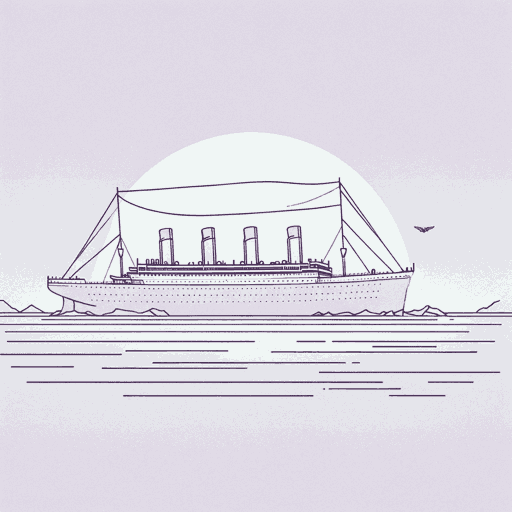
The Second Mrs. Astor: A Heartbreaking Historical Novel of the Titanic
67 pages • 2-hour read
Shana AbeThe Second Mrs. Astor: A Heartbreaking Historical Novel of the Titanic
A modern alternative to SparkNotes and CliffsNotes, SuperSummary offers high-quality Study Guides with detailed chapter summaries and analysis of major themes, characters, and more.
Chapters 10-20Chapter Summaries & Analyses
Chapter 10 Summary
The newspapers report that the colonel and Miss Force were caught on the lawn of Beechwood having an intimate tête-à-tête. Her father calls the colonel to say the engagement must be made public so Madeleine’s reputation isn’t ruined. Newspapermen flood the Force lawn when the news gets out. Madeleine complains that they pick apart everything she does. Her mother claims that navigating this attention is Madeleine’s job now, and Madeleine should say something so they’ll go away. Madeleine goes outside to talk with the reporters, and one asks her if she feels confident stepping into the role of the former Mrs. John Jacob Astor, “leader of the society of Newport and New York” (113). Another asks if she’s aware Jack’s divorce agreement doesn’t allow him to remarry. Madeleine flounders and withdraws. Jack sends her red roses—the American Beauties she said were her favorite.
Chapter 11 Summary
A newspaper article misrepresents Madeleine as boasting that she will reign over New York society just like the previous Mrs. Astors. Letters arrive to Madeleine from long-ago acquaintances who want to reconnect as well as from utter strangers. Some look up to her, some provide advice, and some ask her to sponsor their fundraiser.
Chapter 12 Summary
Madeleine tells Jakey that the hardest part of planning the wedding was finding a pastor who would marry a divorced man. The newspapers are full of speculation, yet for every column inch discussing the preparations, “there would immediately follow some dour, dire write-up by A Person of Virtue denouncing me, my parents, my education, your father, the entire world itself as corrupt and beyond redemption” (119). To flee her unwanted entourage, they take Jack’s yacht, the Noma, to Beechwood or Ferncliff Farm in Rhinebeck. “Back then,” Madeleine says, “the ocean was a friend. Back then, being out at sea felt like freedom” (120).
August 1911. At sea, Madeleine is woken by her father in the midst of a gale. A boat has tipped over, and the Noma is rescuing the stranded sailors. Madeleine offers them blankets and coffee.
Madeleine hates being judged and dissected by everyone but is learning to deal with the gossip that continually attends Jack. One day, they are going to lunch at a hotel and encounter Margaret Brown, who is truly friendly to Madeleine. A man across the street makes notes about them as all three go into the hotel.
Chapter 13 Summary
Madeleine tells Jakey that Newport society remained cold and aloof to her. Margaret Brown was her only friend. Madeleine and Jack married at Beechwood and spent their wedding night aboard the Noma. Madeleine says of that night, “I was uncoiled. And all the world was new” (128).
September 1911. The family tries to throw the press off the scent of wedding plans. Madeleine has little concern for the planning as she cares only about becoming Jack’s wife. One day, when a man waylays her outside the jewelry store to demand details about the prenuptial agreement, “A white-hot pressure spiked through her [Madeleine] that felt very much like murderous rage” (129). Everyone counsels her not to lose her temper with nosy reporters.
They take the yacht to Beechwood for the wedding. Katherine tells Madeleine about a Scottish boy who stole kisses and asked Katherine to marry him. Katherine declined because what she felt wasn’t love. Katherine asks if what Madeleine feels is truly love. Madeleine assures her it is, though she fancies briefly she might become a mermaid rather than a missus, wear pearls and live an enchanted life. Jack teases her, asking if mermaids have husbands. He says Madeleine makes him happy, and she tells him to become accustomed to happiness.
The room is cold during the ceremony, and a storm gathers outside, but Madeleine holds hands with Jack and is full of joy.
Chapter 14 Summary
Madeleine tells Jakey that they sailed the Noma for months. On land, the journalists, the gawkers, and the Four Hundred waited for them, and the established families craved and despised them. She pities that Jakey will have to navigate both these worlds, the Old Guard and the New.
December 1911. The couple enjoy being newlyweds, and Jack drapes Madeleine in jewels: pearls, emeralds, sapphires, belts, and bangles. She has a ring for every finger. In time, they weary of sailing and return to Manhattan to the Fifth Avenue chateau. The first night, Madeleine wakes alone and feels it is unfamiliar, even though she is the mistress here. She goes to breakfast and realizes she is sitting where Lina sat, where Ava sat.
Madeleine looks through her correspondence and sees a letter from Ava to Vincent, asking for a portrait of the family. Vincent is curt about her seeing it. Madeleine learns that meals are served on a strict schedule and imagines Ava set it. Jack suggests they host a luncheon and give out diamond rings as favors. “We’ve done it before,” he says (143) and Madeleine realizes his “we” is him and Ava, his first wife. Jack says he will have his secretary, Dobbyn, give her a list of around 50 people to invite, and they can commission a gold stickpin with their initials from Tiffany.
Madeleine peeks into Vincent’s bedroom to find the portrait of Ava. She is painted as a Roman goddess, Vincent and Jack with her. Madeleine sneaks away.
Chapter 15 Summary
December 1911. The chapter is a list of polite responses to Madeleine’s invitation, all expressing regret that they cannot attend.
Chapter 16 Summary
Madeleine tells Jakey she doesn’t think Jack was aware of how many versions of “she’s not Ava” she heard whispered by the Knickerbockers. Madeleine feels cold and lonely and has 40 gold stickpins with the initials J&M in her jewelry safe.
December 1911. Madeleine shivers in the immense rooms in Jack’s house, even with fires burning. Margaret visits and advises her to redecorate, make the place her own. Margaret describes how she was a shop girl who moved to Colorado and married a man who became rich, but she was never accepted by Colorado high society, who call themselves the Sacred Thirty-Six. Margaret spoke out on behalf of laborers and miners and their families, which also did not make her popular among the elite. Jack enters, and Madeleine asks if he would like to go to Egypt with Margaret.
Chapter 17 Summary
Madeleine tells Jakey they sailed on Olympic and met J. Bruce Ismay, chairman of the White Star Line, who bragged to Jack about the ship he was building. Madeleine says if Ismay were before her and she had a pistol, she would shoot him.
January 1912. France is rainy, and though their rooms at the Ritz-Carlton are well heated, Madeleine still feels cold and wears her furs everywhere. Food makes her queasy, and she realizes she is pregnant.
February 1912. As they approach Egypt, Madeleine thinks that everything is gray except for the Burmese rubies at her ears. Her lady’s maid, Rosalie, gives her a coat. Kitty has traveled with them. The hotel does not typically allow pets in its apartments, but Jack bribes the manager. Madeleine notices that the rooms are furnished exactly like those in France, like those back home.
Chapter 18 Summary
Madeleine wants Jakey to know that his parents were in love; “we were twin spirits in love,” she says, and Jakey is “the spark born from us both” (168).
February 1912. Madeleine wakes in Cairo to find the rain gone. They climb one of the pyramids, and Jack teases that she is no longer a mermaid but a gazelle. As they swim in the hotel pool that night, Madeleine tells Jack she saw him when she was 13 and thinks that is the moment she fell in love with him. Jack says he fell in love with her when she asked to read his book. It is the first time they have said the words “I love you” to one another, and the words add to “their dark and precious bond” (175).
Chapter 19 Summary
Madeleine describes their dahabiya, a boat built for traveling the Nile. She recalls how Jack smiled as he stepped onto the boat, “feeling the languid, steady pulse of the Nile rolling gently beneath our feet” (177). She hopes to see Jack’s smile again through Jakey.
February 1912. They visit the temple of Seti I with Margaret and her daughter, Helen. Madeleine reflects on how ancient the land is and how they will arrive in their motorcar, feast on fine food and wine in their tent, and the next day return to their boat on the Nile. At the temple, vendors are selling items, and a girl offers Madeleine a string of reddish-orange beads she says are carnelian. Their dragoman tells Madeleine not to buy it; he will find better from his cousin in Luxor. Madeleine enjoys exploring the temple. That night Jack calls her out of the tent to see the moon and gives her the strand of carnelian. The next day, they return to the boat to find that Kitty is gone.
Chapter 20 Summary
Madeleine tells Jakey they delayed their trip to search for Kitty but did not find her. Madeleine enjoys the unhurried pace of life aboard the boat; she feels sunken and heavy. Jack hires a nurse, Carrie Endres, to look after her. Madeleine complains that she is not a child, but Jack insists.
March 1912. They visit Aswan and see the statue of Ramses II. Madeleine notes the girl carved by his feet, a royal daughter: “A girl who had lived and died thousands of years past, still standing at her father’s feet […] the princess had been captured in a singular moment forever because of a great man” (186).
As they sail, Madeleine watches Jack, who stands at the rail, looking for Kitty. He shouts, and Madeleine sees another boat coming toward them. On it are men holding Kitty. They are all overjoyed to have her back. Madeleine feels they are knit together, a unit.
At Alexandria, they part with Margaret and Helen, who are going to Naples. Jack has booked them passage on Ismay’s new steamship. Madeleine treasures the time they spend exploring Cairo. Madeleine likes their suite at the New Khedivial hotel, the “Arab” suite, which is decorated much differently. She and Jack talk about baby names. He wants a daughter they can name Paris. She says, if they have a boy, they can name him John Jacob Astor the Fifth, and Jack says there is already a Fifth, a distant cousin in England. Madeleine says the Sixth, then.
Chapters 10-20 Analysis
In this second act of the book, Jack and Madeleine marry and consummate their love, but marriage does not allay the tensions that Madeleine experiences. The theme of The Cost of Celebrity is ever present. Madeleine’s discomfort with public scrutiny increases, particularly the keen attention of the press, but also the condescension, scorn, and snobbery she experiences. In both cases, Madeleine dislikes being judged, evaluated, misrepresented, or dismissed. As she finds in making a statement about her engagement, the reporters will twist her words to fit the story they want to tell. Her experiences, her words, her very image no longer belong solely to her.
Madeleine is young and in love, and in the third-person narrative portions, she does not fully anticipate what it will mean to be John Jacob Astor’s wife. The first-person Madeleine possesses that understanding, though, and the difference in their wisdom creates an ongoing tension and irony. The reporter’s question about whether young Madeleine is ready to step into the role of Mrs. Astor throws her badly because, in truth, Madeleine isn’t. When she and Jack stood in his Fifth Avenue mansion before the imposing portrait of his mother, all Madeleine feels is awe of the woman and attraction to Jack. Later, when they marry, she will feel Lina is still looking down on her—a perception reinforced by Vincent, who continues to treat Madeleine as a usurper. The theme of the May-December Romance is present here as well, with society’s perceptions of such a romance fueling much of the judgement and disdain with which Madeleine struggles.
Madeleine has in fact never before served as a social hostess or a leader of anything; she’s been sheltered by her mother and following in the footsteps of her much-admired sister. While Madeleine enjoys the activities available to a young girl of her station—swimming, tennis, boating, symphonies, plays—she doesn’t comprehend what is demanded of a married woman of her station, particularly a woman married to an Astor. Her mother clarifies to Madeleine that this role is her “job” now; her career will be to present a public face as the second Mrs. John Jacob Astor. Madeleine falters at this because all she cares about is her private love with Jack. She doesn’t want to have anything to do with the public aspects of being his wife. When she is alone with him and sheltered, as they are aboard his boat, all is peaceful; this is the life Madeleine longs to have. Their voyages on the Noma and on their dahabiya in Egypt create and safeguard their private world, but ironically, in the third act, it is the sea that will separate them.
The setting of Madeleine’s new home serves to emphasize to her how poorly she fits into this new life. The Fifth Avenue mansion is large, empty, cold, and uninviting to Madeleine. The decorations, all showing the influence of the previous Mrs. Astors, Jack’s mother and first wife, emphasize to Madeleine that she does not fit in. Her peek at the portrait of Ava cements this feeling in her mind. Ava is larger than life, depicted as a powerful goddess, a figure of mythic proportions and power; Madeleine feels tiny in comparison.
The jewelry in which Jack drapes Madeleine reflects that he prizes and adores her and indicates her new worth, but all the outward gilding—which she hates in the mansion—feels, like the mansion, uncomfortable for Madeleine. The mansion isn’t her home, and her new role as a top-level socialite likewise does not feel natural; being a socialite has never felt natural to her. Madeleine would much rather explore and be her own person, and though she might concede to the rules and customs of her society, her conversations with Katherine show that neither of the Force girls have invested their identities in their status as the Mrs. Astor did. They would rather have love and as much personal freedom as might be allowed. These elements of the story deepen the theme of The Insulation of Wealth, teasing out the issues of being confined within a hierarchy of ever-more insulated circles. Insulation can mean safety and comfort and, in turn, naivety and hubris. Insulation can also entail restriction, and the mechanisms that keep wealth insular can make it incredibly difficult for someone to enter an already established group.
Madeleine must be coached by Jack and his secretary into planning her first social event, and even with their assistance, it’s a disaster, an expensive waste (much like the Titanic) as indicated by the gold stickpins she commissions for favors. The coldly polite letters she receives expressing regrets show her that, while Jack might be powerful and accepted, not all of his actions will be received with admiration. These letters contrast with the other commentary Madeleine receives on her behavior: the lectures from anonymous Persons of Virtue who express their moral outrage about a divorced man marrying a much younger woman, which follow the announcement of their engagement, and the letters Madeleine receives, from distant acquaintances and perfect strangers, expressing approbation, seeking intimacy, or simply trying to capitalize on her wealth, image, and name.
Madeleine is not equipped to handle this attention, and she resents the intrusion. While she can deal with Vincent’s resentment of her, as she understands its causes—and Vincent is her age, the type of young man she had grown up learning how to deal with—Madeleine has thinner skin for the snubs of her fellow society matrons. She understands, most significantly during the rescue of the overturned sailors in New England, that she has been sheltered. She protests it as a step too far when Jack hires a nurse for her pregnancy—she is not a child, to require a nurse—but consents to the care in order to make him happy. Her love affair with Jack is her purpose and Madeleine’s only real concern.
The setting of Egypt offers a vivid contrast to New York and provides escape in more ways than one from what oppresses Madeleine about New York. Abroad, Madeleine doesn’t have to be an image; she can simply be a body. At first, in France, she is consumed by what she believes is that body’s illness, until she realizes she is pregnant. She welcomes the thought of a baby and, in characteristic style, Madeleine does not look ahead to what it will mean to be a mother, particularly the mother of another Astor.
The furnishings, culture, and surroundings in France and, initially, Egypt, concern Madeleine. She fears that she will not, in fact, be able to escape New York as she wishes. But the fog lifts in Cairo as the rain stops and she is able to explore the exotic and unfamiliar, including climbing a pyramid. Egypt is unique and ancient, with the kind of expansive history that makes the pretensions of the United States seem puny. She enjoys the reprieve, but Madeleine also senses, when she visits the statue of Ramses II, what her place in history truly is: she is one of the tiny women who will be remembered only because she mattered to a great man.
In addition to the first-person reflections fronting the chapter, the third-person portions are full of increasing foreshadowing of the Titanic disaster. Even before their honeymoon, Jack’s yacht Noma was a refuge, a way to retreat into their private world. The shipwrecked sailors intrude, giving Madeleine a small foretaste of what she will endure later.
While their dahabiya on the Nile is another floating refuge, and Madeleine simply enjoys the sights, the relaxation, the feelings of being pregnant, and the sites they are allowed to visit, the disappearance of Kitty foreshadows the loss that will destroy their family. Jack’s bond to the dog is strong, and Madeleine’s bond has become strong through him. When Kitty is reunited, Madeleine feels their family is complete and growing. Kitty, who is allowed places dogs aren’t typically allowed—like the Maine club, like the hotel—is a representation of how Jack Astor can go where he wants in the world and do as he likes. He is, as Madeleine has observed, not an ordinary man; different rules apply to him, at least in the human world. However, Kitty’s temporary disappearance hints at the limitations or fragility of that power; all humans are mortal, and eventually, Madeleine will learn that Jack’s wealth and status cannot protect against that.
Jack’s buying the carnelian for Madeleine sums up his love and care for her. He will give her whatever she wishes; he wants to heap her with gifts and precious things to show the world what she means to him. He’s also wise to the small deception that their dragoman, their leader and guide, perpetuates to channel Astor money toward his own family. Madeleine understands that she is married to a great man, an important man. She realizes that Jack is larger than life, a part of history, like the enormous statues of the Egyptian kings. A small army will be set in motion simply to find Jack Astor’s dog. The coming loss is all the more poignant, then, as the narrative sets the lovers on course for the Titanic and the disaster that awaits.

Unlock all 67 pages of this Study Guide
Get in-depth, chapter-by-chapter summaries and analysis from our literary experts.
- Grasp challenging concepts with clear, comprehensive explanations
- Revisit key plot points and ideas without rereading the book
- Share impressive insights in classes and book clubs