The Sirens
60 pages • 2-hour read
Emilia HartThe Sirens
A modern alternative to SparkNotes and CliffsNotes, SuperSummary offers high-quality Study Guides with detailed chapter summaries and analysis of major themes, characters, and more.
Literary Devices
Allusion
Content Warning: This section of the guide includes discussion of gender discrimination and death.
An allusion is a reference to a work or cultural artifact outside the text that offers additional context, meaning, or associations. The title of Hart’s novel, The Sirens, is a reference to the female figures in the epic ancient Greek poem The Odyssey, attributed to Homer. These sirens are supernatural hybrid creatures with bodies half-woman, half-bird, who sang in beautiful voices to entice sailors to come closer. In so doing, the ships would wreck on the rocks and perish. In the poem, Odysseus is advised by a witch, Circe, to stop his sailors’ ears with wax so they cannot hear the song and have himself bound to the mast so he can hear the sirens’ voices but not follow them to his death. The word “siren” thereafter entered the cultural consciousness of Western Europe as a symbol representing a temptation that led one to self-destruction. Hart retains this traditional sense of the sirens posing a danger to men, with the twist that the men the sirens lure are being punished for their violence against women and children.
Other allusions to Greek mythology add to the sense of myth and legend that contextualizes the narrative. Jess likes a particular painting, Pandora by John William Waterhouse. The myth of Pandora, the woman who peeks into a forbidden box and thus releases all sorrows and ills on humankind, is often used as an admonition against curiosity. However, the novel subverts this idea with Lucy’s inquisitiveness and her love of journalism, which lead her to find out the truth of things, correcting injustice rather than causing it.
Cameron Hennessey shows Jess a painting of Orpheus and Eurydice by Carl Goos. In that myth, the gifted poet Orpheus ventures to the underworld to reclaim his beloved wife, Eurydice. He is told not to look upon her until she is safely back in the human world, but an anxious Orpheus looks behind him too soon, and Eurydice disappears back into the underworld. The two are a metaphor for doomed lovers, foreshadowing that Jess and Cameron will part. Jess interprets the painting as Orpheus rescuing his wife, reflecting the way that she hopes Cameron will see and possibly rescue her. In a sense, Jess rewrites this myth when she is the one who lures Cameron to the underworld, the world of the sea cave, and then kills him in self-defense.
Archetype
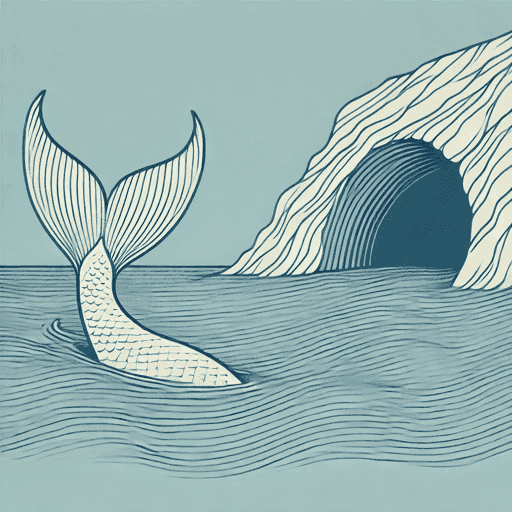
In common usage, an archetype generally describes something that is the pattern, model, original, or prototype for another. In the psychology approach based on the theories of Carl Jung, an archetype is a symbol shared across a collective or cultural consciousness and carries the same meanings and associations. Given its prevalence in the mythologies and legends of ancient peoples around the globe, the image of the half-human, half-fish figure is an archetype that, in most usages, combines beauty, provision, allure, and danger.
The water-women called “mermaids” in English and “merrows” in Irish lore are figures who commonly represent both the beauty and mystery and the potentially destructive qualities of the sea. The most frequent version of the myth portrays the mermaid as attempting to live a human life for a time but eventually abandoning her human lover to return to the sea, leaving him and her children heartbroken. However, “The Little Mermaid,” as told by Hans Christian Andersen, reframes this narrative to show the mermaid heartbroken by the loss of her human beloved.
Capturing a similar element of danger and allure, sirens in the collective unconscious of Western European literature are, due to the cultural impact of The Odyssey, a metaphor for specifically female allure, particularly when that allure has destructive repercussions for the man who falls into temptation. Both sirens and mermaids are archetypes of seductive but ultimately unreliable women who bring sorrow or destruction to men.
Anagnorisis
Anagnorisis is a literary device introduced in discussions of classical tragedy, defined by Aristotle in Poetics as the moment when a protagonist realizes either their own or someone else’s true identity and, by this, perceives the current conflict in a new and deeper way. This moment of realization typically leads to the resolution of the conflict. In a common example, in the play Oedipus Rex by Sophocles, the moment Oedipus realizes he has killed his father and unknowingly married his mother is the realization that leads to his downfall.
The outcome needn’t always be tragic; in stories of transformation, the protagonist’s discovery of their true nature or hidden strength frequently resolves the conflict in positive ways. In The Sirens, the moment of anagnorisis happens for all three of the female characters when they finally discover their true abilities and what that means. This discovery that their natural element is the sea describes the painful skin condition that has made each of them feel different throughout their lives, but for each woman, entering the sea and taking on these characteristics represents the achievement of self-acknowledgment and self-actualization. They understand the extent of their abilities as well as the place where they most belong.

Unlock all 60 pages of this Study Guide
Get in-depth, chapter-by-chapter summaries and analysis from our literary experts.
- Grasp challenging concepts with clear, comprehensive explanations
- Revisit key plot points and ideas without rereading the book
- Share impressive insights in classes and book clubs