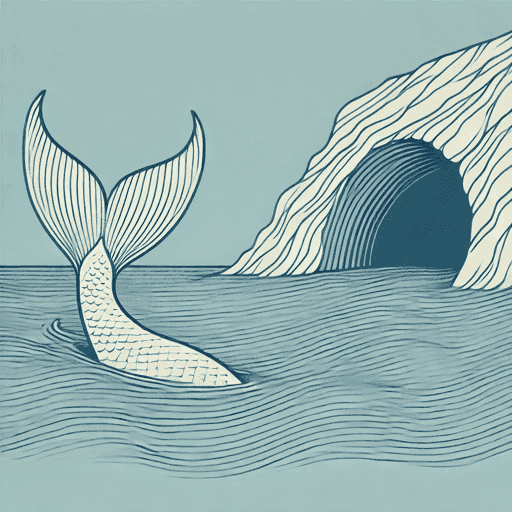
The Sirens
60 pages • 2-hour read
Emilia HartThe Sirens
A modern alternative to SparkNotes and CliffsNotes, SuperSummary offers high-quality Study Guides with detailed chapter summaries and analysis of major themes, characters, and more.
Part 3, Chapters 33-40Chapter Summaries & Analyses
Content Warning: This section of the guide contains discussion of sexual assault, physical abuse, and death.
Part 3, Chapter 33 Summary: “Jess”
19 September 1999
Jess is on a bus to Comber Bay. She’s been dreaming of the cave where she was found and thinks, “The sea was in her veins, calling loud as a song” (236). She lets Max believe her child is Hennessey’s. Cameron left the school, and Jess thinks he is repulsed by her now. Max is the one who wants to take care of her.
At Cliff House, her labor begins. Jess hears women calling to her, singing a song she knows. She makes her way to the cave. Her fingers and toes turn webbed, and the skin of her neck feels different. She births the child, then hears the sound of a motor and sees her father in a boat.
Later, Jess awakens in the hospital. She tells her mother that the child is named Lucy. A woman comes from the child welfare office and tells Jess that because she has endangered her child, Lucy will be put in emergency foster care. Her mother suggests that they, the grandparents, register as carers.
Part 3, Chapter 34 Summary: “Mary”
Mary is thirsty and feels a new, strange pain in her body. One of the women describes factories in the colonies where men come to pick out wives or servants. Mary knows not all men are like Byrne—her father is not. She sees that Eliza has developed gills, but Mary still refuses to remember what their mother told them.
Part 3, Chapter 35 Summary: “Jess”
Monday, 11 February 2019
Jess wakes in her bed in Cliff House, which she bought six months ago. She hasn’t been able to afford to fix it up. She decided to paint the women “[a]s if to let them know that she was there. That she was ready. It would be the opposite of an exorcism. A summoning” (250). Melody befriends her, and Jess is happy to have someone to talk to. She remembers discussing how her mother was hesitant, when Lucy turned 18, to tell her the truth, as they’d agreed when her parents first took custody. Jess realizes she just wants Lucy to be happy, but not telling her made Jess uncomfortable and hurt her feelings.
She gets a call from Cameron, whom she still sleeps with occasionally. He is in trouble and coming to see her. Jess reads the article about the allegations of assault. She always told herself she was old enough for what they did, but she knows now that she wasn’t.
She remembers that she wanted to interact with Lucy as a baby but was afraid she’d hurt her, so she let her mother take over. She enjoyed their bond, though, and remembers when Lucy gave her a snakeskin she’d found. Lucy asked Jess if she, Lucy, might grow a new skin, too. Jess finds the snakeskin and paints it into the canvas. Finally, she feels like she’s captured the two women.
Part 3, Chapter 36 Summary: “Mary”
The women are thirsty, and Bridie suggests they open a barrel of rum. The women work together to break open a barrel, and then share the liquid. Mary thinks that “the long, dark weeks had smoothed away the roughness between them, like water carving rock” (262). She dreams of giving birth and wonders if, once they reach New South Wales, she will have a chance to have a child. Wright discovers the empty barrel and reports them. Aoife claims she was the one responsible.
Part 3, Chapter 37 Summary: “Jess”
Tuesday, 12 February 2019
Jess wakes when Cameron knocks on the door. She doesn’t want to see him. He says his wife kicked him out and the allegations aren’t true, just “[t]eenage hysterics.” He tells Jess what they had was different. After his father’s abuse, Cameron says, Jess made him feel bigger. He pleads with Jess not to believe he took advantage of her. Jess realizes, “All this time, she had thought he believed she was special” (267). She forms a plan.
Part 3, Chapter 38 Summary: “Mary”
Mary and the others are forced to watch as Aoife is whipped in punishment. Below deck, Bridie, Sarah, and Mary tend to Aoife as she lies dying. Aoife tells them she was sentenced for killing her husband, who abused her. She took the blame because she wants Bridie to have a chance to live.
Part 3, Chapter 39 Summary: “Jess”
Tuesday, 12 February 2019
Jess feels revulsion when she looks at Cameron now. She doesn’t want to help him, but she tells him she can hide him for a while. They drive his car to the beach, then return to Cliff House. Jess asks Melody to look in on her cat. As they climb down the stairs in the cliff, Cameron drops his wedding ring. When they reach the cave, Jess remembers giving birth there. The tide whispers to her “[l]ike a mother’s lullaby” (278). She disposes of Cameron’s phone in the water and tells him they have to wait.
Part 3, Chapter 40 Summary: “Mary”
Mary wakes to Eliza singing a lament and realizes Aoife is dead. As best they can, the women wash her body. Mary wonders who will take care of her Da when it is his time. The women are not allowed to witness the burial, so they say Catholic prayers for Aoife. Mary wonders what is going to happen to her and Eliza.
Part 3, Chapters 33-40 Analysis
In these chapters, Lucy’s narrative is put on hold and Jess and Mary have interwoven storylines, bringing to light the parallels in their narratives and further emphasizing the ways all three of the female protagonists are connected, highlighting The Pull of Familial Relationships. The process of physical transformation continues for both Jess and Mary, but the nature of it is confirmed and somewhat explained by Jess’s experience in the opening chapter of Part 3, which flashes back to Jess in the 1999 timeline. This time, however, her experience is not written from the first-person perspective and conveyed through the diary but instead told from a close third-person point of view, as are the other chapters with Mary and Lucy. With this strategy, Hart gives immediacy to the dramatic action, unfiltered by the device of a frame story, and serves as a stylistic means of linking their individual narratives.
In that same chapter, young Jess is the first to discover what really happens when water touches her skin: Her human flesh peels away to reveal scales beneath. She now understands her compulsion to be near water, as it brings out what feels like her truer and more beautiful self, developing the theme of Discovering and Expressing Oneself. This compulsion is heightened by her wish to give birth near her own birthplace, as her dreams of the sea cave have made her believe this is a nurturing and protective place for her. With Jess’s realization, Hart again aligns the novel with The Odyssey; as the wish to return home drives Odysseus through all his adventures, so Jess’s choice resonates with that same pull toward her origins.
In returning to Cliff House and following the sound of singing to the cave below—her own version of being lured by the sirens—Jess is participating in the ritual that Mary dreams of when she drinks the rum. She is also replicating the experience of the woman giving birth in the Prologue, although Hart implies that the woman in the Prologue is not Jess. The imagery surrounding the sea, and especially the cave, is no longer threatening but inviting, soothing, and maternal. The cave is a place that shelters women, and women finding these safe spaces is another powerful theme of this section. Jess chose to buy Cliff House partly from a wish to return to her roots but also because she is searching for a place where she feels safe.
The theme of Female Connections as Protective Influence strengthens through Mary’s changing perception of the community that the convict women of the Naiad have formed during their long journey. They no longer taunt or quarrel with one another. Mary’s song served to unite them, defying the torturous conditions of their imprisonment in the creation of beauty. Next, they work together to follow Bridie’s suggestion that, since they are being given barely any food or water, they can drink the captain’s rum. Finally, when the captain’s punishment leads to Aoife’s death, the women work together to mourn her with the prayers and rituals of their own Irish culture, not the Protestant traditions enforced on them by the English. Through their collaboration and support of each other, the women find true community, safety, and even agency. In the present, seeking protection in female company, specifically Jess’s, is the reason Lucy comes to Cliff House, and while there, Melody’s befriending both Jess and Lucy also speaks to the power of female community and connection.
Aoife’s confession and her death are shocking to Mary not only because she is not accustomed to physical violence, but also because torturing Aoife seems excessively cruel to her. Twice, at the hands of the law, Aoife has been punished for trying to protect herself. She murdered the husband who physically abused her to keep him from killing her and was sentenced to transportation to New South Wales because of it. This parallels the cruelty of the sentence against Mary and Eliza; they are being punished because Eliza protected Mary from being assaulted by Byrne. The women drank the rum to try to stay alive; the captain denied them sufficient rations of food and water. Aoife sacrifices herself to protect the rest of them, particularly Bridie, whom she previously derided. The novel makes clear that building a sense of community and doing what they can to protect one another are the only recourse these women have against the more powerful and destructive men who have no interest in their lives or well-being.

Unlock all 60 pages of this Study Guide
Get in-depth, chapter-by-chapter summaries and analysis from our literary experts.
- Grasp challenging concepts with clear, comprehensive explanations
- Revisit key plot points and ideas without rereading the book
- Share impressive insights in classes and book clubs