The Terror
75 pages • 2-hour read
Dan SimmonsThe Terror
A modern alternative to SparkNotes and CliffsNotes, SuperSummary offers high-quality Study Guides with detailed chapter summaries and analysis of major themes, characters, and more.
Chapters 1-11Chapter Summaries & Analyses
Content Warning: This section of the guide includes discussion of racism, gender discrimination, graphic violence, sexual content, illness, and death.
Chapter 1 Summary: “Crozier”
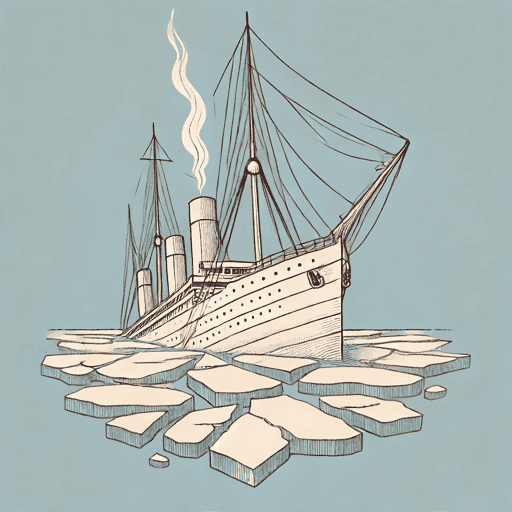
In October 1847, Captain Francis Crozier is aboard HMS Terror, which is locked in the thick ice of the Arctic near its sister ship, Erebus. He’s still frustrated by the rejection of Sophia Cracroft and his alienation among his English peers. Though an experienced and capable leader, he feels undervalued and resents being assigned to the expedition under Sir John Franklin, whom he considers an inferior seaman.
As Crozier inspects the watch, he speaks with Cornelius Hickey, a caulker’s mate, who reports hearing what might have been a scream from Erebus. Crozier then meets with Lieutenant Irving, who stayed after his watch to remain with the non-verbal Indigenous woman the men call “Lady Silence.” The crew fears her, and many of them believe she has supernatural powers. Crozier sternly orders Irving below, then warns Silence to seek shelter from the cold.
Crozier’s inspection is interrupted when Private Wilkes brings news that a sailor, Seaman Manson, refuses to carry coal past the Dead Room, claiming he hears ghosts inside. Crozier knows the noises likely come from rats feeding on corpses in the hold, but he also suspects that something else is trying to break into the ship from beneath the ice.
Chapter 2 Summary: “Franklin”
In May 1845, Sir John Franklin is in London four days before his expedition departs for the Arctic. Stricken with influenza, Franklin lies feverish in his home, recalling past failures, especially the 1819 overland journey through northern Canada, during which he and his men resorted to eating their leather boots. He continues to spiral through memories of botched expeditions, loss of life, and disciplinary failures. At Fort Enterprise, there was nearly a duel between two young officers over an Indigenous girl nicknamed Greenstockings, the memory of whom Franklin still feels a mix of attraction and revulsion toward.
As Franklin’s wife, Lady Jane, sews a ceremonial Union Jack to be raised upon the successful completion of the voyage to find the Northwest Passage, he relives a reception to honor his upcoming expedition. Sir John Ross questioned him about his preparedness, especially the lack of a rescue plan or food caches. Though Franklin maintained a proud front, he felt humiliated.
Franklin awakens from his fever dreams to find that Lady Jane draped the Union Jack over him to keep him warm. He scolds her, as the flag is only used to cover the dead.
Chapter 3 Summary: “Crozier”
In October 1847, Crozier descends through Terror’s cramped interior. He surveys the officers’ quarters and the crew’s living space. He notes the modifications made by Silence, who now sleeps in a small area near the galley, which is warm and isolated from the men.
Crozier descends further into the orlop deck and then the hold, which is cluttered with provisions and plagued by rats. He finds Manson standing where he had refused earlier to continue carrying coal. Crozier warns him that disobedience may earn him a night alone with the dead.
Crozier checks in with the ship’s engineer, James Thompson, in the boiler room. Thompson confirms that Erebus’s engine is beyond repair and nearly out of coal. Terror has enough coal left for six months of limited heating, or five days of steaming if the ship breaks free next summer. Crozier concludes that the ships may be doomed, but still hopes to save the men by retreating the way they came.
Crozier is then joined by the ship’s carpenter, Mr. Honey, and they open the Dead Room. Inside, they find a mass of rats swarming over the corpses. When Crozier inspects the inner hull, he finds that the ship’s reinforced layers of wood have been smashed inward. Within the destruction are massive claw marks streaked with blood, and a tunnel bored through the ice.
Chapter 4 Summary: “Goodsir”
In April 1845, a month before their departure, Dr. Harry D. S. Goodsir, the assistant surgeon aboard HMS Erebus, begins a personal diary separate from his official log. In it, he reflects on his dual hopes of contributing to the expedition’s medical needs while also pursuing his passion for natural history, particularly a fascination with polar wildlife.
The expedition departs from England on May 19th, 1845, in a celebration with thousands of spectators, speeches, and bands. Lady Jane bids Franklin farewell alongside his daughter and niece. Spirits are high among the men as they begin the voyage, with the ships towed by steamships and accompanied by a transport vessel, Baretto Junior, which carries additional provisions.
The North Atlantic crossing proves rough and miserable, especially for Goodsir, who suffers severe seasickness. Upon reaching Greenland, the expedition stops at Disko Bay to resupply. There, the crew celebrates with fresh meat and grog. Four men are deemed unfit and dismissed. Despite the cold, morale remains strong.
On July 26th, the ships meet two whalers, Prince of Wales and Enterprise, and moor at a massive iceberg. The officers and scientists set up an observatory on the summit to take measurements while sailors hunt arctic terns to preserve for food. As the expedition prepares to move further into the ice and the whalers drift away, the last outside contact for Terror and Erebus disappears.
Chapter 5 Summary: “Crozier”
On November 9th, 1847, Crozier is awoken from a dream of Sophia by the sound of a gunshot. He quickly dresses and is informed by his steward, Jopson, that there’s trouble on deck. Joining several officers, Crozier heads onto the deck. They find Private Heather with part of his skull crushed, though still breathing. His musket remains unfired. The other man on watch, Seaman Strong, is missing.
Crozier, along with a few men, descends onto the ice to follow a faint blood trail that leads toward a towering pressure ridge. Suspecting the creature that was attacking the ship from beneath has taken Strong, Crozier divides the party to flank the trail. He instructs Lieutenant Hodgson and a few others to move in parallel with him.
At the base of the icy ridge, Crozier and a young seaman named Evans find more blood leading upward. Crozier climbs, hoping to spot Strong from the summit, but sees no trace of the missing man. He descends again, only to find that Evans has vanished and his rifle lies abandoned in the snow. Crozier fires it into the air to signal the others. When distant lanterns respond, a roar comes from just 20 feet away. Crozier, now armed with his pistol, challenges the creature to come for him, but there is no response.
Chapter 6 Summary: “Goodsir”
Dr. Goodsir chronicles the winter of 1845-1846 at Beechey Island, where Erebus and Terror are icebound. John Torrington, a stoker from Terror, dies after suffering from tuberculosis exacerbated by pneumonia. After his death, the surgeons from Terror prepare the body with care, dressing and securing it in a coffin crafted from ship’s mahogany. Two days later, Goodsir joins a small group, including Franklin and officers from both ships, to Beechey Island for Torrington’s burial. The coffin is pulled on a sledge and buried near makeshift storage buildings on the shore. A headstone is erected, and Franklin conducts the service.
Tragedy strikes again when John Hartnell, a seaman from Erebus, collapses and dies during dinner. Unlike Torrington’s slow decline, Hartnell’s death is abrupt, prompting a postmortem examination by Goodsir and Chief Surgeon Stanley. The autopsy reveals signs of tuberculosis and pneumonia, and liver damage from heavy drinking, but no evidence of scurvy or contagious disease. Nevertheless, the crew is disturbed, especially Hartnell’s brother Thomas, who has to be restrained during the procedure.
Hartnell is subsequently buried next to Torrington. During the burial, the marines fire their muskets to scare off three polar bears that approach from the ice. Franklin delivers another, shorter eulogy.
Chapter 7 Summary: “Franklin”
On September 3rd, 1846, despite the deaths of three crewmen from pneumonia and tuberculosis that winter, the men’s health has improved after a dietary change emphasizing tinned foods over salted meat. Once the ice broke in late May, Erebus and Terror resumed sailing south and west. The summer brought open water and a renewed sense of optimism. Franklin obeyed his orders to pursue the Southern Approach, rather than attempt the alternative path toward the Open Polar Sea.
As the ships head southwest toward King William Land, they find increasingly dangerous conditions. Aboard Erebus, Franklin meets with key officers, engineers, surgeons, and ice masters to decide the expedition’s next move. Ice Masters Reid and Blanky warn of worsening pack ice coming from the northwest. Crozier advocates for retreating and sailing around the eastern side of King William Land, which he suspects may be an island and could provide shelter. He also proposes abandoning Erebus and transferring all men and supplies to Terror. Franklin, however, rejects the idea and decides to press forward into the worsening ice.
By September 15th, the expedition is trapped in the ice again. Franklin orders the fires in both ships’ boilers to be drawn down, keeping only minimal steam to heat the lower decks.
Chapter 8 Summary: “Crozier”
On November 11th, 1847, Crozier continues to lead search efforts for Evans and Strong, rotating parties in four-hour shifts. After 12 hours overseeing the teams, Crozier returns to Terror and checks on the ship’s conditions. The crew is weary, suffering from cold and malnutrition. He visits the sick bay, where several men are suffering from scurvy or pneumonia. Heather remains alive but brain-damaged, and Surgeon Peddie admits he likely won’t live long. Peddie also warns Crozier that the continued search efforts risk further injuries and deaths, but Crozier insists on continuing. He also finds that Silence is missing, and Irving reports that no one has seen her since the last attack.
Crozier decides to visit Erebus to consult with Commander Fitzjames. Though traveling alone between the ships is dangerous and against his own orders, Crozier refuses company as he sets off across the ice. He hears movement and prepares to confront the creature, but Silence emerges from the darkness instead. They walk toward Erebus together, but before reaching the ship, she disappears back into the ice field. When Crozier hails the deck, a panicked crewman fires a shotgun, nearly hitting him. Furious, Crozier berates them and prepares to board Erebus.
Chapter 9 Summary: “Franklin”
In May 1847, Franklin remains outwardly calm despite the reality that the ships remain trapped in ice with no signs of thaw. Though the crew is never formally informed, all understand they are now locked in for a second consecutive winter. Franklin turns to his faith for strength, as well as his belief that Lady Jane is already organizing a rescue in Britain, though he dreads the shame of being “saved.”
Franklin prepares five sledge parties to scout in all directions. The most important of these, led by Lieutenant Graham Gore and Second Mate Charles Des Voeux, is sent southeast toward King William Land. Franklin dictates a formal update for them to leave in a cairn left years earlier by Sir James Ross, but mistakenly uses the wrong dates for their winter at Beechey Island. Goodsir, determined to study local wildlife, persuades Franklin to let him join the party.
The other parties return one by one over the following week, each bringing news that there is no open water in any direction, no game animals, the land routes are impassable, and several men are suffering from frostbite and snow blindness. Franklin continues to cling to the hope that Gore and the southeast might still offer salvation. On June 3rd, the lookout finally spots Gore’s team returning.
Chapter 10 Summary: “Goodsir”
As Gore’s team heads out in May and June 1847, Goodsir insists on pulling the sledge alongside the sailors, but he quickly learns he’s physically outmatched and hinders the group’s progress instead. After an hour of struggling, he reluctantly steps aside. The ice itself is uneven and treacherous. The men pour hot water over the runners to keep the sledge from freezing in place and work in shifts.
Their first night camping on the ice is harsh for Goodsir. He opts to sleep outside with the men rather than in the cramped tent, but finds no rest due to the light never entirely fading and the intense cold.
Around 2 AM, Goodsir awakens to gunfire. Two polar bears were circling the camp, and the sentries fired to drive them off. The camp settles again. By morning, Des Voeux reminds the men that they still have over 22 miles before they reach land.
Chapter 11 Summary: “Crozier”
On November 9th, 1847, by the time Crozier reaches Erebus, he’s frozen and exhausted. He accepts brandy as he settles in to speak to Fitzjames in the Common Room, which was formerly Franklin’s private quarters.
Crozier reports his lost men. Fitzjames tells him that his men have also been on edge, firing at shadows in the ice, and confesses that the sailors have started calling the unknown predator “The Terror.” They speculate on the creature’s nature and the growing belief among the crew that some kind of monster is hunting them. Crozier is particularly bitter about Silence, the Inuit woman aboard Terror, whom the men view as a Jonah. Though he defends her right to safety, he’s conflicted and blames himself for Evans’s death.
Fitzjames then asks Crozier about his earlier Arctic expeditions, particularly the winter of 1824 when Crozier dressed in costume for a shipboard masquerade, and they laugh at the absurd “Open Polar Sea” theories that sent them north in the first place.
They’re interrupted by Irving, who reports that remains have been found. A single mutilated corpse, propped against the stern rail of Terror, is identified as a grotesque fusion of Strong’s upper half and Evans’s lower. The guards on duty hadn’t noticed who or what had placed it there.
Chapters 1-11 Analysis
The Terror blends genres, crossing historical fiction with horror. HMS Erebus and HMS Terror were real ships trapped in the ice near King William Island between 1845 and 1848. Franklin died in June 1847, leaving Crozier in command. Details such as the removal of topmasts, the use of canvas shelters, frostbite, and the dwindling daylight are historically accurate. Even minor officers, such as Irving and Hodgson, were real men on the expedition.
However, Simmons layers the supernatural over the historical to create a gothic environment. The monster chasing the men of the expedition across the ice calls back to the frame narrative of Mary Shelley’s Frankenstein (1818). The ships themselves build on the conventions of the genre in terms of space: As Crozier moves from the lower deck into the hold, the downward movement mirrors the descent into crypts, catacombs, and dungeons where buried horrors emerge. The final discovery of claw marks in the hull completes the pattern—the outside horror has penetrated the innermost sanctum.
The destruction to the reinforced hull also visualizes The Clash Between Human Ambition and Nature. The ship represents imperial confidence, and the fact that something has clawed through 10 inches of layered wood dramatizes that confidence’s fragility. Provisions, too, wobble. The surgeons recommend tinned soups over salted meats after early deaths, and fresh meat when possible. Later, Surgeon Stanley tries to brief officers about spoiled foods and is urged to wait. The news, like much else, is deferred. The dwindling, spoiled food supplies reinforce the narrative tension by suggesting that the men are far more ill-prepared for the rigors of the voyage than they originally assumed.
The novel introduces the theme of Colonialism as Horror by presenting the expedition’s overconfidence as just as much, if not more, a source of death as the literal monster stalking them. The apparatus of exploration works until it doesn’t, leaving the men stranded due to their earlier determination to push on even after the dangers have become increasingly apparent. The novel also critiques colonialist attitudes by depicting the fearful and belittling attitudes many of the white crew members have towards Silence. In gothic tradition, outsiders often embody cultural anxieties. As a disabled, non-European woman, Silence occupies that position from multiple angles. Since she first appeared when the Tuunbaq (i.e., the creature) killings began, the crew members place their fears onto her. As Fitzjames says, “The men think she is a Jonah” (155), referencing the Biblical figure who was thrown overboard during a storm due to being the perceived cause of bad luck.
For her own part, Silence neither explains nor pleads, and as Crozier says, “[he] realizes that he has never seen an expression on her face, other than perhaps a mildly inquisitive look” (124). She’s enigmatic and, as a result, the expedition often perceives her as a symbol rather than a person. The cost of their inability to understand her means the Tuunbaq remains another far more dangerous unknown, despite the presence of one person nearby who knows its true nature. The relationship between her and the men also connects to the way historical Inuit testimony was usually ignored or mistrusted by British authorities.
Simmons also plays with the story’s timeline and use of perspective in the opening chapters to build suspense. The cairn note that Gore deposits with the breezy “All well” (132) is situated in a sequence of chapters where almost nothing is well. The wrong winter date given by Franklin in the same message isn’t a mere slip; it’s an emblem of temporal dislocation, of official language sliding a few inches off reality. The out-of-sequence structure, jumping between the early months of the expedition in 1845 and 1846, makes causality feel unreliable, as the expedition’s “before” is already haunted by its “after.” The brutal deaths at the hands of the Tuunbaq are interwoven with the mundane burials on Beechey Island. At the same time, Franklin’s calm spring of 1847 arrives after the reader is already shown Crozier’s hunt for missing men in a sunless November of the same year. It reinforces how stuck in place the crew of the ships feels.
Furthermore, the novel itself begins in medias res. There is no exposition explaining the Franklin Expedition or its objectives; instead, the reader is thrust onto the deck of HMS Terror. The choice mirrors the disorientation of the sailors: They are trapped in the middle of an endless, frozen landscape, without clarity about their fate. The out-of-order telling refuses to grant the illusion of steady, linear progress and instead emphasizes the expedition’s lateral motion.

Unlock all 75 pages of this Study Guide
Get in-depth, chapter-by-chapter summaries and analysis from our literary experts.
- Grasp challenging concepts with clear, comprehensive explanations
- Revisit key plot points and ideas without rereading the book
- Share impressive insights in classes and book clubs