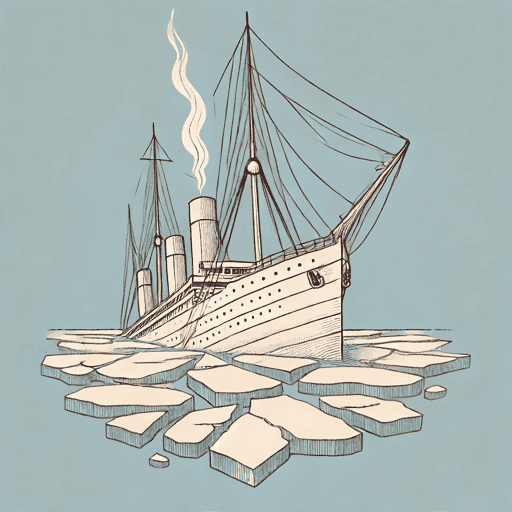
The Terror
75 pages • 2-hour read
Dan SimmonsThe Terror
A modern alternative to SparkNotes and CliffsNotes, SuperSummary offers high-quality Study Guides with detailed chapter summaries and analysis of major themes, characters, and more.
Chapters 12-23Chapter Summaries & Analyses
Content Warning: This section of the guide includes discussion of racism, gender discrimination, antigay bias, ableism, suicidal ideation, animal cruelty and death, substance use, substance dependency, graphic violence, cursing, illness, and death.
Chapter 12 Summary: “Goodsir”
From May 24th to June 3rd, 1847, Gore’s party, including Dr. Goodsir, makes the trek across the ice to King William Land. Though pools of drinkable water are found near the island, the approach is blocked by towering icebergs. To lighten their load for the crossing, the men cache much of their supplies, including robes and food, on the sea ice.
They locate Sir James Ross’s Victory Point cairn on May 28th and leave the message there. Exhausted, they return to camp, only to discover that most of their preserved rations are spoiled, leaving them little to eat except salt pork and canned soup. Soon after, a violent and unseasonal lightning storm erupts over the island, and the men take shelter.
After the storm, they find that their supplies were destroyed by a lightning strike, along with animal tracks that are too large for a polar bear. They then realize that one of the men, Tom Hartnell, is missing. Rushing back to the tent, they find him unconscious under the collapsed canvas.
With their food spoiled, their shelter damaged, and Hartnell injured, Gore decides to continue southward with one man, Best, to plant a second Admiralty message and search for signs of open water, while Des Voeux will take the others back to the ice cache, bringing Hartnell with them. Goodsir volunteers to accompany Gore, but Gore declines.
Chapter 13 Summary: “Franklin”
On June 3rd, 1847, Franklin and his officers watch the return of the southeast sledge party. Of the eight figures approaching, only a few are recognizable. Des Voeux appears exhausted, and an injured Hartnell stumbles along. Dr. Goodsir tends to a wounded Inuit man on the sledge, while beneath him lies the corpse of Gore. A second Inuit, a young woman, follows them. Franklin is aghast at them bringing the Inuit aboard the ship, but Goodsir insists on treating the man in the sick bay.
Franklin orders Des Voeux to help prepare Gore for burial and report afterward, then gathers with Crozier and Fitzjames to hear from Best. Best recounts the party’s misfortunes and how they felt they were being followed by something that made sounds like a bear, though they never saw the creature. When they reunited with Des Voeux’s group, Goodsir was attempting to save a wounded Inuit elder whom the crew had shot after mistaking him for a bear.
Shortly afterward, Gore was attacked by a massive white creature that rose from the ice. No one dared shoot, afraid of hitting Gore. When the fog lifted, they found Gore’s mangled body and no evidence of the attacker. Best finishes his report, then collapses from exhaustion.
Chapter 14 Summary: “Goodsir”
Aboard Erebus, on June 4th, 1847, Goodsir and Surgeon Stanley attempt to save the Inuit man, though they know it’s futile. Goodsir notes the man wears a bear-shaped amulet. Meanwhile, the woman who accompanied him is examined by another surgeon, Dr. McDonald. It’s discovered that her tongue was removed in childhood, chewed off by something, rendering her permanently non-verbal and earning her the nickname “Lady Silence.” Franklin visits the sick bay and is disturbed upon seeing the girl in a state of undress during examination.
When questioned later, Goodsir explains to the ship’s officers what he witnessed during Gore’s death. Though he admits to seeing a large white shape in the fog, he agrees the wounds could be consistent with those inflicted by a polar bear.
Later that night, the Inuit man dies. The crew performs a hasty burial, performed by dropping the wrapped corpse through a hole in the ice used for fire safety on Franklin’s orders.
Crozier and Irving arrive to escort Silence back to Terror, and the former instructs that she be protected and kept out of sight. When Goodsir asks why she can’t be returned to her people, Crozier explains that there are no Inuit settlements nearby.
Chapter 15 Summary: “Franklin”
On June 4th, the day of Gore’s funeral, Franklin is still shaken by seeing Silence naked. He’s convinced that she and Greenstockings are the same person, and has come to taunt him with temptation. He distracts himself with the burial, which is performed with full military honors.
In the days following, the area is hit with violent thunderstorms, accompanied by sightings of a creature prowling near the ships. Alarmed, Franklin gathers both ship crews for a compulsory Sunday service on the ice, delivering a fervent sermon filled with biblical allusions to Jonah and Leviathan, promising financial rewards to the crew upon killing the creature. The speech bolsters morale and gets the men to form hunting parties, resulting in accidental shootings but no sign of the monster. Marines then propose constructing a hidden hunting blind out of canvas and iron rods, and baiting it with a butchered bear cub.
On June 11th, Franklin inspects the hunting blind and sits in it with the Marines. The monster then emerges from the hole they cut for Gore’s burial and attacks, killing several men. Franklin is grabbed by the creature and thrown into the hole. In the icy waters, Franklin is disoriented, freezing, and fighting for air. As he struggles toward the dim light of the hole, the creature attacks again, crushing his skull in its jaws and killing him instantly.
Chapter 16 Summary: “Crozier”
On November 10th, 1847, Crozier sits in his cabin aboard the Terror, staring at his whiskey bottle and loaded pistol. The alcohol supply on the ships is dwindling. He considers dying by suicide when it runs out rather than face the withdrawal symptoms from his alcohol dependency.
Crozier recalls the attack on the hunting blind five months prior that resulted in Franklin’s death. He’s certain the predator isn’t just an animal, but something malevolent. As he drinks, Crozier reminisces about his time in Tasmania in 1840 and 1843, when he fell in love with Sophia Cracroft, Franklin’s niece. Despite Crozier’s feelings for her, Sophia rejected his marriage proposal.
Returning to the present, Crozier decides the crew must resume hauling emergency supplies to nearby King William Land despite the creature stalking them and the brutal weather conditions. He decides to lead these sledge trips personally. Exhausted and drunk, Crozier sets the pistol aside.
Chapter 17 Summary: “Irving”
On November 13th, Irving searches for Silence, who has been missing for several days. Though no official order has been given, Irving feels responsible for her welfare and is also in love with her. A blizzard has forced work crews indoors, and the crew is on edge due to worsening conditions, dwindling supplies, and fear of the creature.
As he searches in the deepest levels of the ship, Irving finds two men, Manson and Hickey, in a way that implies that the two were just having sex. Irving considers reporting this, but Hickey threatens him with blackmail into staying quiet for the moment.
Irving finds Silence in the ship’s cable locker. She built a small, insulated den among the ropes, where she’s sitting, slicing and eating raw meat, though none has been available on the ship for months. Irving flees, thinking that the meat may have come from the missing parts of Strong and Evans’ remains.
Chapter 18 Summary: “Goodsir”
On November 20th, Dr. Goodsir writes that the crew is facing imminent starvation due to a massive failure in their supply of canned goods, which were supposed to sustain them for up to seven years. Goodsir, McDonald, Stanley, and Peddie, the four expedition surgeons, conducted a full inventory of the remaining rations and discovered that many of the cans were already bloated, ruptured, or otherwise tainted. This confirms earlier suspicions raised by McDonald. The blame is placed on the provisioning contractor, Mr. Stephan Goldner, who secured the Admiralty contract with a low bid and a fast turnaround time.
Crozier reacts with disbelief and fury during the secret meeting when he hears these findings. Fitzjames, however, had long suspected that Goldner’s supplies were untrustworthy. The surgeons explain that improper soldering allowed air and bacteria to contaminate the food, and that the cold of the Arctic has not been enough to prevent decay. Attempts to recook the food or heat it with spirit stoves proved ineffective due to fuel shortages. Crozier, though reluctant to act immediately, agrees to separate the spoiled tins from those that appear safe. He announces plans to reduce rations further after Christmas.
After the meeting, as Goodsir and Stanley watch the others return to Terror, Stanley whispers that it might be preferable if the creature killed them, rather than if they died by starvation or scurvy.
Chapter 19 Summary: “Crozier”
In early December 1847, the creature kills the bosun, Thomas Terry, on Erebus. The crew is horrified when only his severed head is returned to the ship with no visible bite marks or claw wounds. It causes a wave of panic and superstition among the men. Although most of them grumbled about Franklin’s compulsory religious services, they now ask for a joint Sunday service for both ships. Hickey delivers the request to Captain Crozier, who distrusts the caulker’s mate and suspects him of making trouble. However, he still agrees to make arrangements with Fitzjames.
On Sunday, December 5th, both crews gather on Erebus, with the lower deck converted into a temporary chapel. Fitzjames delivers a sermon from the Book of Psalms, while Crozier surprises the men with a thunderous reading, not from the Bible, but from Thomas Hobbes’s Leviathan, which he presents in the cadence of scripture. Though many sailors are confused by the reading, they accept it.
Following the service, the crews enjoy hot food, grog, and brief camaraderie. Crozier leads his men back to Terror through the cold and snow, half-expecting disaster to have struck in his absence. However, they find the ship and its skeleton crew safe.
Chapter 20 Summary: “Blanky”
On the evening of December 5th, a snowstorm blows in. Thomas Blanky, the Ice Master aboard Terror, is on duty overseeing the port watch, which includes Alexander Berry, John Handford, and David Leys. Leys, once sociable, is having mental health issues. He went catatonic for weeks before suddenly returning to himself, though still withdrawn. Superstition is also rampant among the crew, as some men wear polar bear parts as talismans. Others, led by Hickey, leave offerings to the creature, which they refer to as “the thing on the ice” (314), believing it to be a demon. Silence is now in hiding in the cable locker, where the men leave these “sacrifices.” Blanky, however, remains grounded.
Blanky also reflects on the worsening conditions on Erebus, as relayed to him by his counterpart James Reid. The stern is being crushed from below, and makeshift reinforcements provide only temporary protection. Blanky regrets helping guide the ships so far south and west from their original wintering location, feeling he may have used his skills in service of a fatal mistake.
At that moment, a shout rings out through the storm, followed by a shotgun blast.
Chapter 21 Summary: “Blanky”
Blanky and the watch respond to the gunfire and shouting out on the ice and find the creature has killed the sailor John Handford, and that only a bloody coat and twisted remains are left. Another crewman, Alexander Berry, is found alive but frozen, with one leg shattered. Blanky and the others carry him back to the ship for treatment. However, Blanky notices that the creature’s massive tracks appear and then vanish, as if it can choose when to be seen or not.
Inside Terror, Dr. Goodsir examines Berry’s injuries, while Blanky reports what he saw to Crozier. The captain tells Blanky to begin preparing traps and alarms around the ship. Blanky, who has come to believe the creature is smart enough to understand intent, knows the efforts may be futile. Still, he assigns the men to keep watch, reinforce weak points, and string up makeshift signal wires.
Chapter 22 Summary: “Irving”
Irving becomes obsessed with uncovering how Silence manages to come and go from Terror without being seen. On December 13th, he stakes out the cable locker to see if he can catch her leaving. After hours of freezing in the darkness, he discovers a hidden exit: A section of the ship’s hull near the bow that was loosened, creating a narrow passage out into the surrounding ice. Since the reinforced hull has been breached, it could mean Terror is no longer seaworthy. He strips off multiple layers of clothing to squeeze through the gap to follow Silence. He crawls through a tunnel and out onto the ice, following a faint trail westward into a field of ice boulders. There, he hears something that sounds like a surreal blend of bagpipes, flutes, and animal wails, which leads him deeper into the ice maze.
He finds Silence kneeling naked in a circle of ice with the creature. Its massive jaws are over her open mouth, and it uses her like an instrument to create the strange music through her throat. The creature does not harm the woman, but instead brings her fresh, raw meat. After the creature disappears, Silence dresses and collects the offerings. She notices Irving watching, but doesn’t confront him. When she leaves, Irving approaches the site and tastes the still-warm blood left behind.
Chapter 23 Summary: “Hickey”
Hickey plans to murder Irving, whom he views as a threat due to the Lieutenant knowing about what happened between him and Manson. Hickey plans for Manson to kill Irving during a work detail on the ice on December 18th, using the creature’s previous attacks as cover. However, Manson is unsettled by the idea of killing someone who’s done him no harm.
As the moment of the attack nears, their plan is interrupted by a new attack by the creature. Hickey aborts the assassination attempt as the crew rushes toward the commotion. There, several men report that Erebus First Mate Robert Orme Sergeant was killed and dragged off by the creature. Crozier arrives and organizes a retaliatory hunting party to find the creature and recover Sergeant’s body. However, they fail to locate either.
The failed assassination leaves Hickey frustrated, and Irving has become suspicious of him and Manson. As they return to the ship, Manson begins crying for Sergeant because, having died so far from the ship, Sergeant’s ghost won’t be able to find its way back.
Chapters 12-23 Analysis
These chapters follow up on what was building in the opening chapters as the Franklin Expedition begins its long descent into disaster. They, too, are set out of chronological order, though this is the last time Simmons decides to do so in the novel. Small mistakes made by the officers accumulate into cascading problems that make the catastrophe unavoidable, deepening the text’s exploration of The Clash Between Human Ambition and Nature.
The issue of the ships’ supplies comes to the forefront, once more showing how the expedition’s hubris and faith in their own preparations have proved misleading. Simmons draws on historical fact: The Franklin Expedition’s real canned goods were likely compromised by botulism and lead contamination. The food supply, meant to guarantee survival, becomes instead a slow poison that kills the crew. As Goodsir writes in his diary: “We do not have enough food to survive another Winter and Summer here in the ice […] We shall be running out of our last edible supplies sometime next spring. And should we all perish because of this, the Reason is Murder” (290). Due to selfish decision-making in England, the men are left to suffer. They cannot trust the food that keeps them alive, but they cannot stop eating it either. Simmons uses the food crisis as another example of how the unwavering Victorian faith in technology led to unanticipated disaster.
Running parallel to the threat of poisoned food is the new menace of the Tuunbaaq. Though it has already killed Franklin chronologically in the first chapter, it makes its first real appearance here with the attack on the hunting blind. The lead-up to the scene itself is another example of the men’s hubris, particularly Franklin’s. First, the idea of constructing a “country fair canvas booth” (225) on the ice highlights the absurdity of transplanting English practices of hunting and fairground display into the Arctic. The inadequacy of this idea reinforces the sense that Franklin and the crew are failing to adjust to the climate, conditions, and threats that surround them.
Second, Franklin’s enthusiastic approval of the plan demonstrates his misplaced confidence in military order, reinforcing the text’s emphasis on Colonialism as Horror. Despite his earlier sermon about Jonah and the Leviathan, Franklin is still approaching the Tuunbaq as a wild animal rather than a literal manifestation of the Arctic’s cruelty. Instead of being delivered from Leviathan, he’s swallowed by it, dragged into the sea, and crushed between its jaws. Franklin, who imagined himself as a prophet and commander, is revealed as prey. His death symbolizes not only the failure of one man but the collapse of the imperial mission itself and the beginning of the end for the expedition. Fear of the Tuunbaq makes the crew hesitant to work on the ice, and each new disappearance chips away at the officers’ claims of control.
While starvation and the monster stalk the crew physically, corruption and mutiny rot the expedition from within, introducing the theme of The Psychological Effects of Isolation. Crozier and Fitzjames, who step into positions of leadership, are themselves compromised. Hickey, hinted at as a source of concern in passing in the first chapters, steps into the role of antagonist by eroding discipline aboard the ships. He rationalizes his violence with the language of inevitability: “Irving would be just another corpse to deal with come the thaw” (378). The casualness of this thought shows how death itself becomes normalized as the ongoing hardships take their toll. As the novel moves out of its first act, Simmons makes it clear that the expedition failed not because of a single monster, but because of a convergence of natural, human, and supernatural forces.

Unlock all 75 pages of this Study Guide
Get in-depth, chapter-by-chapter summaries and analysis from our literary experts.
- Grasp challenging concepts with clear, comprehensive explanations
- Revisit key plot points and ideas without rereading the book
- Share impressive insights in classes and book clubs