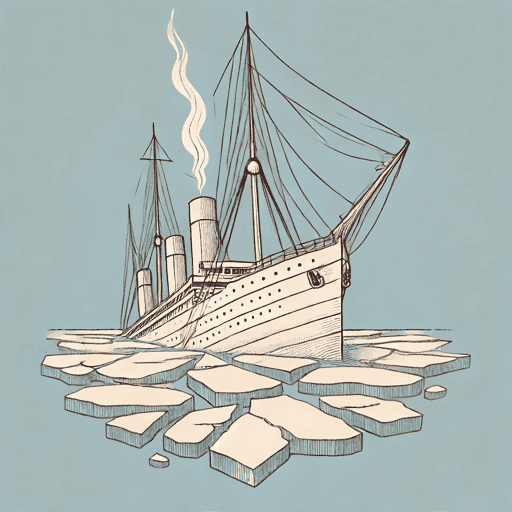
The Terror
75 pages • 2-hour read
Dan SimmonsThe Terror
A modern alternative to SparkNotes and CliffsNotes, SuperSummary offers high-quality Study Guides with detailed chapter summaries and analysis of major themes, characters, and more.
Chapters 24-31Chapter Summaries & Analyses
Content Warning: This section of the guide includes discussion of racism, religious discrimination, suicidal ideation, animal cruelty and death, substance use, substance dependency, graphic violence, illness, death, and physical abuse.
Chapter 24 Summary: “Crozier”
Crozier navigates the grim holiday season aboard Terror. When the weather clears after Boxing Day, preparations begin for the “Second Grand Venetian Carnivale” (380). Fitzjames defends the event to Crozier as necessary for morale. Despite Crozier’s concerns about discipline and resource conservation, he reluctantly allows the celebration.
On the evening of December 31st, Crozier goes with the rest of the crew to the Carnivale site. On the way, Irving reports that Silence is missing again. Despite having been told by Irving about seeing her with the creature, Crozier rationalizes that she’s getting the meat herself somehow.
The Carnivale is held in a constructed maze of seven massive sailcloth chambers built against an iceberg, each dyed a different color. Crozier is disturbed by the decadent atmosphere, and most of all by the final chamber. The ice was blackened, and at the far end sits Franklin’s grandfather clock with a bear head mounted above it. Crozier is furious, both at the grotesque imagery and at having not been informed that two bears were shot and prepared for the feast.
Crozier leaves and finds Fitzjames waiting near Erebus, who explains that the structure was inspired by an American story one of the stewards, Aylmore, remembered reading several years prior. Fitzjames invites Crozier to join him for one final bottle of whiskey in Franklin’s former cabin, and Crozier agrees.
Chapter 25 Summary: “Crozier”
As New Year’s Eve 1847 transitions into January 1st, 1848, Crozier and Fitzjames leave Erebus and walk back out onto the ice, both drunk. They head toward the makeshift banquet, where bear meat is being grilled and served to the costumed crew. Singing begins as the crew belts out “Rule, Britannia!” led by a crank-operated music machine.
The festivities turn grotesque when a theatrical procession enters with a headless, costumed effigy of Franklin and a towering bear-costume monster made by Hickey and Manson. Crozier is appalled but hesitates to intervene, realizing the event has already spiraled out of control.
When the procession enters the final, black tent, the creature erupts from the darkness. The men flee through the maze of tents, which begin to burn. Crozier drags Fitzjames and an unconscious George Chambers as he tries to shepherd survivors out of the labyrinth.
Outside, Marines mistakenly open fire on the fleeing men, believing the creature is among them. Crozier stops the shooting and takes command, organizing the panicked men around Erebus. He assigns Goodsir to begin preparing the great cabin on the ship as a hospital ward, ordering a count of the dead and injured.
Chapter 26 Summary: “Goodsir”
On January 4th, Goodsir reflects on the Carnivale disaster. He’s now the only surviving surgeon of the expedition. The others all died, as well as Lieutenant Fairholme and First Mate Hornby. 18 others were injured, with six wounded, including Blanky, who required a leg amputation. Crozier ordered public floggings aboard Erebus for the three men deemed most responsible: Aylmore, Hickey, and Manson. Aylmore screamed until he passed out, and Manson sobbed. Hickey, however, endured the lashes in silence. Goodsir attended to their injuries afterward.
As Goodsir splits time between both ships caring for the wounded, he documents increasing signs of scurvy among the men. Crozier, incapacitated by symptoms of alcohol withdrawal, retreats into his cabin, leaving Lieutenant Little in charge of Terror.
Chapter 27 Summary: “Crozier”
By January 11th, Crozier is delirious in his bunk aboard Terror. He revisits memories from his childhood of his grandmother, Memo Moira, who claimed he had the Second Sight.
As his fever intensifies, Crozier has visions of Lady Jane Franklin orchestrating efforts to find her lost husband and rescue missions being launched from England. He sees a swarm of future rescue ships gathering near Beechey Island and Cornwallis Island, trying in vain to find clues from the graves there, unaware that Franklin’s ships had long since sailed in the opposite direction. He then sees the spiritualist Fox sisters in New York, who stage séances that claim Sir John is still alive. Later, he sees an older Maggie Fox with Elisha Kane. A parade of Arctic explorers who will come searching, years too late, follows. Finally, he sees Lieutenant William Hobson discovering the pinnace from Terror, containing skeletons and relics from the ships.
Crozier regains consciousness to find himself being nursed by Jopson and Dr. Goodsir, who have been keeping him alive. He asks for a hot wash, a shave, and food. He also asks for Lieutenant Little to bring his pistol back, which he had given him for safekeeping before the withdrawal symptoms struck.
Chapter 28 Summary: “Peglar”
Peglar, a seasoned sailor aboard Terror, delivers a message to Erebus on January 29th. His real motivation is to see John Bridgens, his friend and former lover from their time on HMS Beagle. Once Peglar delivers the message to Fitzjames, he and Bridgens go for a walk across the ice to watch the long-awaited sunrise.
As they pass the burned remains of the Carnivale site, Bridgens wonders if the creature might be a remnant of some ancient species that predates modern polar bears, which segues into talk about change, extinction, and their time with Charles Darwin aboard the Beagle. As they return to the ship, Peglar tells Bridgens about a mutiny attempt on Terror led by Hickey three days prior. He’d started a mob against Silence, whom the men believed was involved in the Carnivale disaster. Crozier defused the plot and convinced the men that, since she’s the only person among them who managed to get fresh meat somehow, she’d be useful when things got worse. Since then, the woman has disappeared again.
As they return to Erebus, Bridgens warns Peglar to keep a close eye on Hickey. As they say a quiet farewell, Peglar risks frostbite when he takes off his glove long enough to caress Bridgens’s cheek.
Chapter 29 Summary: “Irving”
On February 6th, despite being exhausted from double watch duty, Irving goes alone to find Silence under Crozier’s orders to learn how she’s surviving on her own. Irving brings gifts of biscuits, a handkerchief, and marmalade to win her trust. He finds her snow-house hidden among the seracs. Inside, he finds her waiting.
The two share a meal, with Irving struggling to eat raw seal blubber using her stone knife. He tries to communicate that the men aboard the ships are starving and need her help to learn how to survive. As he prepares to leave, Irving questions whether she understood his message.
Chapter 30 Summary: “Crozier”
On February 15th, Crozier holds a meeting aboard Terror to determine the best course of action for the expedition’s survival. Fitzjames provides a report on the condition of Erebus, saying it will sink if the ice thaws. Terror is in slightly better shape, as her steam systems are partially operational, and the hull damage is less severe. Lieutenant Little and Peglar believe Terror might still be capable of sailing if the masts are reinstalled.
The group considers their three options: Remain with the ships and hope for a thaw; head south toward the Great Fish River; or trek east to Baffin Bay across Boothia Peninsula. Goodsir warns that declining health and nutrition will make sledge journeys impossible if they wait too long. Blanky and others point out the near-impossibility of hauling boats across hundreds of miles of ice, and some officers argue for leaving the boats behind to reduce the load. Crozier presses for earlier departure dates if abandoning the ships becomes necessary, leaving by mid-April at the latest.
Chapter 31 Summary: “Goodsir”
On March 6th, Dr. Goodsir is awakened by screams aboard Erebus. When he’s summoned to the forward part of the ship, he learns that the creature is inside the ship and attacking crew members below. Fitzjames organizes an armed response with their limited weapons, and a small party descends to the orlop and hold decks. They discover Engineer John Gregory disemboweled, and Stoker Tommy Plater burned to death with his head and shoulders inside the furnace. The creature appears, and fires break out on the orlop deck after a lantern is thrown at it. In the aftermath, Second Master Henry Collins is found mauled, missing an arm, and with his face partially removed.
Eventually, the fire is brought under control, but a significant amount of the ship’s food and carpenter stores is lost. Fitzjames reports that the creature may have retreated back into the hold.
Chapters 24-31 Analysis
These chapters in particular play with the more overt horror elements in the novel as Simmons draws on gothic and allegorical techniques to illuminate Colonialism as Horror. It begins and ends with attacks by the Tuunbaq and is centered around Crozier’s feverish “Second Sight” visions, foreshadowing the expedition’s ultimate doom.
The entire Carnivale, in particular, is a direct reference to Edgar Allan Poe’s The Masque of the Red Death (1842). The tent structure is called out by Fitzjames as being based by Aylmore on a story he read in an American magazine “about a strange masqued ball given by a certain Prince Prospero” (398). Critically, Aylmore cannot remember how the story ends, and so he and the others are doomed to repeat it. In the original short story, Prince Prospero hosts a masque in a castle with a series of colored rooms, ending in a black room with an ebony clock. At midnight, Death enters, and all the revelers die from the very plague they were hiding from. Simmons echoes this structure: Seven chambers matching the original colors, ending in black, with a clock at its heart. The revel courts Death, invites it aboard, and discovers too late that what masquerades as diversion is a ritual of self-annihilation.
Poe’s Prospero believes he can keep out the plague with castle walls, while the sailors imagine they can keep out the Tuunbaq with the even flimsier dyed sailcloths and their attempts to feel in control of their surroundings. When the real monster appears, the line between masque and reality collapses. The red death itself is replaced with the expedition’s equally immortal monster and the destructive fire that follows. The callbacks to the earlier disaster follow through in the description when Goodsir likens the partially removed skin on Collins’s face as being “like a loosened Carnivale mask” (522). The ships are no safer than the Carnivale tents, and soon they, too, will be abandoned.
Between the two events, Crozier deals with the effects of withdrawal from alcohol and The Psychological Effects of Isolation. While his symptoms are on the surface accurate to what those with the same illness deal with in reality, Simmons uses it to foreshadow the truth about who Crozier is. In Chapter 27, Simmons introduces the idea of Crozier having the “Second Sight,” inherited from his grandmother. His visionary episodes usually appear during times when he’s having near-death experiences, as it’s only then that he cannot repress the supernatural with his grim nihilism. What could just be hallucinations are fragmented visions of what was and will be collapsing into the liminal space where Crozier is trapped, blurring the boundaries between memory, prophecy, and nightmare.
Simmons also uses the chapter to bridge his fictional re-creation and the real history of the Franklin Expedition and its aftermath. He lets Crozier “see” future rescue expeditions, including James Clark Ross’s futile 1848 search and the later discovery by William Hobson of the two skeletons in a boat. Their identities, as with most of the crew’s remains, have never been identified, though the novel implies in its final chapters that these are Hickey and Manson. Simmons also shows the Fox sisters’ séances in New York, which helped launch the Spiritualist movement that captivated Victorian society, including those desperate for news of Franklin.
Religious imagery also saturates the more memory-focused portions of Crozier’s dreams, rooted in his childhood memories of Memo Moira, his Catholic grandmother. Crozier recalls both his attraction to and his shame about Catholicism, forbidden in his Protestant milieu. Crozier imagines himself as a child receiving communion, but describes:
The grey-haired priest looming over him in his white robes is dripping water on the floor and altar rail and onto Crozier himself. And the priest is too large even for a child’s point of view—huge, wet, muscled, lumbering, throwing a shadow over the kneeling communicant. He is not human. (448)
In Crozier’s vision, the priest and the Tuunbaq are one, foreshadowing what happens during Chapter 66 and also combining his past and his future into one event. The twining of Catholic ritual and Arctic horror emphasizes Crozier’s identity as both insider and outsider. He’s a man haunted by shame for his heritage, which is the one thing he needs to embrace most to survive.

Unlock all 75 pages of this Study Guide
Get in-depth, chapter-by-chapter summaries and analysis from our literary experts.
- Grasp challenging concepts with clear, comprehensive explanations
- Revisit key plot points and ideas without rereading the book
- Share impressive insights in classes and book clubs