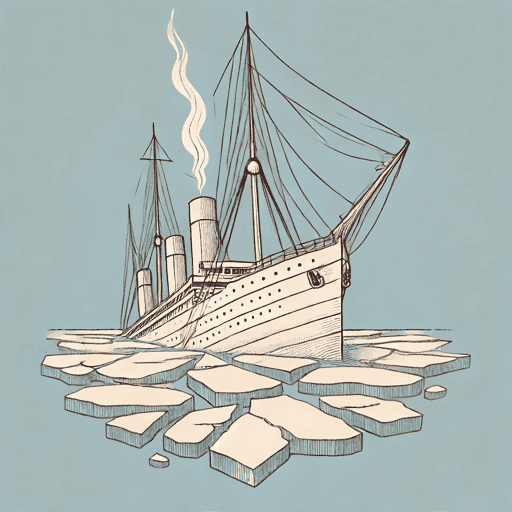
The Terror
75 pages • 2-hour read
Dan SimmonsThe Terror
A modern alternative to SparkNotes and CliffsNotes, SuperSummary offers high-quality Study Guides with detailed chapter summaries and analysis of major themes, characters, and more.
Chapters 44-59Chapter Summaries & Analyses
Content Warning: This section of the guide includes discussion of ableism, death by suicide, suicidal ideation and self-harm, graphic violence, illness, death, and physical abuse.
Chapter 44 Summary: “Goodsir”
Dr. Goodsir writes that the crew halted their southward march to allow Fitzjames to die in relative peace. They set up their tents, lit a coal stove for warmth, and cooked warm food—an unusual luxury at this point.
Though Fitzjames has scurvy like many of the others, Goodsir suspects the man is also suffering from severe food poisoning. Fitzjames dies on June 6th and is buried with military honors. Afterward, Crozier privately asks Goodsir whether Fitzjames may have been poisoned by the captain’s current steward, Aylmore, who had been serving the officers’ meals. Goodsir replies that it could have been deliberate poison or botulism from spoiled food. Crozier says that everyone will be taken off canned rations except Aylmore.
Chapter 45 Summary: “Blanky”
On June 18th, Blanky struggles to keep pace with the other survivors, as the creature’s attack months prior has left him needing to use a makeshift wooden leg. He’s on his third due to the rough terrain, and this one finally breaks as well, leaving him immobilized and in pain from worsening gangrene in his stump. He decides to stay behind and takes a seat on a boulder.
Crozier and the carpenter, Mr. Honey, find him. After some pushing, Crozier realizes Blanky’s decision to remain behind is final. Blanky asks Crozier to visit his family in Kent if he makes it back to England, and refuses a pistol to defend himself from the creature. As night falls, Blanky waits in the cold. The creature appears on the ice, and Blanky throws his broken leg at it before greeting it.
Chapter 46 Summary: “Crozier”
Crozier leads the remaining crew deeper into the Arctic wilderness during the 10th week of their desperate march. Despite the brutal conditions, Crozier is driven forward by a “blue flame” burning in his chest.
As snow returns in early July, the strain becomes unbearable. On July 4th, Crozier halts the march, allowing Dr. Goodsir to tend to the sick and sending out hunting and scouting parties in all directions. Despite the canned goods being spoiled, the crew returns to eating them out of necessity, leading to more deaths.
A group of 23 men, led by Hodgson and supported by Hickey and Manson, confronts Crozier to suggest abandoning the journey and returning north to Terror Camp, believing they have a better chance of survival there. Crozier tries to reason with them, warning that the return journey would be even deadlier than pressing on. Just as weapons are about to be drawn, Lieutenant Little and a scouting party return with news that open water lies just two miles to the south. The men’s mood shifts from rebellion to celebration, and Hickey and Manson melt back into the ranks.
Chapter 47 Summary: “Peglar”
On July 9th, after waiting two days for the hunting and scouting groups to return, the crew launches boats into what they hope is a path to salvation. Despite brutal weather, thin ice, and exhaustion, they manage to haul their boats across rough terrain to the lead that Little had reported, only to find it has already frozen over. The crew continues east across cracking ice. One man, Private Daly, falls through and nearly dies of exposure. Morale falters once they realize they are still at least 30 miles from the inlet to Back’s River, and won’t reach safety before September.
Eventually, Crozier organizes a scouting mission to explore the new lead that appears to have opened. He selects nine men, including Peglar, to go with Little and Ice Master Reid in a whaleboat. They push into the narrow channel through the fog and row for hours. Just when they think they may have found open water, they realize it’s just a large, isolated lake in the ice. As they prepare to turn back, Peglar marks the entry point with a pike in the ice so they can find their way back.
On the return trip through worsening fog and snow, Peglar notices a large serac of ice that wasn’t there before. He warns the others just as the boulder turns, revealing itself to be the creature.
Chapter 48 Summary: “Goodsir”
Nine days after Little’s departure, Crozier leads the rest of the surviving 80 crewmen in their boats down the narrow ice lead in hopes of finding the missing whaleboat and a path to safety. The men find blood-smeared ice, floating wreckage, and the headless body of James Reid and the naked and frozen corpse of Peglar. The crew gathers the bodies, as well as the remains of a third man, and performs a makeshift burial at sea.
After the burial, the crew attempts to press on southeast toward Back’s River, hauling their boats and sledges across increasingly unstable ice. Crozier consults Goodsir about reducing rations, but the surgeon confirms that the crew is already starving and cannot sustain further cuts. With only a few days of salt pork and rum left, the captain decides to reduce the number of boats to five and begin traveling lighter.
On the night of July 16th, a sudden crack in the ice swallows one of the tents, killing six men. There is no burial for them, and the crew leaves their bodies behind. On July 17th, Crozier announces they will turn north toward land, hoping to find food. As they head north, new leads and melt-pools make it impossible to travel in a straight path.
Chapter 49 Summary: “Crozier”
Crozier struggles to keep himself and the dwindling survivors alive while haunted by the same dreams that he had while suffering the effects of withdrawal. He continues sending out hunting parties, but the sea is eerily empty. He considers that their best chance for food may come from the creature stalking them and contemplates using himself as bait. He then turns to the practicality of cannibalism, should the situation become desperate enough, recalling what happened to the whaler Essex. Crozier considers using comatose sailor David Leys as bait or food, noting with grim admiration that no one has yet voiced the idea aloud.
As the ice floes begin to shift on July 22nd, Crozier orders the men back into the boats. Over the next few days, they drift through narrow and impassable leads. By July 26th, they glimpse land and realize that King William Land is actually an island, which confirms that the Franklin Expedition found the Northwest Passage. Crozier announces the achievement to his men and receives only a faint cheer.
The five remaining boats head toward land and finally reach it just before midnight on July 28th. They all collapse where they land, too exhausted to pitch tents. Crozier takes a sextant reading, only to realize they drifted farther from their goal than they were two days before. As he sleeps, he dreams of Memo Moira and a dripping priest, from whom he accepts the Eucharist.
Chapter 50 Summary: “Bridgens”
Though the river provides water for their new camp, there is no sign of life besides the men. The medicine supplies are nearly exhausted, and Goodsir can do little for the men.
Crozier intends to push the men east along King William Island to a higher vantage point, where they will wait for the ice to break. If it does not, they will attempt to haul the boats south across the strait toward the Adelaide Peninsula and to the Back River inlet.
On July 29th, the eve of the move, Bridgens decides to leave the expedition. He packs his few belongings, including Peglar’s journal, and says a veiled farewell to Goodsir. He declines to tell Crozier, knowing the captain would stop him. After leaving camp, Bridgens walks a few miles northeast to a dry ridgeline. There, he eats a biscuit, watches the sunset that briefly breaks through the clouds, and lies down while holding the journal.
Chapter 51 Summary: “Crozier”
On August 13th, the men are camped at the southeastern tip of King William Island at “Rescue Camp.” Goodsir suggests that he should stay behind with the most ill and those who have undergone amputations. Crozier will attempt to take the healthiest survivors south to reach Back’s River before winter sets in. Both men understand this is a near-impossible plan, and that those left behind, including Goodsir, are unlikely to survive.
As conditions worsen and ice shows no consistent sign of breaking up, Crozier prepares to announce his plans to the men. However, Hodgson and Hickey step forward with a splinter group of 16 men who want to return north to Terror Camp. Despite Crozier’s warnings about the dangers, Hickey is adamant that they can row back along the coast. Crozier lets them go, offering the group one boat. When they demand to take two of the disabled men, George Chambers and Davey Leys, with them, Goodsir accuses the men of planning to cannibalize them.
Afterward, three more men request permission to strike out on foot toward Terror independently, which Crozier also allows. He then orders a final ration distribution of an equal share of the remaining provisions for each man. After that, each will be responsible for rationing his own food. Crozier instructs Hickey’s group to leave at dawn and wants no further contact with them.
Chapter 52 Summary: “Goodsir”
On August 15th, two days after the camp split, the men are tense and suspicious. Two groups have now left: Hickey and 15 men, who dragged a loaded boat northwest, and three others who chose to strike out on foot toward Terror Camp. Goodsir notes that Hickey’s party took not only supplies but also many useless trappings of civilization, including 105 chunks of chocolate hoarded by Diggle and Wall. Goodsir and Mate Couch reflect on bodies left behind along the trail, and the doctor prays that Bridgens’s body remains undisturbed.
That afternoon, Crozier summons Goodsir and the remaining senior officers. They agree to watch for any return of Hickey’s group and decide to send out a team to shadow them, just in case. More importantly, Crozier shares his updated strategy: Instead of setting off toward Back’s River, the group will remain at Rescue Camp for another week in the hope that the ice will break, allowing the boats to be used. If the ice clears within five miles of shore, they’ll load the dying men into the boats and leave. Finally, Des Voeux and a team are sent to scout south across the ice the next morning to search for open water and bring back blubber and meat.
Chapter 53 Summary: “Golding”
The young seaman Robert Golding returns to Rescue Camp in a frantic state on August 17th, claiming to bring an urgent message from Des Voeux for Crozier and Dr. Goodsir. He insists they accompany him alone to a site on the ice where something critical has happened that, according to Des Voeux, changes everything. Despite instructions to come without backup, Crozier brings two armed men with him, Bosun John Lane and William Goddard, for protection.
Golding leads the small group across the ice to a secluded spot where Hickey’s splinter faction ambushes them. Lane and Goddard are killed, Crozier is subdued, and Goodsir is taken prisoner. Hickey reveals that he murdered Tom Johnson as well, presenting the captain with the man’s severed arm as proof. Crozier uses a concealed pistol to wound Manson, then flees into the ice field. Though Hickey and his men shoot him multiple times, Crozier disappears. They search for hours, but find no body, and conclude he must have drowned. Meanwhile, Golding butchers Lane and Goddard’s bodies for meat and Goodsir is forced to carry a bag of flesh under threat of violence.
Chapter 54 Summary: “Des Voeux”
Des Voeux returns to Rescue Camp on August 19th with good news: He and his team found a break in the ice four miles from camp, leading all the way to the Adelaide Peninsula and Back’s River. They also brought back eight seals. Des Voeux is excited to share the good news and is hopeful that everyone at Rescue Camp now has a chance of survival.
However, when the party arrives, the men there appear haunted and unresponsive. Des Voeux is taken aside by the remaining officers: Couch, Thomas, Farr, and Andrews. They tell him that Lane and Goddard were murdered and butchered by Hickey and his splinter group. Crozier is presumed dead, and Dr. Goodsir was taken captive. Thomas Johnson, sent to track Hickey, has also not returned. They consider pursuing Hickey, but the officers agree that it’s too dangerous and too late.
As the senior surviving officer, leadership is transferred to Des Voeux. Des Voeux’s first command is that only those men who can walk to the boats under their own power will be taken on the journey to open water the next day. The ill will be left behind.
Chapter 55 Summary: “Goodsir”
On August 20th, Goodsir is held in a tent alongside Hodgson, both of whom have thus far refused to eat human flesh. The doctor notes that, while several members of Hickey’s group have embraced cannibalism, a smaller subset, including himself, Hodgson, and a few others, are still subsisting on moldy ship’s biscuits and resisting the pressure. However, he acknowledges the disturbing allure of the cooked flesh due to his hunger. Hickey, now in full control of the group, keeps tight control over all weapons.
Hickey’s group has also found open leads in the ice. A navigable sea route could lead them back to Terror Camp in just a few days instead of the months that it took them on foot. Goodsir realizes that the group’s ability to sail means that they no longer need as many men. With the boat overloaded, he fears some of the weaker or unwanted men will soon be sacrificed. Hickey, Manson, and Aylmore begin calling everyone out of their tents late that night.
Chapter 56 Summary: “Jopson”
It’s August 20th, Jopson’s 31st birthday, but no one acknowledges it, and his deteriorated condition causes the others to treat him as if he were already dead. Suffering from extreme scurvy, he’s barely able to move. Despite this, he becomes aware that the remaining crew is making final preparations to abandon the camp and head for open water, leaving behind the sickest men.
Jopson forces himself to crawl from his sleeping bag and out of his tent, struggling even to move a few feet. He sees the tents collapsed and the remaining crew dragging boats across the ice without him. With what little strength he has, Jopson tries to call out to them, but the men are already too far away to hear.
Chapter 57 Summary: “Hickey”
Hickey’s plan to return by sea to Terror Camp falters when the ice pack blocks their route along the southwestern cape of King William Island. Lacking navigational tools and expertise, especially after killing Hodgson, Hickey decides to remain close to shore. They abandon water travel altogether and reload their boat onto a sledge to continue overland.
Now in near-total control after crowning himself “king” of the expedition, Hickey has solidified his dominance by executing dissenters and consolidating power. He first killed Hodgson, then Aylmore and Thompson, staging mock trials to justify the deaths. The remaining 11 men are treated as expendable beasts of burden as Hickey rides in the sledge alongside his “consort,” Manson, who is suffering from abdominal pain due to bullet wounds. Goodsir is kept alive for his medical expertise and is forced to tend to Manson.
Their current food supply is dwindling, so on September 8th, Hickey plans a lottery to choose the next victim. He begins preparing slips of paper for the drawing, exempting himself, Manson, and Goodsir from the selection.
Chapter 58 Summary: “Goodsir”
On October 5th, Dr. Goodsir records his final thoughts in his diary as he dies from the poison he prepared and drank. He reflects on how, weeks earlier, Hodgson had apologized to Goodsir for helping Hickey and betraying Crozier. The next morning, Hickey executed Hodgson in front of the group and demanded that Goodsir begin the dissection. When he refused, Hickey retaliated by having Manson amputate two of Goodsir’s toes. The campaign of abuse led to the removal of all of Goodsir’s toes, one ear, and even his foreskin over time.
Despite everything, Goodsir manages to sabotage his captors by diluting the painkillers he gives Manson and lies about the severity of the man’s gunshot wounds. He admits that from the start, he knew the bullets would be fatal without surgery, and he chose not to operate.
In his final moments, Goodsir recounts how a brutal storm destroyed any hope of reaching Terror Camp. The freezing temperatures, blizzards, and starvation led to mass death among Hickey’s group. Some fled into the storm, some were executed for food, and others died from the elements or poison.
Finally, Goodsir pins a warning note to his chest, stating that his body is poisoned and should not be consumed. He apologizes and writes a farewell to his brother Thomas and anyone who may find the diary.
Chapter 59 Summary: “Hickey”
By October 18th, Hickey believes he has transcended mortality and become a god. Isolated on the southwestern cape of King William Island, he sits atop his frozen boat as the last survivor of his group. He feels no hunger, cold, or thirst and imagines that he commands the elements. He continues to sit on his “throne,” across from the body of Manson.
Hickey’s fantasy begins to unravel when the creature appears. At first, Hickey imagines it has come to worship him. Instead, it devours Manson’s body in front of him. Hickey, paralyzed, can only watch in horror. When the creature turns to Hickey, it leans in close to him. Hickey exhales a final breath as his soul is taken. The creature then snorts in disgust before vanishing into the snow. Left behind, Hickey dies frozen in place.
Chapters 44-59 Analysis
The collapse of order and morality threatened in the prior chapters comes to fruition here, beginning with the death of Fitzjames as The Clash Between Human Ambition and Nature grows ever more intense and deadly. Fitzjames was once the affable but brittle officer who represented Franklin’s optimism and the expedition’s public face. Fitzjames’s progressive immobilization as he deteriorates also mirrors the crew’s own entrapment. They, too, are all but trapped, their movement south slowed to less than a mile per day and their lives constricted by dwindling supplies. The men’s plans for pushing onward and finding better conditions are perpetually thwarted, with the power of nature becoming ever more irresistible.
The location of the camp, “Comfort Cove,” is ironic. The men coined the name because they paused there for two nights, pitched tents, and ate hot food. Its comfort is illusory: It’s where Fitzjames died in agony, where Crozier plots to sacrifice Aylmore, and where Goodsir realizes that he can never truly know his companions. The situation worsens from then on. By Chapter 54, the Franklin Expedition is a shadow of itself. Crozier is presumed dead, Hickey’s faction has split away into cannibalistic violence, and Rescue Camp has dwindled into a sickly, hollow-eyed collection of survivors abandoned to their fate by their former companions.
Simmons also engineers the end of the expedition not only through the plot, but through shifts in narrative style, with the writing itself fraying to reflect The Psychological Effects of Isolation. The writing in Goodsir’s final diary entry degrades into fragmentation and incoherence as the poison he ingested kills him. His confession that he feels responsible for the deaths of many of the men is barely legible: “Mr. Hickey and Mr. Masnsonn sit up There in Ther Boat in the Wind. I thinge, but donnot Know, that Mrr. Mansin is No Lngr Livvng. OI killed him. I kelled the Men I lff behing at Rescue Camp. I am so Sorry” (828). While Goodsir has tried to maintain a semblance of dignity and order even when in the grip of Hickey’s depravity, he succumbs to guilt and despair as he realizes that the expedition’s chances are truly at an end. His apology—“I am so Sorry”—reinforces his characterization as a conscientious and dedicated man, as does his note warning the survivors not to eat his poisoned flesh—a last act of caregiving.
Hickey’s last chapter, Chapter 59, forms a contrast to Goodsir in that Hickey has responded to isolation not with guilt, but with increased defiance and cruelty in his behavior towards the others. The sentences reflecting his mental state are polished and legible, but the perception is deranged: “He had ceased being a king. He was now a god” (830, emphasis added). Hickey’s grandiose self-image is undercut by the reality that he is being dragged across the ice by starving men, who die around him, leaving him to starve surrounded by useless trinkets. Hickey’s sin is hubris, and his fate recalls mythic archetypes from Icarus to Milton’s Satan: The rebel who proclaims himself divine only to be cast down. The Tuunbaq refuses to kill him or consume his body, rejecting his spirit as polluted. The man who thought himself a god is rejected by something close to a real one in one last moment of irony. Human pride and ambition, whether imperial or personal, are annihilated in the face of the Arctic’s indifferent vastness.
Historically, various aspects of the fate of the Franklin Expedition remain a subject of speculation, with few concrete answers. In Inuit testimony collected by John Rae in 1854, reports of cannibalism were dismissed by Victorian England as slander. Nevertheless, forensic evidence has confirmed proof of it happening to some of the recovered remains. While the novel predates the discovery that Fitzjames was one of the individuals to whom this was done, it’s yet another historical reality that Simmons incorporates.
Though Simmons incorporates horror and mythological monsters into the story, he still honors many of the historical facts of the situation and the mystery of the men’s fates themselves. The last the reader is shown of the main remaining crew is at the conclusion of Jopson’s point-of-view chapter: “And then the men and the boats were gone. It was as if they had never existed” (813). The Franklin Expedition began with the promise of progress, and ended with fragmentation and death.

Unlock all 75 pages of this Study Guide
Get in-depth, chapter-by-chapter summaries and analysis from our literary experts.
- Grasp challenging concepts with clear, comprehensive explanations
- Revisit key plot points and ideas without rereading the book
- Share impressive insights in classes and book clubs