The Terror
75 pages • 2-hour read
Dan SimmonsThe Terror
A modern alternative to SparkNotes and CliffsNotes, SuperSummary offers high-quality Study Guides with detailed chapter summaries and analysis of major themes, characters, and more.
Chapters 60-67Chapter Summaries & Analyses
Content Warning: This section of the guide includes discussion of religious discrimination, graphic violence, sexual content, illness, and death.
Chapter 60 Summary: “Crozier”
Crozier experiences a painless, detached existence where he no longer feels hunger, cold, or a sense of self. He “listens” to dreams belonging to someone or something else.
The dream tells the story of Sedna, a beautiful Inuit girl who rejects many human suitors and is courted by a bird who promises her a life of abundance and comfort. Believing him, Sedna marries the bird and journeys to his homeland, but discovers it’s a bleak place. Eventually, her father, after learning of her suffering, helps her kill her husband and flee. However, the bird people retaliate, chasing them across the sea with a terrible storm.
To appease the attacking birds and save himself, her father throws Sedna overboard. When she clings to the kayak, he cuts off her fingers. From her severed fingers, the sea animals are born. Eventually, she sinks to the bottom of the ocean, where she remains as the goddess who controls the sea creatures. If Sedna is pleased, the animals come to the people to be hunted; if not, they stay with her, and the people starve.
Crozier’s consciousness then begins to return, along with his pain.
Chapter 61 Summary: “Crozier”
Crozier regains consciousness, discovering that he’s in a tent made of skins. Silence is tending to him by extracting the bullets from his body and applying poultices to prevent infection and keep him alive.
Over several days, he regains strength, though he remains bedridden. At times, she attempts to communicate using an intricate string game that Crozier cannot yet decipher.
Eventually, Silence dresses him in clothing scavenged from the remains of the dead and the wrecks of the expedition. She also constructs a traditional Inuit sled. Once it’s complete, Silence bundles up Crozier and drags him across the ice.
Chapter 62 Summary: “Crozier”
Crozier has another vision about Sedna and the creation of the world. Shamans, or angakkuit, maintained harmony with the spirits by learning to communicate with them.
The Tuunbaq, the creature who had followed the expedition, is a spirit created by Sedna to kill the other two great spirits: The Spirit of the Air and the Spirit of the Moon. Though Sedna’s creation failed to destroy them, it became too dangerous to exist in the spirit realm, and she banished it to the far north, where it adopted the form of a monstrous polar bear and began consuming human souls. It decimated villages and spread fear throughout the Arctic.
To stop the Tuunbaq from destroying humanity, the clairvoyant sixam ieua arose, who could communicate with the Tuunbaq through mind-speech rather than words. They struck a bargain with it: In exchange for peace, the Tuunbaq would be fed animal offerings and revered in its icy domain. The families of the sixan ieua withdrew from the rest of society to live in the remote north.
Silence describes a vision passed between her and her father of the man she would marry, and her father’s death at the hands of a white man.
Chapter 63 Summary: “Crozier”
Crozier wakes with a headache and mental fatigue from the dreams that plague him. He now lives in a snow-house, reliant on Silence. Despite Crozier’s repeated pleas to return to his remaining men, Silence never responds to the requests, neither with expression nor with her silent string language. He has tried to leave on his own three times, each time becoming lost in the wilderness. Every time, Silence finds him, rescues him, and brings him home. He’s come to believe she understands him, even his thoughts and dreams, and feels their identities almost blur together.
He joins her on the sea ice as she hunts seals. After waiting for hours, she harpoons a seal, and together they haul it from the ice. Afterward, she passes water from her mouth into the seal’s to honor its spirit so future seals will return.
Back at the snow-house, they eat seal meat. When Crozier points out how greasy their faces are, for the first time, he thinks he sees her smile. Later that night, she initiates sex with him, and they collapse in exhaustion in each other’s arms.
Chapter 64 Summary: “Crozier”
In a poem about the origins of light, the world exists in total darkness until Tulunigraq, the Raven Trickster, hears two men dreaming of light and sets out to find its source. Flying inland, Raven discovers a snow-house where an old man lives with his daughter, who is blind. Suspicious that they are hiding light, Raven sneaks inside and sees two skin-bags hanging in the smokehole. One contains darkness and the other, daylight. Using thought-sending, Raven encourages the girl to ask her father to play with the “ball,” which is the daylight wrapped in caribou skin. The father takes it down. Raven again uses his influence to prompt the girl to push the ball outside, right into his waiting grasp.
He takes the ball and runs, but is pursued by the old man, who transforms into a peregrine falcon. As the falcon dives at him, Raven tears open the skin-ball with his beak, releasing the daylight across the land. A shouting match ensues between Raven and Peregrine, one crying out for daylight, the other for darkness. Their struggle creates a balance, establishing the cycle of the seasons and the natural order.
Chapter 65 Summary: “Crozier”
Crozier and Silence leave their snow-house and embark on a long journey north with their sledge, sharing the labor of pulling it. Silence is pregnant, though neither says anything about it.
They travel along the coastline, and Crozier considers multiple paths forward: Returning south to search for survivors, heading east to find rescue at Fury Beach, or disappearing entirely. Though capable of surviving on his own now, he cannot face returning to England in disgrace, nor does he believe Silence could survive if they fled together.
After eight days of travel across unstable ice, they stop. Silence asks if he’s ready, and Crozier affirms. Together, they construct a crude tent using parts of the sledge and animal skins. For three days, they prepare. On the final night, Crozier has a dream in which he hears his unborn son singing a death song. He awakens, realizing this is a farewell from his former self.
Chapter 66 Summary
Crozier and Silence leave their tent wearing minimal clothing and begin throat-singing. The ceremony lasts for hours and, as it ends, Silence withdraws. Crozier strips off the last of his clothes and kneels at the edge of the ice. The Tuunbaq emerges to loom over him. Though terrified, he tilts his head back, opens his mouth, and extends his tongue as one would for communion.
Chapter 67 Summary: “Taliriktug”
In May 1851, Crozier, now known as Taliriktug, learns of objects from the expedition surfacing in southern Inuit villages. He and his wife, Silna (Silence), travel south to investigate. They are accompanied by their two children, and some of her people, including Asiajuk and his wife—the only survivors of Hodgson’s massacre.
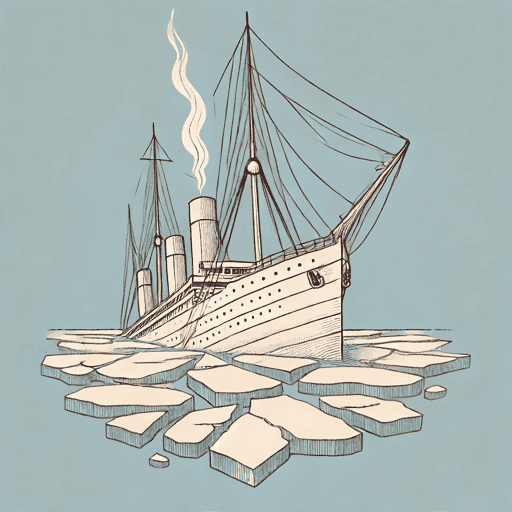
Upon reaching a village called Taloyoak, they find items from Erebus and Terror. They continue westward to Back’s River, where they meet an old hunter named Puhtoorak who describes a three-masted ship trapped in ice. They follow his directions to find Terror frozen off the Adelaide Peninsula. Boarding the deserted ship, Crozier finds a mummified corpse with elongated teeth in his old bunk and an unsettling atmosphere that confirms something terrible occurred there.
Realizing the ship is tainted, Crozier spreads gunpowder and lamp oil throughout its decks and sets it aflame, burning it to prevent the horrors aboard from ever being discovered by future searchers. After watching Terror sink beneath the ice, Crozier, Silna, and their family return eastward.
Chapters 60-67 Analysis
Simmons closes The Terror with a sole focus on Crozier and his rebirth into a new person as Taliriktug. While he, too, probably died with the rest of the members of the expedition in reality, in the novel, he is the sole survivor. He also takes a narrative pivot by grafting the wreckage of the Victorian expedition onto elements of Inuit cosmology. Instead of another scene of cold, starvation, or mutiny, Simmons inserts myth and challenges the expedition’s original ideas of Eurocentric superiority by having Silence save Crozier and Crozier fully embrace her way of life, enabling the text’s exploration of Colonialism as Horror to find its resolution.
The final chapters exist between worlds, half dream, half material. Crozier begins Chapter 60 suspended in a space where he sees “dreams that are not his own” (838). The Tuunbaq itself is a fictional creation by Simmons, likely based on the tiriarnaq, the “weasel bear,” of legend, known for being massive and long-bodied. However, the dreams in Chapters 60, 62, and 64 about Sedna, the Raven, and Inuit cosmology are based on real Inuit stories. Even the novel’s meta-forecast that the arrival of Europeans in the Arctic will poison the Tuunbaq and bring warming seas transposes the historical future of the Arctic thaw into the mythology of the story, while reinforcing the harmful effects of colonialist and imperialist hubris and exploitation of nature.
Simmons incorporates the liminality into the novel’s paratext as well. The majority of the chapters begin with the dates, locations, and coordinates in which the chapter takes place. It reflects the empirical and rational nature of the expedition, echoing real ship logs. Beginning with Chapter 60 and up until Chapter 67, Simmons does away with the trend. Crozier doesn’t know the date or where he is, and that is reflected in the text itself. Chapter 66 even removes the title, which reflects the chapter’s point-of-view character. Instead, it’s left blank, as it’s before Crozier becomes Taliriktug, but after he is “Crozier.” The transformation is not easy. Crozier experiences terrifying dreams, a symbolic death of his old self, and a ritualistic confrontation with the Tuunbaq. His prior recurring dreams of the Eucharist become the present as he kneels and allows the Tuunbaq to remove his tongue.
Critically, Crozier is not submitting to the Tuunbaq. Instead, he “Surrender[ed] only to the human being he wants to be with and to the human being he wants to become—never to the Tuunbaq or to the universe that would extinguish the blue flame in his chest” (912). He is embracing a new role within the spiritual economy of the Arctic. The Tuunbaq, the Inuit, and the land itself are bound by a different order of exchange than the one Crozier left behind. He symbolically accepts that he is now part of that order. Cut off from his past, he redefines himself. The ending of the novel redefines what survival means. Crozier doesn’t cling to his old identity but accepts a new one shaped by the world he once sought to conquer. In this way, Crozier alone escapes the fate of the expedition not by defeating the Arctic but by becoming part of it.
The novel closes on Crozier’s return to the ship he abandoned, which invokes The Clash Between Human Ambition and Nature. Terror embodies the past: Empire, exploration, hubris, and failure. While most of the ship is eerie, the true horror comes from the corpse in Crozier’s bunk with long teeth. The image is vampiric, but it’s also based on another historical report by the Inuit. In reality, it was Erebus, not Terror, upon which the corpse of a large man with long teeth was found. As the novel was published seven years before the location of the first ship was rediscovered, and nine years before the second, Simmons was left to speculate and fictionalize.
While the real Terror never burned, it’s a final act of severing himself from his past for the fictional Crozier. By the time he reaches it, several years later, it’s a horror of order preserved in time and infested by resentful ghosts. The ship is both a tomb and a haunted house stranded in Arctic ice. The past clings, refusing burial, and only fire can exorcise it. Fire erases evidence, denies England the chance to mythologize failure, and purges the “plague” Crozier senses inhabiting the ship.
The last image of the novel, however, is not one of horror. Instead, it’s of two parents walking across the ice with their young children. When Crozier reflects that he “had no illusions about life being anything but poor, nasty, brutish, and short. But perhaps it did not have to be solitary “(936), the “perhaps” is not hedging—it’s the principle that has replaced imperial certainty. If Hobbes’s mantra in Leviathan has shadowed Crozier for hundreds of pages, the novel’s closing proposal is not a refutation, but a correction. Silence, their children, and their extended family are not antidotes to the harsh realities of nature, but they do make it livable.

Unlock all 75 pages of this Study Guide
Get in-depth, chapter-by-chapter summaries and analysis from our literary experts.
- Grasp challenging concepts with clear, comprehensive explanations
- Revisit key plot points and ideas without rereading the book
- Share impressive insights in classes and book clubs