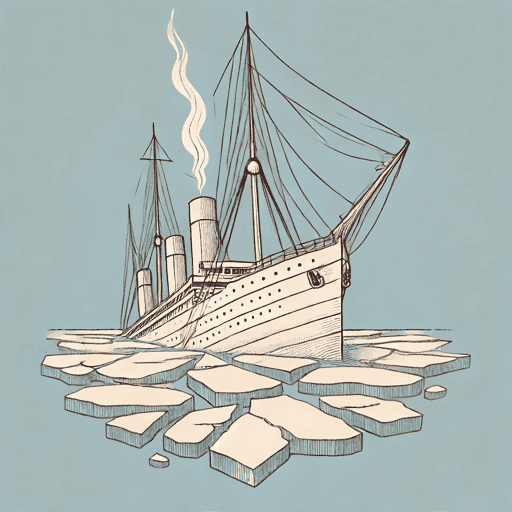
The Terror
75 pages • 2-hour read
Dan SimmonsThe Terror
A modern alternative to SparkNotes and CliffsNotes, SuperSummary offers high-quality Study Guides with detailed chapter summaries and analysis of major themes, characters, and more.
Character Analysis
Content Warning: This section of the guide includes discussion of racism, religious discrimination, graphic violence, illness, and death.
Francis Crozier
Francis Rawdon Moira Crozier, second-in-command of the expedition and later captain of HMS Terror, is one of the point-of-view characters and the novel’s protagonist. Simmons uses him to explore the divide between imperial hubris and cultural integration. When Crozier is introduced, he’s already marked as different from the other senior officers of the Franklin Expedition. The real Crozier was Irish and Catholic, a background that set him apart from the Anglican English officers who dominated the Royal Navy. Simmons builds on this difference, presenting Crozier as an outsider who has achieved rank through competence and long service rather than connections or noble birth. Among his peers, there is a sense that Crozier is tolerated but not embraced. Crozier himself believes he has failed in every aspect of life. He isn’t married, his naval career feels stalled, and he sees himself as destined to die in obscurity.
Crozier’s role shifts after Franklin’s death and Fitzjames’s decline. Leadership of the expedition falls to him by necessity. At first, he seems reluctant, even broken by the responsibility. The men are starving, scurvy-ridden, and trapped in the ice with little hope of relief. Crozier, unlike Franklin, leads through pragmatism and a grim willingness to face unpleasant truths. One of his most difficult decisions is to abandon the ships. In historical records, this decision is often viewed as disastrous, but Simmons presents it as Crozier’s attempt to save lives in an impossible situation. He weighs dwindling supplies, the men’s health, and the absence of rescue, concluding that remaining on the ice-locked ships is certain death. By leading the men south toward the Back River, he takes a gamble that fails for most, but which shows Crozier as a leader willing to act rather than freeze in indecision.
His pragmatism is turned on its head after he’s shot during the mutiny and separated from the others. Previously, Simmons described Crozier’s memories of his grandmother telling him that he had inherited the Second Sight, which he dismisses but later turns out to be the truth. It connects him to Silence, who saves him and shows him how to survive. Crozier begins to shed his old self—the failed naval officer—and embrace a new identity. Unlike the others, Crozier does not die, but instead confronts the Tuunbaq, the monstrous spirit that has stalked the expedition, and submits to it. At the end of the novel, Crozier lives on, not as a naval hero but as Taliriktug, husband to Silence and father to their children. He’s something new, remade in the Arctic, his old life burned away with the wreck of the ship.
Lady Silence (Silna)
Silna, known for the majority of the novel as “Lady Silence” or just “Silence,” is an Inuit woman who, after her father is shot and killed by the expedition, is kept under Crozier’s protection on HMS Terror. The nickname stems from her being unable to vocally communicate due to her tongue having been removed, later revealed to be because she’s a sixam ieua.
For the crew, Silence is an elusive, almost spectral figure. They fear her, suspect her of witchcraft, and see her as an outsider whose presence is dangerous. The sailors’ assumption of her connection to the Tuunbaq is correct, but oversimplified. The sailors assume she controls or summons the beast, while the reality is that she has a relationship of obligation and ritual with the Tuunbaq, one that ties her survival and identity to forces the British cannot comprehend.
Fundamentally, Silence functions as a cultural counterpoint to the British sailors. The Franklin Expedition represents the height of Victorian imperial confidence: Two technologically advanced ships packed with provisions, scientific instruments, and officers who see themselves as the spearhead of empire. Nevertheless, their modernity becomes their undoing. Their canned food rots, their reliance on cumbersome sledges slows them, and their inability to adapt to the Arctic environment seals their fate. Silence, in contrast, is their only hope for survival—something Crozier recognizes early on, and which becomes true later when she saves his life after the mutiny.
Silence isn’t given direct narrative perspective in chapters. Instead, she’s viewed through the eyes of others, who project their fears, fantasies, or misconceptions onto her. This changes at the end of the novel, when poems from her perspective interject into chapters otherwise told from Crozier’s point of view as she communicates telepathically with him. In the end, when Crozier undergoes his transformation and takes on the role of Silence’s partner, it’s she who guides him through the process. She saves him not just from physical death, but from despair and purposelessness.
The Tuunbaq
The Tuunbaq, also known as The Thing on the Ice, is a monstrous spirit that stalks the men of the Franklin Expedition across the ice. It’s described as a massive, polar-bear-like predator with a triangular head and a stench of rot that clings to its fur. Unlike a natural predator, however, the Tuunbaq is persistent in its hunt. It mauls without consuming, leaving corpses strewn across the snow. The Tuunbaq serves the narrative function of a horror monster by creating external conflict, heightening suspense, and isolating the characters in a hostile environment. Each attack escalates the sense of futility surrounding the expedition.
However, more than just being a source of horror, the Tuunbaq represents the spiritual and mythic dimension of nature’s resistance to human encroachment. For the sailors, the Tuunbaq represents the inexplicable, something outside the rational frameworks of Western science. No weapon is capable of destroying it, and attempts to hunt it result in further slaughter. The monster’s presence shatters the illusion that the men can measure and control their world.
For Silence, however, the Tuunbaq is part of a balance between humans, spirits, and the environment. Within the narrative, the Tuunbaq is explained as a creature created long ago by Sedna, the goddess of the sea and mother of animals, as a kind of weapon in the distant past. The Inuit characters like Silence know it as a being that is dangerous and powerful, but also part of the spiritual order of the Arctic.
Cornelius Hickey
Cornelius Hickey is the primary human antagonist of The Terror. Based loosely on an actual caulker’s mate who sailed on HMS Terror, Simmons transforms him into a figure of ambition, chaos, and perverse charisma. He operates on two levels: as a self-serving and opportunistic character and as a thematic device embodying the breakdown of imperial order.
Hickey’s status on the expedition is marginal from the outset. As a caulker’s mate, he’s neither officer nor regular seaman, and his position places him near the bottom of the social hierarchy. Simmons emphasizes this outsider quality, portraying Hickey as someone who thrives by exploiting gaps in authority. He’s quick to gossip, undermine officers, and use insinuations to plant seeds of doubt.
As the novel progresses, Hickey emerges as the mastermind of dissent. He thrives on the suffering of others, using fear and hunger to consolidate control. His pivotal moment comes when he engineers a mutiny against Captain Crozier, seizing control of part of the crew. Hickey’s methods are as theatrical as they are brutal. He stages mock trials, public executions, and forces others to participate in his grotesque rituals. In many ways, Hickey represents the collapse of the taboos that once held the expedition together. Eating human flesh is the ultimate violation of civilization, but for Hickey, it becomes a tool of control. By encouraging and enforcing cannibalism, he breaks down resistance and binds his followers to him in complicity.
By the final chapters, starvation, isolation, and delusion convince Hickey that he has transcended humanity. He sought power and control, exploiting others’ suffering for his gain. Once all his followers are dead, Hickey turns inward, creating a fantasy in which he has succeeded. His delusion reflects not triumph but emptiness: He has no followers, no kingdom, only corpses and the endless ice. Hickey’s belief in his divinity also sets the stage for his final confrontation with the Tuunbaq. When the creature approaches, Hickey welcomes it, imagining that even this supernatural terror will bow before him. Instead, it rejects Hickey and leaves him to die alone.
Dr. Harry Goodsir
Dr. Harry D.S. Goodsir is one of the expedition’s surgeons and the only one to survive the Carnivale disaster, as well as one of the novel’s major point-of-view characters. His chapters are unique compared to the others, as they are written as entries in his diary rather than in the third-person prose used for the others.
Goodsir is a surgeon and naturalist, younger and less seasoned than his companions. His training is scientific rather than military, which shapes his perspective throughout the novel. The Franklin voyage was, in part, a mission of science, intended to chart the Northwest Passage and expand geographical knowledge. Goodsir embodies this intellectual idealism, even as the expedition devolves.
Unlike Crozier, who is caught in a leadership crisis, Goodsir has no real authority. His role is instead that of witness and reluctant participant. This makes him invaluable to the narrative, as he’s free to be horrified, to recoil, and to cling to ideals of decency, where others must harden themselves for command. As a result, Goodsir also serves as a moral foil to characters such as Hickey, whose descent into depravity is contrasted by Goodsir’s stubborn resistance to moral collapse. In Hickey’s camp, he’s one of the few to abstain from cannibalism. Goodsir’s refusal to cross that final line becomes an act of defiance, one of the few and final forms of resistance still available to him in the end.
John Irving
Lieutenant John Irving is a point-of-view character and, when he first appears in The Terror, embodies many of the qualities expected of a young naval officer: Confident, lighthearted, and even rakish. His first narrative function is being the primary person dealing with Lady Silence for much of the novel. Whereas many sailors treat her with fear, suspicion, or hostility, Irving treats her with courtesy, though he’s also infatuated with her.
Despite his youthful frivolity, Irving does win Crozier’s trust. Crozier, often disgusted with his officers’ incompetence or arrogance, finds Irving reliable, and he’s devastated at his death. His dedication to Naval order contrasts with Hickey, who comes to resent Irving and plots his death for much of the novel. Irving’s death is representative of the final loss of hope for the expedition as a whole. When he encounters an Inuit hunting party, it’s their last shot at survival through food, knowledge, and guidance. Irving’s willingness to engage with them as best he can results in a mutually respectful exchange.
However, those hopes are dashed when Hickey kills him and pins the blame on the hunting party, resulting in their deaths at the men’s hands in retaliation. Hickey’s duplicity ensures that Irving’s attempt to bring salvation back to camp never succeeds, sealing the expedition’s doom.

Unlock analysis of every major character
Get a detailed breakdown of each character’s role, motivations, and development.
- Explore in-depth profiles for every important character
- Trace character arcs, turning points, and relationships
- Connect characters to key themes and plot points