50 pages • 1-hour read
The Tombs of Atuan
A modern alternative to SparkNotes and CliffsNotes, SuperSummary offers high-quality Study Guides with detailed chapter summaries and analysis of major themes, characters, and more.
Chapters 10-12Chapter Summaries & Analyses
Chapter 10 Summary: “The Anger of the Dark”
Content Warning: This section of the guide includes discussion of religious discrimination/trauma and death.
Ged smiles, assuring Arha that she has saved them both, for “alone, no one wins freedom” (115). He declares that the broken pieces should be whole again, placing his hand over the two halves of the amulet. He speaks a few words, fusing the halves. The Ring of Erreth-Akbe is a small armband, sized for a woman or child. He slips it on Arha’s arm.
Ged wishes he had his staff, and Arha reveals that she brought it with her and left it in the corridor. They leave the Treasury, rushing through the tunnels and back to the pit. As they make their way across the narrow ledge, Manan appears. He tries to lunge for Ged and misses, falling into the pit and to his death. Arha feels numb as they continue. She loses count of the turns and becomes lost, beginning to despair.
Ged urges her on, explaining that he is using all his power to stop the Nameless Ones from using an earthquake to collapse the tunnels and crush them. Arha leads Ged into the Undertomb, toward the trap door in the Throne Room. They reach the trap door only to discover it is locked or barred. Ged says they must try to break through the Prisoner’s Door, though it only opens from the outside. He can use his power to force it.
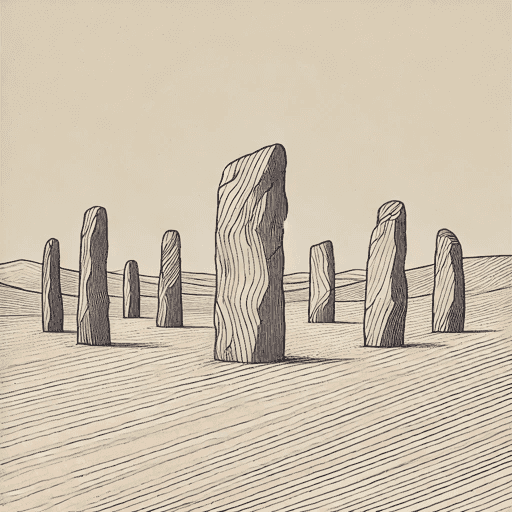
Arha leads the way to the Prisoner’s Door, and Ged shatters the rock with his staff. They emerge among the rocks beyond the Wall. The sky is dark. Arha collapses, yelling at Ged to leave her and escape on his own, but Ged calls her name, Tenar, and commands her to come with him. Weary, she stands and follows him. As they run through the desert toward the mountains, Tenar looks back to see the ground shake. The Tombstones crumble and fall into the tunnels, leaving an enormous black hole in the ground. Realizing that Ged held back this earthquake the entire time they were underground, Tenar is awed by his power.
Chapter 11 Summary: “The Western Mountains”
They stop in the desert to sleep during the day. Tenar wakes at sunset. She looks at Ged and thinks it is strange how quiet he appears in his sleep, though he possesses magic like “the Old Powers of the Earth” (126). Eventually, Ged wakes. Tenar asks how long it will take for them to reach the sea. Ged answers that it took him two days and nights to reach the Tombs, but the return will take longer because he is tired and weak. Tomorrow they will reach the mountains, where they will have access to more food and water. Tenar asks if he can hunt using magic. Ged explains that he can use an animal’s true name to call it willingly to its death, but it is a cruel thing to do. Tenar asks if he could call a rabbit anyway, just so she can see.
Ged speaks the rabbit’s true name, and a rabbit comes passively out of the brush and right to his hand. After a moment, he lets it leave again. Tenar remarks on his gift for calling, thinking of herself, and Ged looks at her but does not respond. They fall asleep and wake before dawn to start walking again.
They spend the next day and night traveling through the mountains. Tenar is happy and wishes they could stay there. Ged agrees it is a beautiful place and reminds him of his home on the mountainous island of Gont, but he says she will like Havnor. Tenar is reluctant to go there, but Ged assures her that the people of Havnor will welcome her like a princess and love her because she is bringing the Ring of Erreth-Akbe and because she is beautiful.
Again, Tenar says she wants to stay in the mountains, where it is quiet and peaceful. Ged responds that he does not have the proper supplies to survive a snowy winter, but he will stay with her if that is what she wishes. Tenar relents, admitting that it is not possible, but she is afraid. She knows nothing about the world, but she will have to learn. Ged winces and does not speak.
The next day, they descend the mountain and walk into a small village. Ged uses an illusion to change their appearance. They stay one night with a friendly villager and, when they leave in the morning, Ged uses a bit of magic to heal the villager’s sick goats, remarking that kindness and hospitality are important.
In the afternoon, they reach a larger town protected by Kargish soldiers. Tenar fears that, if all the cities are as large as this one, Kargad could one day conquer the Inner Lands, but Ged tells her that the Inner Lands contain many towns like this, along with larger cities. Suddenly afraid, Tenar asks if Ged will stay with her when they reach Havnor. Ged regretfully explains that his work requires him to travel. He promises to visit and to come to her if she ever needs him, but says he cannot stay with her. He promises that she will be happy and will not need him. She does not respond.
Chapter 12 Summary: “Voyage”
Tenar and Ged reach the beach where Ged hid his boat in a cave. Ged suggests they rest while they wait for the tide, and he sits at the lip of the cave. Tenar realizes that he has left his body and gone someplace she cannot follow.
Tenar is suddenly angry that he called her to his hand like the rabbit in the mountains, and now that he has the ring and has left the Tombs in ruins, he will leave her alone again. She takes a small knife from Ged’s belt, but he does not react. She turns to him, lifting the knife in one hand, and he opens his eyes with “the look of one comes from a long way off, one who has seen terrible things. His face was calm but full of pain” (140). He says her name and her anger fades, leaving only fear.
Ged says it is time to leave. Meekly, Tenar follows and helps him push the boat into the water. Ged uses magic to call the wind and keep them moving. As the shore disappears behind them, Ged says that they have finally escaped. Tenar knows it is true but is not happy, only afraid. She cries for her wasted years and the uncertain path ahead of her, realizing that “freedom is a heavy load” (141) filled with difficult choices.
They sail for several days. One night, Tenar tells Ged that she knows the identities of the old man and woman he found on the deserted island. She tells him how the second half of Erreth-Akbe’s amulet was passed down in the family of Hupun. The family dwindled in power and size until only two young children, a boy and a girl, remained. The current emperor’s father feared they would rise against him, but did not dare kill them himself. Instead, he had them captured and shipped to the middle of the sea, left with nothing but their clothes and some meager supplies. They were named Ensar and Anthil. It was Anthil, the girl, who gave Ged the broken ring.
Tenar tells Ged she does not want to go to the Inner Lands and be welcomed like a princess. She does not belong there any more than she belonged in her homeland. She has betrayed her people and done evil things. She asks Ged to take the ring and leave her on a lonely island in the middle of the sea, like Ensar and Anthil. She is not free and must pay for the evil she has done.
When Ged asks what evil she believes she has committed, Tenar tells him about the three prisoners she ordered to death by starvation. She also feels responsible for Manan’s death. Ged says:
You were the vessel of evil. The evil is poured out. It is done. It is buried in its own tomb. You were never made for cruelty and darkness; you were made to hold light, as a lamp burning holds and gives its light. I found the lamp unlit; I won’t leave it on some desert island like a thing found and cast away (145).
He will take her to Havnor and celebrate her as the light that saved him from death and brings peace back to the land. After that, he says, he will take her away from the city, because he realizes she is right. She does not belong there because she is too young and wise for rich princes and merchants. Instead, he will take her to Gont to live with his old master, Ogion. There, she will find kindness and peace while she heals and learns to live again. He asks if she will agree to that, and she agrees. He promises to visit when he can.
Days later, they reach the ports of Havnor, where news of their approach spread ahead of them. Tenar stares at the crowd that greets them on the shore and the elegant palaces of the city. She lifts her arm so the Ring of Erreth-Akbe gleams in the sun, and everyone cheers. Ged leaps from the boat and holds his hand out to her, welcoming her “like a child coming home” (146).
Chapters 10-12 Analysis
The final three chapters conclude both the external and internal conflicts in ways that defy established fantasy tropes. For example, a traditional fantasy novel would likely include a final confrontation between Tenar and Kossil to resolve the external conflict. Many fantasy novels function with the idea that the protagonist must face the person or thing they most fear to be free. The first novel follows this trope, with Ged’s coming-of-age narrative concluding when he stops running from the evil shadow and faces it, recognizing it as part of himself. However, Tenar’s narrative subverts this expectation; Tenar and Ged escape by avoiding Kossil entirely, thus indicating that Kossil was never the real threat, and Tenar’s internal struggle to choose is far more important. This reinforces the thematic assertion that The True Meaning of Freedom comes from individual choice. Some critics have noted that the novel could have ended in Chapter 10, with the collapse of the tunnels and Tenar and Ged’s escape into the desert. Such an ending would imply that Tenar’s internal conflict ends the moment she agrees to leave with Ged and leads him out of the Undertomb. However, the narrative subverts this expectation, showing Tenar’s continuing struggles with fear and uncertainty. The farther they get from the Tombs, the more she hesitates to take the final steps to freedom. In this way, Le Guin suggests that rather than being a one-time decision, freedom requires continual choice. Tenar has relinquished control to the Tombs all her life. Now that she is free of the Tombs, the burden of choosing her own path lies on her shoulders.
Chapters 11 and 12 are the most emotionally focused of the novel. They reveal the extent to which Tenar has internalized her role in Kargish society, building on the theme of The Roles of Women in Patriarchal Society. Despite knowing that she does not belong in her homeland or in her position as the One Priestess, she continues to grapple with her decision to leave behind the life that is all she has ever known, despite its oppressive nature. Her ambivalence arises from grief over the years she has lost in the dark and her fear of the unknown, suggesting that her lack of power in her former role has cost her a sense of herself and confidence in her abilities.
Tenar’s confusion demonstrates that the process of change and healing is long and recursive, rather than linear. This is evident in the way Tenar accepts her new path in one moment, then resists it in the next, as when she announces her wish to stay in the mountains rather than go to Havnor with Ged. The narrative acknowledges that the need to make choices is a difficult and unrelenting aspect of life. Tenar struggles with guilt over the part she played in the deaths of Manan and the three prisoners, which she believes hinder her from accessing the freedom Ged has promised. Tenar’s internal conflict reaches its final climax not when they escape the Tombs, but when she asks Ged to leave her on a deserted island as punishment for her sins. Ged acknowledges that he underestimated the difficulty of this ongoing process for Tenar. Through Ged’s subtle facial expressions and reactions, Tenar picks up on his guilt over shattering her perceptions of the world and facilitating this painful process. Yet, as he states at the beginning of Chapter 10, they need each other, both to escape the Tombs and to survive the journey that follows, because “alone, no one wins freedom” (115). This highlights the core meaning of true power and freedom, which also come not from exerting control over others, as Kossil does, but from inner strength, trust, and collaboration between equals.
Only after Tenar asks him to abandon her does Ged understand the depth of her turmoil and realize that installing her as an object of adoration in Havnor will be a disservice to her, much in the same way that her role as the One Priestess was a disservice rather than an honor. Again, Tenar’s journey contrasts with Ged’s. In the first Earthsea novel, Ged left his home on Gont in search of adventure and peril. Now, he offers to take Tenar from adventure and peril to the quiet kindness of his old mentor on Gont. The motif of dark and light appears again when Ged compares Tenar to a lamp that casts light on the dark places of the world. Where she believes she is evil, he sees that she is the opposite. Ged’s faith in Tenar nearly puts her in peril again, suggesting that The Nature of Faith is oppressive because it places people in roles without considering their needs. Ged’s initial insistence on leaving her in Havnor focuses more on his needs than on hers, echoing the patriarchal society she just escaped. It is only when he listens to her request that he acknowledges her as an equal.
Though the ending is bittersweet, the final passage ends on a note of hope. The last paragraph returns to the Ring of Erreth-Akbe, which symbolizes harmony and peace, offering hope not only to the crowd awaiting Ged’s return but to Tenar as well. The last line depicts Tenar walking into Havnor “like a child coming home” (146), implying that Tenar will eventually find a new home and sense of belonging in this new place, despite her initial fears. The ending leaves her fate, as well as her ambiguous but significant friendship with Ged, open. It is not until the fourth novel, Tehanu, that the series reveals Tenar’s later life. In Tehanu, Ged is disappointed to find her an older widowed woman living on Gont, again subverting his faith that she was destined for great things. This ending demonstrates that Tenar has achieved full self-determination, using her power to freely choose a quiet, average life, regardless of the role anyone else would give her. Just as she refused the role of oppressed priestess in the Tombs, she also refused the role of heroine that Ged wished for her, instead choosing a quiet, peaceful life.

Unlock all 50 pages of this Study Guide
Get in-depth, chapter-by-chapter summaries and analysis from our literary experts.
- Grasp challenging concepts with clear, comprehensive explanations
- Revisit key plot points and ideas without rereading the book
- Share impressive insights in classes and book clubs