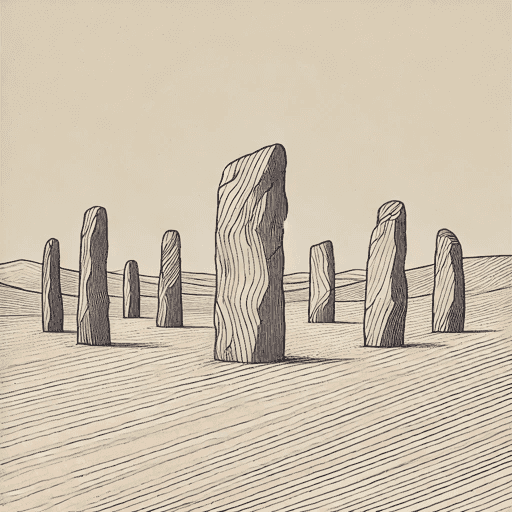
The Tombs of Atuan
50 pages • 1-hour read
Ursula K. Le GuinThe Tombs of Atuan
A modern alternative to SparkNotes and CliffsNotes, SuperSummary offers high-quality Study Guides with detailed chapter summaries and analysis of major themes, characters, and more.
Chapters 4-6Chapter Summaries & Analyses
Chapter 4 Summary: “Dreams and Tales”
Content Warning: This section of the guide includes discussion of gender-based discrimination, racism/xenophobia, religious discrimination, and death.
Arha falls ill. As she lies in bed, she tries to devise more elaborate executions for the next group of prisoners, feeling pressured by Kossil to make the deaths more gruesome. However, she dreams about the three prisoners she sentenced to starvation and wakes every night screaming, “They aren’t dead yet! They are still dying!” (38).
One morning, Penthe visits. She tells Arha that she did not want to be a priestess, but her family was poor and had too many children to feed, so her father sent her to the Godking’s temple. She dismisses Arha’s devotion to the temple, saying that the Godking is only a man for whom she feels no awe or devotion. Secretly, Arha agrees that the Divine Emperors of Kargad are upstarts, stealing worship from the true gods, but she is deeply unsettled and frightened by “the solidity of Penthe’s unfaith” (41).
By the time Arha returns to her duties, the three prisoners have died and been buried in the cavern. Thar teaches her the passages of the Undertomb, which Arha memorizes by touch. She does not enter the Labyrinth, preferring to wait. Thar also shows her spy holes scattered throughout the Place, even hidden among the rocks outside the walls, which look down into the Labyrinth.
In the spring, Arha ventures into the Labyrinth and learns the paths to various rooms within. Thar explains that the Labyrinth was built to hide the most valuable treasures in the secret Treasury of the Tombs, which is sacred. The previous One Priestess taught Thar how to access it, and Thar teaches Arha the path, warning that any other who enters will die. Only the One Priestess may enter; not even Kossil and Thar are allowed.
The Treasury’s greatest prize is the broken amulet of Erreth-Akbe. Thar and Kossil tell Arha the story of Erreth-Akbe, a sorcerer from the godless Inner Lands, inhabited by wizards with dark skin. Centuries ago, Erreth-Akbe came to Kargad and fought the High Priest of the Twin Gods. The High Priest won, taking Erreth-Akbe’s amulet of power and breaking it in half, though Erreth-Akbe himself escaped and fled home. Half of the amulet was hidden in the Tombs for safekeeping, and the other was held by a minor king of Kargad from the House of Hupun. The family kept the second half for centuries, but the father of the current Godking felt threatened by the ancient noble family and destroyed it. The first half was lost during this time. Since then, wizards from the Inner Lands have attempted to steal the broken amulet. Kossil adds that they have no gods and no souls. Their magic is perversion and trickery, and they spread lies. Arha is fascinated by the topic but dares not ask more.
Chapter 5 Summary: “Light Under the Hill”
Over the summer, Thar dies of an illness, leaving Arha alone with Kossil. Despite Arha’s technically higher status, she has learned not to push Kossil. Since her conversation with Penthe, Arha has come to understand unfaith. Kossil does not believe in any gods; she only worships power. She views the worship of the Nameless Ones as meaningless ritual and would get rid of the One Priestess if she thought she could get away with it.
Over several months, Arha continues to explore the Labyrinth, taking Manan with her. She trusts only Manan and wants him to be able to navigate in case of emergency. One night late in the winter, she enters the Undertomb to escape the cold and heads toward the Labyrinth, wishing to visit the Painted Room, her favorite place in the Tombs. However, as she enters the great cavern, she sees a faint light. At first, she thinks it must be imagining it, as no light has ever been permitted here. As she approaches, however, she sees a person in the cavern with a light burning at the top of a staff.
For the first time, Arha sees the cavern, and she is awed by the beauty of the immense roof and walls covered with glittery crystal and limestone filigree. Then she focuses on the person with the light, a dark-skinned man. Horrified that the Nameless Ones have not already struck him dead for daring to bring light into their sacred darkness, she screams at him to leave. The man turns to stare at her for a moment before he runs, Arha chasing him. When he enters the passage into the Labyrinth, Arha closes the iron door, trapping him. She pauses to consider her options. She does not want to tell Kossil immediately but knows she should. She concludes that the man must be a sorcerer from the Inner Lands who has come to steal the amulet of Erreth-Akbe.
Arha rushes out of the Labyrinth and to the spy hole inside her Small House, which is right above the place in the Labyrinth where she trapped the man. When she peeks inside, she is momentarily blinded by the light from his staff. Her vision clears, and she watches the man inspect his surroundings with a bemused expression. He waves his staff and speaks several words, trying to open the door. When he fails, he laughs. Eventually, he lies down on the rock floor. Arha notices a small crescent-shaped talisman tied around his neck but thinks little of it. She watches him sleep for a while before closing the spy hole.
Chapter 6 Summary: “The Man Trap”
The next day, Arha returns to the spy hole after completing her duties, but the man is no longer there. She recalls that Thar taught her the Labyrinth extends and spirals out in branches and dead ends for over twenty miles. She fears that the man has wandered off and will die of thirst and starvation before she can find him again. She thinks she will have to send Manan in to find his dead body, and the idea is so unbearable that she cries.
Arha tells Kossil about the intruder. Kossil believes he will run out of supplies and die within five or six days, and then she can send her warden to drag the body out. Arha insists that she wants to find the man alive. Kossil does not understand, and Arha cannot explain that the thought of him dying as the three prisoners did is unbearable to her.
The next day, Arha moves from spy hole to spy hole in hopes of finding the man. On the third day, she recalls a passage where one can hear running water behind the stones. She thinks a man in desperate need of water might stay there in hopes of reaching it. The passage is at one of the farthest ends of the tunnels, and she goes outside beyond the Wall of the Place to a spy hole hidden among the rocks. She finds him there, weakly chipping at the stone with a small knife, trying to reach the water behind it. The light on his staff is faint and flickering.
Arha calls out to him through the spy hole, giving him directions to the Painted Room and telling him to wait there. She shakes with giddy nerves as she heads for the spy hole above the Painted Room. She thinks she could watch him for days through that spy hole, sending him small amounts of water, as she wishes to keep him alive. The next morning, she checks the Painted Room through the spy hole. Lowering a small lit candle through the hole, she sees him sitting on the floor.
She gives him a long list of directions to the Treasury, suggesting he might find water there as well. He nods and leaves the Painted Room, following her instructions. She worries that he will get lost and die in the tunnels and she will have to send Manan to fetch his body. At the thought, she curls up and rocks back and forth in pain.
Later, Kossil asks Arha if the man is dead yet. Arha says she will send Manan to find him. Together, Arha and Manan search the tunnels until they find the man collapsed. She orders Manan to carry him back to the Painted Room. Manan objects, begging Arha to let him kill the man, but Arha refuses. She takes the man’s staff and the talisman from around his neck. Then she and Manan lock him in the room and leave.
The next day, she visits the man, who calls himself Sparrowhawk and explains that he is from a city called Havnor in the Inner Lands and has come to rob the Tombs. Arha calls him an unbeliever, but he insists that he believes in the Nameless Ones and has faced them before in other places. Arha notices four parallel scars that run down the side of his face and asks if they came from a dragon. He says the scars came from his battle with a Dark Power like the Nameless Ones. She demands that he stop lying and boasting to make himself sound more important. She is the One Priestess, reborn a thousand times, and she has the power to order his death or lock him in this room until he starves. Sparrowhawk nods and does not speak again, and she leaves feeling shaken.
Chapters 4-6 Analysis
Arha’s shame and guilt following her fainting spell at the end of Chapter 3 prevent her from facing Kossil. This shame and her nightmares indicate that she feels guilty over her role in the prisoners’ deaths, even though she is unable to articulate her feelings, even to herself. This shame is an early incident of questioning her role as the One Priestess, though her devotion to the Nameless Ones remains intact. This conflict between the demands of her faith and her own sense of morality build on the theme of The Nature of Faith. Arha’s faith receives a second blow during her conversation with Penthe, whose “unfaith” terrifies her. Penthe’s lack of faith in the gods and wish to be anything other than a priestess bring Arha uncomfortably close to recognizing her own discomfort and doubt, though she does not acknowledge this feeling for what it is. This echoes her feeling of boredom early in Chapter 3, which she describes as so strong “it [feels] like terror” and “[takes] her by the throat” (24). She is not self-aware enough to understand her feelings, but both her reaction to Penthe’s unfaith and her own terror and boredom suggest an underlying resistance to her religious role, a nod toward the theme of The True Meaning of Freedom. Similarly, her curiosity about the wizards of the Inner Lands, which Kossil and Thar are reluctant to discuss, also hints at her dissatisfaction and yearning for another kind of life. These moments also underscore the ways in which Arha’s supposedly powerful position nevertheless leaves her without true agency, building on the theme of The Roles of Women in Patriarchal Society.
Sparrowhawk’s appearance in the Undertomb brings Arha’s internal conflict to a head, forcing her to make a conscious decision whether to obey the requirements of her faith or her internal morals. Her previous experience with her guilt over the deaths of the three prisoners and her subsequent illness push her to follow her personal morality, keeping Sparrowhawk alive in defiance of Kossil and the law of the Tombs. Despite making this choice, she struggles to articulate to herself why she wants Sparrowhawk to live and makes many excuses, both to Manan and herself. However, this choice is a physical manifestation of her doubts about her role as the One Priestess and the ethics of her actions. This conflict is punctuated by the motif of dark and light, which reveals her internal struggle. For example, the magical light Sparrowhawk brings into the oppressive dark of the Undertomb allows Arha to see the true beauty and grandeur of the great cavern for the first and only time. Despite her faith in the Nameless Ones and her belief that light defiles this sacred place, she cannot help but wish to see the cavern again, foreshadowing the direction her internal struggle will eventually lead.
Illustrating the theme of the true meaning of power and faith, the external conflict between Arha and Kossil increases after Thar dies in Chapter 5. Following her conversation with Penthe, Arha comes to understand that Kossil has no faith in the gods and worships only power. For the first time, she realizes how dangerous Kossil might become if their battle for status and power becomes more overt. As a result, Arha cedes much of her power to Kossil, refraining from giving Kossil commands (though it is her right as the One Priestess) and doing her best to avoid Kossil’s notice. This uneasy stalemate inevitably ends, however, when Arha fails to kill Sparrowhawk as her duty demands. Her choice not to kill him or reveal his location to Kossil is symbolic of her emerging sense of her own power, which comes from her freedom to choose her own actions.
The broken amulet (or ring) of Erreth-Akbe emerges in this section as an important symbol of peace and magical power. In Chapter 5, Kossil and Thar tell Arha the story of Erreth-Akbe to explain the dangers of the heathen wizards of the Inner Lands and nurturing a fear of magic in Arha. This story heavily foreshadows the ring’s significance to the plot. When Arha takes the talisman, described as a piece of rough metal in a crescent shape, from around Sparrowhawk’s neck Chapter 6, her action is another manifestation of her emerging internal sense of power, as it stems from her decision to keep the man safe rather than causing his death. Though Arha does not realize its importance, Sparrowhawk’s open admission that he is there to rob the Treasury, which Kossil and Thar have indicated contains the other half of the ring, foreshadows the amulet’s true importance, which Sparrowhawk will confirm in Chapter 9.

Unlock all 50 pages of this Study Guide
Get in-depth, chapter-by-chapter summaries and analysis from our literary experts.
- Grasp challenging concepts with clear, comprehensive explanations
- Revisit key plot points and ideas without rereading the book
- Share impressive insights in classes and book clubs