52 pages • 1-hour read
The Widows of Malabar Hill
A modern alternative to SparkNotes and CliffsNotes, SuperSummary offers high-quality Study Guides with detailed chapter summaries and analysis of major themes, characters, and more.
Parts 1-2Chapter Summaries & Analyses
Part 1: “1921” - Part 2: “1916”
Part 1, Chapter 1 Summary: “A Stranger’s Gaze: Bombay, February 1921”
Content Warning: This section includes discussions of racism, addiction, abuse, and violence.
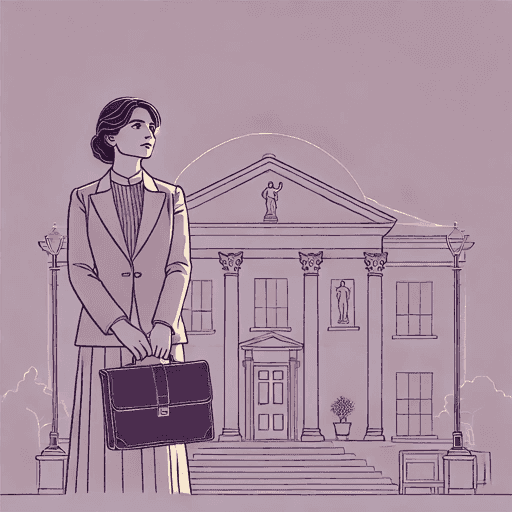
Perveen Mistry is a young female lawyer working for her family law firm in 1921 Bombay, under the guidance of her father. Her family is a wealthy Parsi family, and she is the first female solicitor in Bombay, though she is not allowed to appear in court. When she arrives at Mistry House, the grand family law office, she is startled to find a disheveled man sleeping at the door. She first assumes he is a down-on-his-luck client but realizes from his clothing that he must be wealthy and Bengali. He refuses to speak with her and flees. She questions the family butler, Mustafa, but he knows nothing of the stranger.
Perveen settles down to work, reviewing paperwork for a recently deceased client, Omar Farid. Farid was a wealthy Muslim mill owner who left behind three widows and four children. His estate trustee, Faisal Mukri, wrote to ask the law firm to authorize a change. The widows want to give up their inheritance as donations to the family’s wakf, a kind of charitable trust that supports the needy and gives a dividend to certain relatives. Perveen thinks that such a sudden change bears more scrutiny and resolves to speak with her father.
Noticing that the stranger is now across the street, she leaves the office to speak with him. When she asks him if he knows Cyrus Sodawalla, he flees. Though it is not yet revealed by Massey, Cyrus is Perveen’s abusive husband whom she is legally separated from. Like the stranger, he is Bengali and resides in Calcutta. At the court hearing for their separation, he vowed revenge against her family, and she worries that she will bring shame and trouble to her father and family.
Part 1, Chapter 2 Summary: “Behind A Curtain: Bombay, February 1921”
Perveen’s father, Jamshedji, returns, and the two eat lunch. He tells her that he won the court case for their client, a young dock worker who was charged with inciting unrest by unionizing the dock workers. Perveen is pleased that they won the case, but she is irritated when her father scolds her for approaching the strange man on the street. He tells her not to approach men alone and that he will handle it.
The two discuss the Farid will, and after reviewing the documents, Perveen thinks something is amiss. The women are purdahnashins—Muslim women who live enclosed and do not speak to men to whom they are unrelated. Perveen points out that the documents are in English, a language they are unlikely to speak, and that some of the women signed an X rather than their name. Finally, her father agrees that she may go and speak to the women herself since they will not speak to him. She wants to make sure the women understand what assets they are giving up and that they are doing it of their own free will.
Part 1, Chapter 3 Summary: “The Spirit of Ecstasy: Bombay, February 1921”
Mustafa interrupts Perveen’s work to announce the arrival of a ship from London, carrying Perveen’s best friend, Alice Hobson-Jones. Alice’s father, Sir David, is an important political figure in the British government in India. She and Alice met on board a ship, as they both left India for college in Oxford. They became fast friends and confidantes, and Alice told Perveen that she was a lesbian and that her parents disapproved.
At the docks, Sir David’s secretary finds Perveen and brings her to the family, who are waiting in the governor’s borrowed car. Sir David is friendly and his wife, Lady Gwendolyn, is stiff and a little afraid of Perveen. Perveen rides home with them in the Silver Ghost and is thrilled to be sitting in a Rolls Royce. However, her joy is spoiled when she sees a young man out the window who looks like Cyrus.
Part 2, Chapter 4 Summary: “A Stranger’s Gaze: Bombay, August 1916”
It is 1916, and Perveen is 19 years old and the only female student studying law at Elphinstone College in Bombay. The male students constantly torture her, stealing her tests and playing cruel pranks on her. They are jealous of her good grades and believe she has no right to be there. On this day, they ruin her sari by drenching her seat in chutney. In the women’s break room, her friends, Gulnaz and Hema, comfort her and try to help her clean it. They are studying literature and undergo no such torture from their classmates.
In the courtyard, they find a classmate, Esther Vachha, sitting with a handsome young man. He introduces himself as Cyrus Sodawalla, a wealthy cousin of Esther’s who is in Bombay looking for a bride. Perveen briefly greets him and then rushes in to take an exam. She is unable to take the test because she has lost her pen, and no one will lend her one. When the professor scolds her, she tells him that she resigns from the school.
In the courtyard, she runs into Cyrus who comforts her and convinces her to come to eat with him. Though she knows it is improper, she eats alone with him and confides her troubles to him. In turn, he complains about his parents’ plans for an arranged marriage and that he does not like the candidates. He begs her to meet with him again, and she refuses but tells him where she will be. She knows she is breaking the rules and possibly ruining her reputation, but she is also thrilled by the attention.
Part 2, Chapter 5 Summary: “Behind A Curtain: Bombay, August 1916”
A few weeks later, Perveen and Cyrus have seen each other a few times, including at some chaperoned events. Now they are sneaking off to the beach together, though Perveen knows how scandalous this is. On the trip, Cyrus confides in her about his family, including a sister, Azara, who died at 14 of cholera. Though Perveen does not know this yet, Azara died because she was locked in a room for confinement during her menstrual cycle and left unattended and ill.
Cyrus confesses his love for Perveen on the beach and asks her to marry him. She agrees if their families can be persuaded, and they kiss passionately.
Parts 1-2 Analysis
The opening sections of The Widows of Malabar Hill set up a trilogy of mysteries: the identity of the mysterious man who appears at the door of Mistry Law, the puzzle of the Farid inheritance, and the mystery of Perveen’s past. Massey establishes curiosity about who Cyrus Sodawalla is and what ended so badly between him and Perveen. In setting up these puzzles, Massey relies on some familiar tropes of the detective novel: the unlikely detective, the mysterious stranger, and the complicated legal case. However, she also adds depth and richness to the genre in her portrayal of Perveen. The dual timelines provide insight into Perveen as a young woman, prone to mistakes, and as a slightly older woman, matured by sorrow and circumstance.
The Perveen of 1916 meets with Cyrus alone and kisses him on the beach, though it is against societal mores. The Perveen of 1921 thinks that “it was a heavy responsibility to be the only woman solicitor in Bombay” and worries about disgracing her father (10). Despite these tensions and societal limitations, Massey portrays Perveen as a feisty heroine, and her father teases her that she is “impatient and impetuous,” especially when it comes to issues such as Indian independence and women’s rights. Massey’s use of the dual timelines establishes how Perveen’s character development will be as central to the novel as the mystery plot itself.
The early sections of the novel also establish several of its key themes, including The Impact of Cultural and Religious Traditions on Individual Lives and The Struggle for Gender Equality and Women’s Rights. Though Perveen is an adult and professional woman, she still defers to her father’s feelings and worries about embarrassing him. Flashing back to her time as a law student, Massey reveals the challenges and torment Perveen needed to overcome to gain entry into her field. With male classmates asserting that she has no right to be seeking the same education as them, Massey highlights the constrained position of women in early 20th-century Bombay. As the first female solicitor in Bombay, Perveen has gained entry into a high-achieving profession, even though she is not allowed to appear in court—another constraint Massey highlights to demonstrate The Struggle for Gender Equality and Women’s Rights, even among highly educated, capable individuals like Perveen.
Perveen is subject to strict cultural norms, just as the Farid widows are. She feels “squeamish about polygyny” (16), as she is more used to her cultural marriage practices, which she accepts as normal, including arranged marriages. Despite this acceptance, Massey still establishes the tension characters experience regarding cultural and religious traditions and the effect they have on their lives. As teenagers, Perveen and Cyrus each subvert cultural norms while acknowledging the risk inherent to doing so. For example, when Perveen eats alone with Cyrus and later sneaks off to the beach with him, she boldly asserts her autonomy and follows her romantic desire despite the potential consequences of ruining her and her family’s reputation. When Cyrus resists his parents’ arranged marriage candidates, he too rejects the rigid path his parents expect him to follow. Despite these subversions, Massey’s characters still wrestle with cultural and religious traditions and the expectations that come with them, highlighting the author’s thematic exploration of The Impact of Cultural and Religious Traditions on Individual Lives.
Throughout the novel, Perveen learns not to underestimate the purdahnashins despite their seclusion. Perveen also struggles to be taken seriously as a female attorney. Though her parents are supportive, change comes slowly, and she admits that “the idea of a woman solicitor was a shock to many” (3), further demonstrating how Perveen’s character experiences The Struggle for Gender Equality and Women’s Rights daily. Perveen also advocates for the rights of other women and is disturbed when she reads the last line in the newspaper obituary for Farid: “Mr. Farid is survived by his family, including one son. The obituary didn’t mention his wives and daughters” (19). However valuable or beloved these women were to Farid; they are not considered worthy of a mention in his obituary. Instead, only his infant son is mentioned because as the male heir, he has the most status in society. The status disparity between a male infant and adult women underscores that in 20th-century Bombay, women’s rights are constantly made subservient to men’s.

Unlock all 52 pages of this Study Guide
Get in-depth, chapter-by-chapter summaries and analysis from our literary experts.
- Grasp challenging concepts with clear, comprehensive explanations
- Revisit key plot points and ideas without rereading the book
- Share impressive insights in classes and book clubs