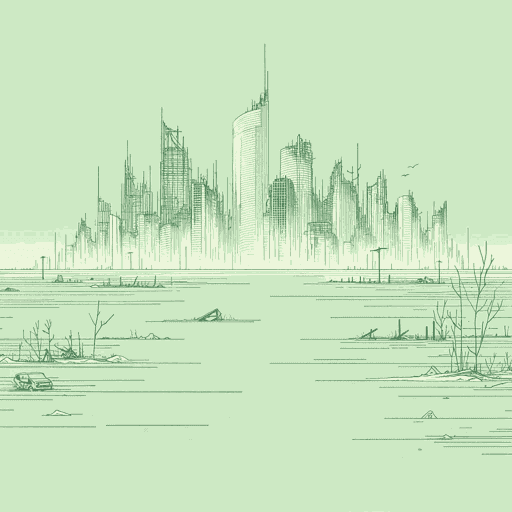
The World Without Us
52 pages • 1-hour read
Alan WeismanThe World Without Us
A modern alternative to SparkNotes and CliffsNotes, SuperSummary offers high-quality Study Guides with detailed chapter summaries and analysis of major themes, characters, and more.
Themes
Nature Is Flux
“Change is the hallmark of nature” (128), Anthony Andrady tells Weisman at the end of Chapter 9. This claim may seem like a truism, especially after digesting the chronicle of past, present, and possible future transformations that is The World Without Us, but it actually represents a relatively new paradigm in the relatively young science of ecology.
In the early 20th century, the first generation of ecologists believed in the “balance of nature”: the idea that, in the absence of interference from humans or exogeneous forces such as fire or meteor strikes, natural systems are inherently stable and static. If a forest burns down, for example, new plants will grow and replace one another in predictable waves until a stable suite of species emerges, perfectly adapted to the specific location and microclimate. This “climax” state will endure until another exogenous disturbance disrupts it. By the 1970s, however, field research was demonstrating that disturbance is in fact integral to ecosystem functioning; the poppy seeds Weisman discusses in Chapter 7, for example, require fire to germinate. Ecologists initially revised the “balance of nature” paradigm only by acknowledging “patches” of change within ecosystems that overall maintained a steady state. In the 1990s, however, dissenters began to argue that long-lasting equilibrium in ecosystem structure is the exception rather than the rule. The global climate, for example, has shifted in and out of ice ages some 50 times in Earth’s history and will continue to do so until planetary death.
Constant flux is the norm, in other words—a message that Weisman highlights throughout The World Without Us. He repeatedly illustrates how the phenomenal diversity of life on Earth is the result of evolutionary adaptation, by means of random genetic mutation at the micro level, to change at the macro level. The evolution of Homo sapiens was set in motion when increasing glaciation caused forest fragmentation in the Rift Valley of Africa, and the Pleistocene mega-extinction was set in motion when humans arrived as an unlikely new apex predator in the Americas. The Sahara was lush savanna only 6,000 years ago, until Earth’s orbit shifted and precipitation patterns changed as a result. The constancy of change can seem alarming, as when Weisman describes how quickly human homes and cities would be undone by weather and vegetation. In the context of human-inflicted environmental damage, however, he frames nature’s tendency toward flux as reassuring: What seem like devastating and permanent alterations to the environment are not insoluble problems from a planetary perspective. Microbes will evolve the capacity to digest plastic, heavy metals will be compressed into limestone beneath Galveston Bay, and forests will take over depleted rangelands. “Our world would start over” (267), Weisman predicts, even without us in it.
Humans as Innately Destructive
The primary focus of The World Without Us is to depict a posthuman future, but the dominant subtext decries the unsustainability of industrial human civilization and warns that current patterns of land use and resource consumption are undermining humanity’s well-being and could potentially hasten its demise. Weisman lays out the stakes in the Prelude:
Our world, some respected voices warn, could one day degenerate into something resembling a vacant lot, where crows and rats scuttle among weeds, preying on each other. If it comes to that, at what point would things have gone so far that, for all our vaunted superior intelligence, we’re not among the hardy survivors? (3).
This is an indictment of humans not only for being voracious consumers but also for not being clever or disciplined enough to control our own impulses. Weisman also suggests that, with humans removed from the picture, the conditions of life for most other species would improve or remain unaffected. For the most part, the world would “heave a huge biological sigh of relief” at humanity’s demise (5).
The question thus arises of whether humans are inherently destructive, either out of malice or simply carelessness. Some of the evidence Weisman cites supports this view; the extinction of the moa, for example, long predated industrialization and therefore seems to suggest that humans naturally wreak destruction when they enter new environments. This is also the view endorsed by some of the people Weisman interviews—most notably Les Knight, founder of VHEMT. As Knight tells Weisman, “By definition, we’re the alien invader. Everywhere except Africa. Every time Homo sapiens went anywhere else, things went extinct” (241). Knight therefore portrays voluntary extinction as a virtuous act of service to the planet, saying, “The last humans could enjoy their final sunsets peacefully, knowing they have returned the planet as close as possible to the Garden of Eden” (243). Because Knight’s language is frankly moralized, framing humans as interlopers in a literally paradisical world, it invites charges of misanthropy, which some critics have also leveled at the book as a whole.
Weisman’s overall portrayal is more nuanced than Knight’s, however. Though he documents humans’ many destructive effects on the environment, he also notes the exceptions—e.g., Africa, where the evolution of nonhuman species kept pace with that of humans, implying that it is possible for humanity to live in harmony with nature. He also implies that—for better or for worse—the disappearance of humans at this point would in some cases exacerbate environmental harm; with no one tending to nuclear reactors and warheads, large swathes of the planet could soon become devastatingly irradiated. Perhaps most notably, Weisman also speaks of fantasies of human extinction as a trap:
The vision of a world relieved of our burden, with its flora and fauna blossoming wildly and wonderfully in every direction, is initially seductive. Yet it’s quickly followed by a stab of bereavement over the loss of all the wonder that humans have wrought amid our harm and excess (244).
In other words, Weisman does not seem to rate human extinction as a net positive for the planet. The point of imagining humanity’s disappearance is not to celebrate or hasten that outcome but rather to motivate people to change their destructive behaviors in order to forestall it.
Reverence for the Earth and Life
The World Without Us is underpinned by an attitude of deep reverence for the Earth and the unlikely phenomenon that is life. Weisman repeatedly invokes not only the almost incomprehensible age of our planet, which circled the sun for billions of years before chimpanzee-like apes evolved into hominids and will most likely continue doing so for billions of years after the extinction of Homo sapiens, but also the dynamism that has repeatedly created and destroyed mountain ranges, formed and sundered continents, turned trees into coal and oil, and so on. “Three times in the past 100,000 years, glaciers have scraped New York clean,” he writes, “[and] at some unknown date glaciers will do so again” (37). The Sahara, today the world’s largest desert, “was once covered with rivers and ponds. With patience—though not, unfortunately, human patience—it will be again” (168). Weisman reiterates again and again that the entire human experience, however monumental it seems and however long it ultimately endures, will be infinitesimally brief in the context of Earth’s history. Describing the disintegration of homes and cities, he writes, “Only eons later, when old mountains have worn away and new ones risen, will young streams cutting fresh canyons through sediments reveal what once, briefly, went on here” (20).
Most remarkably, Earth is the only planet in our solar system that sustains life. A phenomenon that began as simple microbes in the ocean evolved into millions of diverse species of flora and fauna, many of which somehow manage to endure in the least hospitable places on this planet. The source of this diversity is evolution, the improbable process through which random genetic mutations, responding to Earth’s ever-shifting climate and geology, give rise to life forms of great complexity. Moreover, this process has repeated multiple times. Every time glaciers or asteroids wipe out species en masse, life bursts forth into new ones:
The world took off in a different direction […] that went from near nothingness to the lush kingdom of dinosaurs. […] When, after 150 million more years, that other asteroid hit what is now Mexico’s Yucatan Peninsula, and dinosaurs proved too big to hide or adapt, it was time to start over yet again (231).
Though the prognosis for our self-endangering species may not seem encouraging, Weisman reassures readers that the Earth and life will endure. Humans are simply one piece of a vast, complex, beautiful, and abiding whole.

Unlock every key theme and why it matters
Get in-depth breakdowns of the book’s main ideas and how they connect and evolve.
- Explore how themes develop throughout the text
- Connect themes to characters, events, and symbols
- Support essays and discussions with thematic evidence