64 pages • 2-hour read
The Yiddish Policemen's Union
A modern alternative to SparkNotes and CliffsNotes, SuperSummary offers high-quality Study Guides with detailed chapter summaries and analysis of major themes, characters, and more.
Symbols & Motifs
Content Warning: This section of the guide includes discussion of pregnancy termination and racism.
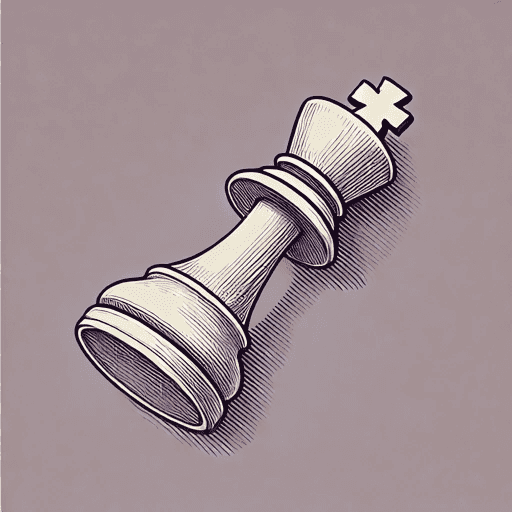
Chess
Chess recurs throughout the novel as a motif for Reconciling Fate and Free Will. When Landsman investigates the crime scene of Mendel’s murder, he becomes fixated on the chessboard he finds there: It records Mendel’s final game with an unknown opponent. It isn’t until the end that the novel reveals that Mendel set up the unsolvable game as a challenge to his killer, Hertz Shemets, to make him understand how Mendel felt about his life. Since Mendel has been forced to live the role of the Tzaddik Ha-Dor, he sees himself as trapped in a predetermined “game” orchestrated by his father and Litvak, where every move has already been decided for him. Thus, this chess game functions as his final act of communication and reflects Mendel’s experience of a life lived without free will.
For Landsman, the game of chess resonates with his own sense of inevitability. After losing his entire family in different ways, Landsman believes he is destined for loneliness and sadness. This perspective is cemented by his conviction that he acted wrongly when he and Bina decided to abort their child, which eventually resulted in the dissolution of their marriage. As a boy, Landsman’s father taught him to play chess with relentless criticism, making him believe that every move he made in each game was the worst possible move. That early experience instilled the conviction that he is destined to fail, which is reinforced by the many losses in his life, including his father’s unexplained suicide and his sister’s recent death. However, toward the end of the novel, Bina reframes his relationship to chess. She reminds him that while he cannot control the outcomes of his choices, the act of choosing still carries agency and meaning. Consequently, he leverages his tendency to “lose” (at both chess and life) to solve the mystery of Mendel’s death. Bina’s advice also emboldens him to do what he thinks is right with the knowledge of Litvak’s conspiracy. In this way, chess symbolizes the crushing weight of destiny as well as the possibility of choice within that framework.
“These Are Strange Times to Be a Jew”
The phrase “These are strange times to be a Jew” recurs throughout the novel as a motif for uncertainty and impermanence. First spoken in Chapter 1 by Tenenboym, the night manager of the Hotel Zamenhof, the line directly refers to the imminent Reversion. This threatens to scatter Sitka’s Jews around the world, condemning them to a life without a permanent home and taking away the only home that many of them, like Landsman, have known. By calling the times they are living in “strange,” the community externalizes its anxiety. The residents of Sitka distance themselves from the terror of an unpredictable future by treating it as a quirk of circumstance rather than a crisis of existence.
The phrase reappears in Chapter 5 when Chabon recounts the history of the Sitka Jews’ arrival in Alaska. Specifically, the expression is used to refer to the destruction of the State of Israel, which extinguished the Zionist dream of a permanent homeland and redirected the diaspora to Sitka. This cements the interpretation of the expression as a motif for uncertainty, as it reflects the Jewish people’s uncertainty of what their destiny is to be in the absence of a permanent homeland.
Red Heifer
The red heifer is a symbol of Using Sacred Tradition to Justify Violence. It first appears in Chapter 34 when Wilfred Dick takes Landsman and Berko to the secret pasture owned by the Beth Tikkun Jews. Berko spots it, noting that among the cows is a single red cow that has been disguised to look like it has white spots. He then identifies the red heifer as a ritual object in Jewish tradition—it is considered a sin offering or a rare sacrifice required for purification. Its hidden presence helps them to realize that Mendel’s murder is enmeshed within a broader plan to manipulate prophecy for political ends.
In Chapter 39, the red heifer is referenced again from Litvak’s perspective, revealing that it was a product of genetic engineering. He thinks: “Where they saw the fruit of divine wishes in a newborn red heifer, he saw the product of $1 million in taxpayer dollars spent secretly on bull semen and in vitro fertilization” (345). This undermines the religious significance of the red heifer as it was not the product of divine providence, but of human deceit, which strips the symbol of any sacred meaning. Ultimately, by appropriating prophecy, Litvak aims to push his violent ends by convincing the Sitka Jews into believing that the restoration of the Temple in Jerusalem is at hand. He hopes to justify war in Jerusalem and rally Jews into a nationalist cause. The irony is that Litvak is using the heifer, which is meant to signify purification, to instead sanction destruction.

Unlock the meaning behind every key symbol & motif
See how recurring imagery, objects, and ideas shape the narrative.
- Explore how the author builds meaning through symbolism
- Understand what symbols & motifs represent in the text
- Connect recurring ideas to themes, characters, and events