There Is No Devil
44 pages • 1-hour read
Sophie LarkThere Is No Devil
A modern alternative to SparkNotes and CliffsNotes, SuperSummary offers high-quality Study Guides with detailed chapter summaries and analysis of major themes, characters, and more.
Chapters 1-6Chapter Summaries & Analyses
Content Warning: This section of the guide includes discussion of death, death by suicide, sexual violence, self-harm, child abuse, physical abuse, emotional abuse, bullying, gender discrimination, addiction, substance use, and sexual content.
Chapter 1 Summary: “Mara”
Mara Eldritch wakes in Cole Blackwell’s ultra-secure Sea Cliff mansion. She dresses in what he has laid out for her, and she remembers him telling her that she can’t wear her old clothes anymore. In the kitchen, they discuss his desire for control over her clothes and what she has for breakfast. Mara feels defiant. She takes a shower and enjoys Cole watching her, teasing him deliberately. He joins her and brings her close to orgasm while speaking to her possessively. He shaves her intimately with a straight razor while they discuss the ongoing threat of Alastor Shaw, a rival artist who targeted Mara. Cole performs oral sex on Mara and then cuts a shallow line on her thigh and tastes her blood before kissing her. Mara remembers previous acts of self-harm when she cut herself.
Mara now feels “calm and placid,” and she asks Cole what he wants her to wear. He takes her shopping at Neiman Marcus, despite her anxiety that she will feel uncomfortable in a luxury store, as she is accustomed to poverty. At the store, Mara is overwhelmed by the prices and quality of the clothes. She feels that Cole is the first person to ever value her, remembering poverty and neglect in her childhood and her lasting feeling that she isn’t a good person. While they shop, Cole puts a small vibrator inside Mara’s underwear; she allows him to do this but doesn’t ask what it is. When Cole turns this on remotely, she realizes it is a vibrator. He controls her arousal while she tries to behave normally in public. Embarrassed, she insists that he turn it off, which he does. Then, Mara begins to find it funny and allows Cole to continue activating it. By the time they leave, Mara thinks that she has never felt “so cared for […] so loved” (23).
Chapter 2 Summary: “Cole”
Back at Cole’s mansion, Mara initiates sex, saying that it’s “her turn.” Cole thinks about how attracted he is to Mara, partly because of what he sees as flaws and signs of previous “neglect.” He considers that he has “managed to lure her here but not tame her yet” (24). Mara performs oral sex on Cole, and afterward, they discuss their feelings about giving and receiving pleasure and sexual control. They learn that while Mara gets pleasure from giving Cole pleasure, he gives her pleasure in order to gain control. Mara straddles Cole and puts her nipple in his mouth. He is aware of the metal of her nipple rings. When they are both aroused again, they have penetrative sex with Mara on top.
Afterward, they lie together, quiet and naked. They discuss how they both enjoy her nipple rings, put in forcibly by Alastor Shaw when he abducted her. Mara says that she has kept them because they “suit her” and remind her that the experience brought her to Cole. Cole asks Mara if she is happy in his house, and she says that she is because he is interesting and she can’t bear to be bored.
Chapter 3 Summary: “Mara”
Some weeks later, Mara works in the studio that Cole has provided. She considers their relationship, her knowledge that Cole helps her to control her, and her conflicted feelings about this. Mara knows that Cole is dangerous and wonders if he will become “cruel” to her now that she is reliant on him. Sonia, Cole’s assistant and Mara’s friend, visits, and they discuss art for a while. Sonia then tells Mara about her abusive husband, his resistance to her separation, and their acrimonious divorce. Sonia’s difficulties ended suddenly when her husband died after falling asleep with his car running in the garage, while intoxicated. Sonia implies that Cole caused this death in order to help Sonia.
Mara visits her old house to pay her former roommates, Frank and Joanna, some money she owes them. Frank is civil, but Joanna refuses the money, blaming Mara for the death of their mutual friend, Erin Wahlstrom, who was murdered by Shaw. Upset, Mara returns to Cole in his car and asks him about it. Cole says that this information is dangerous for him and accuses Mara of keeping her own secrets. Reluctant to share her history of abuse, Mara suggests a deal: She will tell him what he wants to know if he shares some information with her. Cole says that she can ask “one question” and vetoes any discussion of Shaw. Mara asks Cole to tell her about his first murder.
Chapter 4 Summary: “Cole”
Before answering, Cole starts the car, driving them to China Beach. He stops and insists that Mara drive, even though he knows she has no license or permit. Mara argues but then agrees. She learns how to use the car and starts to relax but then becomes distressed. She explains that her anxiety is caused by flashbacks to being in the car as a child while her mother drove under the influence of alcohol.
Back at the mansion, Cole shows her his father’s abandoned secret office and recounts his family history. He tells about his moneyed and successful grandparents and about his father, who grew up in privilege and was cruel to Cole and Cole’s mother. Cole’s mother died by suicide, which Cole intimates was the result of his father’s behavior toward her. After her death, Cole was left alone with his father and his father’s abusive and “jealous” brother, Ruben. Cole wanted to go to art school, but his father intended for him to join the family firm. When Cole’s father got ill, his uncle Ruben was made Cole’s legal guardian.
Cole describes his experiences of the physical and emotional abuse perpetrated by Ruben. He reveals that Ruben was the first person he murdered: As a teenager, he trapped Ruben in a pit on a hunting trip and left him to die, knowing that Ruben intended to kill him first and inherit the family fortune. Cole tells Mara that he has since killed 13 other men, including Sonia’s ex-husband. Cole then explains that Shaw targeted Mara to provoke him after seeing them together at an art show. Cole and Mara talk about how both of them are “wild” and “untamed.” Cole is aroused that Mara isn’t afraid of him and roughly initiates sex. Afterward, Cole asks Mara about her stepfather, Randall Pratt.
Chapter 5 Summary: “Mara”
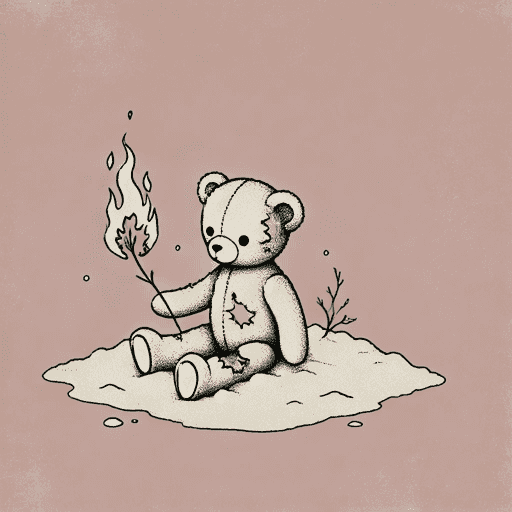
Mara tells Cole about her experiences as a child, 12 years earlier, when she was 14. One day, classmates bullied Mara for her poverty and ill-fitting clothes on her walk home. Randall punished her for being late by taking her iPod. Mara was frightened of Randall, especially of the way he looked lecherously at her in her school uniform, which he wouldn’t let her change out of. He belittled Mara as she cooked for him, calling her and her mother “sluts.” When Mara responded, he slapped her so hard that she blacked out and started bleeding. When her mother, Tori, came home intoxicated from alcohol, Randall made Tori burn Mara’s cherished teddy bear, Buttons. Mara went to bed suffering withdrawal because her mother had used or sold all of Mara’s prescription Adderall. Tori then told Mara that the bear was not a gift from Mara’s biological father, as Mara had believed. Late that night, Mara buried the bear’s remains, resolving to survive the “1,794 days” until she could leave home at age 18.
Chapter 6 Summary: “Cole”
The next morning, Cole looks at Mara’s laptop while she sleeps. Going through her emails, he finds thousands of abusive emails from Tori in a folder. He is shocked by the volume of emails and how vicious they are. Waking up, Mara finds Cole looking at her laptop but accepts that he is curious about her. Cole says that they must attend a gallery party later that evening and that Shaw will be there. Mara says that she doesn’t want to see Shaw, but Cole says they need to go and reassures her that he will look after her.
Mara dresses in her old clothes, insisting on working her waitressing shift at the Sweet Maple restaurant. She tells Cole about her loyalty to the owner, Arthur, who hired her after her mother had destroyed her art portfolio to stop her studying and Mara was living without a home. When Mara explains how Arthur offered her help and a job, Cole agrees that she can work her shift. Mara drives herself in Cole’s car, confronting her fear of driving and asserting her independence.
Chapters 1-6 Analysis
These opening chapters establish the novel’s dark, fantastical world where psychological control is the primary language of love, introducing the theme of Redefining Love Through Control and Submission. The dynamic between Mara and Cole is shown to be built on a series of rituals based around conflicts between ownership, control, autonomy, and consent. Cole’s actions—from preparing Mara’s latte to shaving her with a straight razor—are presented as acts of supreme attention as well as objectification, where his desire for control over her body is a testament to his devotion. This paradox is central to the novel’s expression of the dark-romance genre, in which elements of the narrative’s sexual and emotional fantasy often rely on taboo or ambiguous dynamics.
In these chapters, Mara’s vulnerability is shown to be as the basis for the bond between her and Cole, precipitated by her need to be protected from Shaw. Cole offers a form of coercive physical and financial security that Mara recognizes to be a “terrifying” attack on her coping mechanisms of independence and self-reliance. His declaration that he wants her “obsessed with [him], bound to [him], dependent on [him]” serves as a mission statement for their relationship in this section (5). Mara’s combination of compliance and resistance creates emotional tension, setting up the increasingly mutual intimacy in later chapters. The shopping spree in Chapter 1 exemplifies this, as Cole asserts his domination over her physical sensations while buying her the material trappings of a new identity, a double expression of ownership. The semi-consensual use of the vibrator in this scene acts to signal the novel’s ambiguity around sexual-consent boundaries and the push and pull of desire, control, and acquiescence.
The narrative structure, which alternates between Mara’s and Cole’s first-person perspectives, is introduced as a crucial mechanism for exploring Vengeance as a Dark and Alternative Form of Justice. By immersing the reader directly into the protagonists’ subjective realities, the novel dismantles external moral frameworks, encouraging suspension of disbelief and alignment with the characters’ self-justifications. This narrative choice supports the novel’s presentation of the characters’ extralegal violence as a necessary corrective in a world where conventional justice is ineffective, as Sonia’s description of the legal system as “a stick in the hand of the biggest bully” confirms (34).
In these early chapters, trauma is established as the foundational material from which both protagonists construct their identities. The novel uses internal exposition of their pasts—Cole’s confession in his father’s ruined office and Mara’s extended flashback—to establish that their identities are forged in response to formative violence. For Mara, her recollection of the destruction of her teddy bear, Buttons, is a pivotal event. Its ritualistic burning by her mother and stepfather was an act of profound psychological violence, annihilating the emotional support object she had used to survive and that she was attached to in lieu of kind or secure relationships. This moment marked the premature death of her childhood hopes and the birth of a hardened identity, as she was committed to enduring until escape was possible. Cole’s origin story functions as a dark parallel. His murder of his abusive uncle Ruben was a foundational act of self-preservation that codified his identity as a protector and executioner. He reclaimed power from his abuser, transforming from victim to predator and establishing the personal code of justice that would define his life. Both characters are shown to be defined by a violent break with their pasts. This shared history of traumatic transformation becomes the bedrock of their mutual understanding as the novel progresses.
Throughout these chapters, concepts of transformation underscore the characters’ conscious efforts to reclaim their narratives. Mara’s decision to keep the nipple rings installed by Shaw during her captivity is characterized as a powerful act of agency. This act of repurposing aligns with Cole’s philosophy of turning pain into power, encapsulated in his assertion that “[a] diamond can’t shine until it’s cut” (6). This idea is further reinforced through the driving lesson, a therapeutic ordeal where Mara confronts a phobia linked to her mother’s abuse. By mastering the car, she seizes control over a source of past terror, a literal and metaphorical act of taking the wheel of her own life. The shopping spree functions similarly as a ritual of reinvention, where Cole strips Mara of her old clothes and gives her a new, powerful identity. These plot points illustrate the novel’s interest in self-reinvention and reassessment, hinting at the developments that will unfold.

Unlock all 44 pages of this Study Guide
Get in-depth, chapter-by-chapter summaries and analysis from our literary experts.
- Grasp challenging concepts with clear, comprehensive explanations
- Revisit key plot points and ideas without rereading the book
- Share impressive insights in classes and book clubs