There Is No Devil
44 pages • 1-hour read
Sophie LarkThere Is No Devil
A modern alternative to SparkNotes and CliffsNotes, SuperSummary offers high-quality Study Guides with detailed chapter summaries and analysis of major themes, characters, and more.
Important Quotes
Content Warning: This section of the guide includes discussion of death, death by suicide, graphic violence, sexual violence, child abuse, physical abuse, emotional abuse, gender discrimination, sexual content, and cursing.
“I want all of you, every single part. […] I want to occupy your thoughts like you occupy mine. I want you obsessed with me, bound to me, dependent on me. I want you to live for me, not just with me.”
(Chapter 1, Page 5)
Cole’s declaration of intent establishes the novel’s dark-romance tropes and exploration of the theme of Redefining Love Through Control and Submission. The anaphora of “I want” emphasizes his possessive and consuming desire, framing obsession as the ultimate goal of the relationship for him. By demanding that Mara “live for” him, Cole articulates a philosophy where love is equated with the surrender of individual identity and autonomy.
“He makes one thin slash on my inner thigh, so quick and sharp that the pain flares and vanishes before I even register it. Blood wells up, darker than wine. He catches it on his tongue, lapping the shallow wound, closing his mouth over it.”
(Chapter 1, Pages 13-14)
This moment introduces the Blades motif, part of the novel’s blurring of sexual intimacy and violence. The act of cutting Mara and tasting her blood is presented here as a ritual of possession and sensory experience. The simile comparing her blood to wine references the sacramental image of blood/wine in a taboo way, illustrating the dark, unconventional nature of their bond.
“The value in horrible things is what you make of them. As long as you’re alive, you can still turn shit into gold.”
(Chapter 2, Page 29)
Here, Mara articulates a personal philosophy that is central to her character and the theme of Art as an Expression of Identity and Experience. The metaphor of turning “shit into gold” uses crude language to express a sophisticated concept of alchemical transformation, suggesting that trauma can be repurposed into something valuable, like art. This statement defines Mara’s resilience, especially her practice of repurposing her painful past as artistic inspiration.
“‘A miracle,’ Sonia says. […] ‘He’d driven home late from some bar. Fell asleep in the garage. Never turned off the engine.’”
(Chapter 3, Page 34)
Sonia recounts the convenient death of her abusive ex-husband. The narrative here relies on subtext, as Sonia’s flat, factual delivery of a supposed accident is juxtaposed with her labeling it a “miracle.” Her understated storytelling strongly implies Cole’s intervention, although this remains unspoken by the characters in this scene. Sonia’s account develops the theme of Vengeance as a Dark and Alternative Form of Justice by presenting murder as a necessary and effective solution where the legal system failed.
“I knew he was stone-cold inside because I was, too. He didn’t only hate me because he was jealous—he hated me because I saw what he really was.”
(Chapter 4, Page 51)
In this moment of self-analysis, Cole admits a shared recognition with his uncle Ruben, framing his selfish nature as an unchangeable fact of his identity. This direct characterization establishes a crucial psychological parallel between Cole and his antagonists, suggesting that their conflicts stem from a mutual understanding of a shared internal darkness. Cole’s sense of himself here as “stone-cold” sets up his character arc, as the narrative reveals him to be increasingly open to emotion through his relationship with Mara.
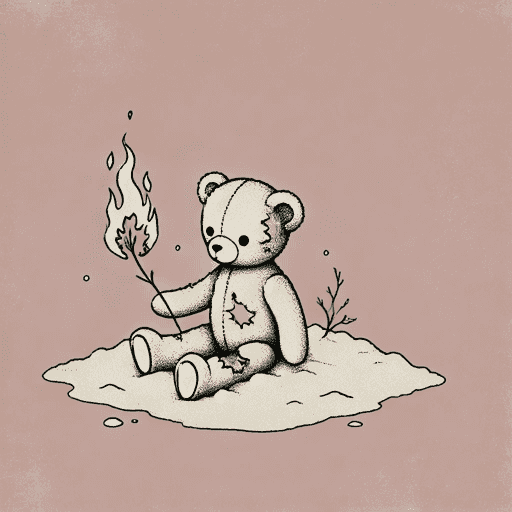
“I watch him burn, and I burn, too, howling with pain that feels physical, like I’ve truly been lit on fire right next to him.”
(Chapter 5, Page 72)
This passage marks the climax of Mara’s childhood trauma, centering on the destruction of Buttons, her childhood teddy bear. The visceral imagery and the metaphor “I burn, too” illustrate the annihilation of her innocence and her last connection to a fantasized paternal love. By internalizing the bear’s destruction as Mara’s own, the text shows that this particular act of cruelty became a formative part of her identity.
“Everything I do for her binds her closer to me. I want her dependent on me so she can never leave. So she never even wants to.”
(Chapter 6, Page 78)
In his internal monologue, Cole reveals the true intention behind his actions toward Mara. This confession clarifies that his generosity and support are calculated tools of control, designed to foster her dependence. His reasoning directly subverts idealized notions of love and support, explicitly expressing the dark-romance nature of the relationship.
“The aggressive color envelops you, making your eyes burn and your head spin. You’re trapped inside a rainbow prism that seems to go on and on forever, disorienting and intoxicating.”
(Chapter 7, Page 90)
This quote describes Mara’s visceral reaction to Shaw’s art installation. The use of vivid sensory details—“aggressive color,” “eyes burn”—and the metaphor of a “rainbow prism” convey the artwork’s overwhelming and sinister nature. The description mirrors the psychological state that Shaw induces in his victims: disorientation, entrapment, and a mix of attraction and repulsion. This moment emphasizes Shaw’s art as a direct extension of his predatory personality, reinforcing the theme of art as an expression of identity and experience.
“I’m a tree that grew in cruel wind, twisted and bent by it. Sex and violence, passion and intensity, are inextricably entwined for me. I can’t have one without the other.”
(Chapter 7, Page 95)
During a session of intensely violent sex, Mara reflects on her need for this. This metaphor of a “tree that grew in cruel wind” provides a concise and powerful explanation for her psychological state, framing her desires as an adaptation to—or continuation of—a traumatic upbringing. The revelation of Mara’s feelings at this point makes her willingness to participate in violent sexual practices explicit, essential to the novel’s portrayal of both consensual and non-consensual sex and violence.
“I HATE HIM! I HATE HIM! I HATE THEM ALL! I WANT THEM ALL FUCKING DEAD!”
(Chapter 7, Page 98)
Mara screams this about Shaw after Cole chokes her without her consent during sex. The use of capitalization and repetition emphasizes the raw, primal nature of her rage, although this rage is directed at Shaw, not Cole. The novel presents this moment as Mara’s shift from being a passive survivor to an active seeker of vengeance, deliberately facilitated by Cole’s non-consensual violence toward her. This scene is therefore the climax of the novel’s ambivalent presentation of consent, autonomy, and control in relationships. Mara’s outburst signals a crucial shift in her character arc, aligning her with the theme of vengeance as a dark and alternative form of justice by showing her embrace of violent retribution.
“The maze includes a dozen routes, but only one will take you all the way through. The correct pathway is hidden within the walls. The openings can only be found by standing at just the right angle or running your hands along the dark glass to feel where it breaks.”
(Chapter 8, Page 102)
Cole reveals the model for his labyrinth sculpture to Mara. The description of the maze functions as a symbolic expression of Cole’s own psyche: complex, deliberately misleading, and accessible only to those with the right perspective or insight. The detail that the path is found by touch or a specific angle suggests that logic is insufficient to navigate his world, requiring intuition and intimacy instead. The labyrinth also foreshadows the setting of the novel’s final confrontation, establishing the physical and psychological endgame for the characters.
“I recognize the childish handwriting: Happy Mothers Day Mommy
I love you so so so so so so much. I made you cinnimin tost.
Im sorry I make so many misstaks. Your the best mom. […] I will be beter. […] I love you Mommy. I love you.”
(Chapter 9, Page 116)
Mara receives an abusive email from her mother containing a scanned image of a card she wrote as a child. The verbatim transcription of the card, complete with Mara’s childlike spelling errors and desperate pleas for love, serves as a powerful artifact of her traumatic past and lost innocence, connecting to the symbol of Buttons the teddy bear. By presenting the text without summary, the raw voice of young Mara directly confronts the reader, demonstrating how adult Mara’s past is actively weaponized against her by her mother.
“Years later, I read the last entry in her journal: ‘I can’t change him. He’s just like them.’”
(Chapter 10, Page 130)
In his mother’s terrarium, Cole recounts the story of her suicide, culminating in this quote from her journal. This line is the origin point of Cole’s self-perception as an irredeemable monster, a belief that has governed his actions since that time. The finality of his mother’s judgment following her death establishes the core of his psychological trauma and explains his detached, controlled nature. The novel presents Cole’s mother’s comment as a self-fulfilling prophecy, leading Cole to pursue an identity that reflects her opinion of him. Mara’s subsequent rejection of this view of Cole is a pivotal moment in their relationship, enabling a considerable softening of Cole’s character.
“‘You think the painting is the product, but it isn’t,’ Cole tells me. ‘You’re the product: Mara Eldritch, the artist. If you’re interesting, then the work is interesting.’”
(Chapter 11, Page 133)
Cole offers Mara advice on self-promotion, reframing her approach to her career. This dialogue explicitly articulates the theme of art as an expression of identity and experience, arguing that an artist’s personal history is inseparable from their work’s value. This dialogue is also expressive of the mentor-student dynamic often adopted between Cole and Mara. Cole’s statement urges Mara to commodify her own trauma and personality, forming part of his continual pushing at Mara’s emotional and psychological boundaries.
“My rejection of violence was a pillar in my sense of self. The evidence that I was a good person. Now I wonder if I’m just a coward.”
(Chapter 13, Page 141)
Mara’s internal monologue marks a fundamental identity crisis, directly questioning a core moral belief she previously held. This reflection demonstrates the breakdown of her former worldview, a shift central to the theme of vengeance as a dark and alternative form of justice, as she begins to reframe inaction as cowardice rather than moral strength. This is a pivotal moment in Mara’s increasing embrace of violence toward others under Cole’s influence, part of the dark-romance thriller plotting.
“In the artist’s version, Mara stands before a large mirror. The ‘real’ Mara is battered and bruised, with a wide-eyed expression of fear. Her reflection appears ten years older: glossy-haired, dressed in a diaphanous black gown, eyes dark and ferocious, and her aura crackling with the power of a sorceress.”
(Chapter 13, Page 144)
This description of Mara’s painting The Two Maras explicitly uses the motif of mirrors and reflections to represent her fractured and evolving identity. The artwork serves as a visual manifestation of her internal state, juxtaposing her traumatized past self with a powerful, emerging persona that she has yet to fully embody. This passage exemplifies the theme of art as an expression of identity and experience, showing how Mara processes her personal history by transforming it into a creative work.
“The Ambien was for me, not for her. I need to know she’s safely locked away in this room so I can focus on the task at hand.”
(Chapter 14, Page 163)
Cole’s narration reveals why he has encouraged Mara to take a sedative: to incapacitate and confine her while he commits murder elsewhere. This direct statement exposes the calculated nature of his control, reframing an act of apparent care as one of dominance. The use of dramatic irony, where the reader becomes aware of Cole’s deception while Mara remains oblivious, highlights the theme of redefining love through control and submission.
“I watch Cole murder Randall slowly, brutally, with obvious pleasure. I watch my vengeance unfold in front of me. When it’s finished, Randall is nothing but meat on the floor. […] I feel hollow inside, all the anger, all the pain, all the resentment scooped out of me.”
(Chapter 15, Page 182)
Mara’s detached observation of her stepfather’s murder signifies a critical point in the novel’s depiction of her psychological transformation. The visceral imagery of the body as “nothing but meat on the floor” emphasizes the violence of the scene and suggests that Mara feels little remorse at Randall’s death. This moment serves as the fulfillment of her earlier desire for action, demonstrating her acceptance of extralegal violence as a form of justice. This episode foreshadows her subsequent independent killing of her mother.
“I may not be Doctor Frankenstein, but I helped flip the switch on that particular monster.”
(Chapter 16, Page 200)
In this confession to Mara, Cole uses a literary allusion to reframe his relationship with his rival, Shaw. By comparing himself to Frankenstein, he accepts a degree of responsibility for creating the “monster” that Shaw became, admitting that his own actions inadvertently fueled Shaw’s first murder. This moment adds complexity to his character, showing self-awareness and a recognition that his personal quest for vengeance had unforeseen, destructive consequences.
“We’re drawing the attention of our fellow partygoers, but I don’t make the mistake of seeing if Shaw is watching, too. I pretend to be entirely engrossed in the argument, trying to quiet Mara, grabbing her by the wrist.”
(Chapter 18, Page 211)
This passage details the calculated performance that Mara and Cole enact to lure Shaw. Cole’s internal monologue reveals the mechanical nature of the performance, as he pretends to be engrossed in an argument while strategically monitoring their target. This focus on performance and deception builds suspense and shows how their intimacy has been weaponized to serve their shared goal of vengeance.
“The reflective glass disorients me. Ghostly versions of myself chase along my left and right side, splitting off at dizzying angles every time I turn.”
(Chapter 19, Page 222)
This quote uses the motif of mirrors and reflections to externalize Mara’s internal state of panic and confusion within Cole’s labyrinth. The “ghostly versions” of herself symbolize a fractured identity and the terror of the moment, including the possibility of her death. This imagery immerses the reader in Mara’s psychological disorientation and mortal fear as she is hunted by Shaw.
“The first time we fucked, she was bouncing and squealing so loud, it echoed up the staircase…Half the party must have heard her. The second time…well, the second time I wasn’t as nice.”
(Chapter 19, Page 224)
Shaw’s dialogue establishes his unrepentant sadism and provides the final justification for Mara’s actions, solidifying the novel’s exploration of vengeance as a dark and alternative form of justice. His crude, taunting recollection of a victim’s murder frames him as a misogynist and malevolent figure against whom conventional justice is ineffective. The casual cruelty in Shaw’s tone adds credence to the novel’s exploration of extralegal justice.
“I’m so afraid that I’ve passed right through to the other side. A deathly clarity settles over me. This is it. This is the end. Whatever happens, I won’t give in.”
(Chapter 19, Page 228)
This passage marks a pivotal moment in Mara’s character arc, showing her extreme fear transform into resolute determination. The phrase “passed right through to the other side” signifies a psychological threshold being crossed, moving her permanently beyond a sense of victimhood and also echoing the potential outcome of her death. The internal monologue shows Mara’s acceptance of her potential death, which paradoxically empowers her to act and reclaim her agency.
“I finally realize what happiness feels like. There’s no malice in it. No greed. It’s not something you seek for yourself. It flows between two people, around and around, back and forth, given and received in the same breath.”
(Chapter 20, Page 232)
Occurring immediately after a scene of extreme violence, Cole’s internal monologue reveals a profound character transformation. His description of happiness as a reciprocal flow directly challenges his prior philosophy of domination and control. This reflection serves as the emotional climax of his arc, suggesting that his capacity for love has been unlocked through the shared, violent act against Shaw with Mara.
“Cole goes still, resting his hand on my lower back. There’s no hint of play in his voice now. ‘Did it satisfy?’ […] ‘It feels right,’ I say at last. ‘It feels good.’”
(Chapter 21, Page 247)
This quiet exchange serves as the thematic culmination of Mara’s revenge arc. Cole’s question, “Did it satisfy?,” bypasses moral judgment to focus on the personal, emotional outcome of her violent act. Mara’s affirmation that killing her mother “feels right” and “good” solidifies the narrative’s suggestion that, for survivors of profound trauma, personal retribution can be a source of legitimate closure and empowerment.

Unlock every key quote and its meaning
Get 25 quotes with page numbers and clear analysis to help you reference, write, and discuss with confidence.
- Cite quotes accurately with exact page numbers
- Understand what each quote really means
- Strengthen your analysis in essays or discussions