There Is No Devil
44 pages • 1-hour read
Sophie LarkThere Is No Devil
A modern alternative to SparkNotes and CliffsNotes, SuperSummary offers high-quality Study Guides with detailed chapter summaries and analysis of major themes, characters, and more.
Symbols & Motifs
Content Warning: This section of the guide includes discussion of child abuse and physical abuse.
Blades
The motif of blades functions to illustrate the novel’s interest with blurring the lines between intimacy and violence and between control and devotion. Cole’s straight razor, in particular, embodies this dangerous duality. In one of the novel’s most defining scenes, he uses it to shave Mara, an act of meticulous care that requires absolute trust; the blade’s cold touch on Mara is a constant reminder of his capacity for lethal precision. This tension culminates when he makes a deliberate cut on her thigh, realizing the blade’s potential for violent control and ritualistic bonding through pain and blood. At this point, he tells her, “You’re never going to be the biggest or the strongest in the fight. You have to be the most ruthless. You may only get one chance” (11). This statement explicitly links the blade to the theme of extralegal vengeance, framing transgressive violence as a tool for personal survival. By the novel’s climax, Mara has internalized this lesson, wielding a knife against Shaw. Mara’s journey from being the passive recipient of the blade’s threat to actively using it herself marks the dark progression of her character arc, under the influence of her relationship with Cole, toward violence and extralegal justice.
The Labyrinth
Cole’s sculptural labyrinth, a massive, disorienting installation of black glass, serves as a major symbol, merging the themes of art, psychological control, and vengeance. Representative of the rivalry between Cole and Shaw, both men bid for the commission in the park. As Cole’s magnum opus, the labyrinth is a physical manifestation of his mind: It is a cold, complex, and beautiful trap with only one true path, which he alone fully understands. Its reflective walls function as a maze of distorted mirrors, forcing those inside to confront fragmented versions of themselves and disorienting their sense of reality. When Mara enters, she notes, “Ghostly versions of myself chase along my left and right side, splitting off at dizzying angles every time I turn” (222). This experience symbolizes her internal journey, integrating the darker, more violent parts of her identity that Cole has cultivated. Through Cole and Mara’s entrapment of Shaw, the labyrinth becomes a custom-built arena for their final, brutal confrontation with him. By staging the novel’s climax within his own creation, Cole asserts his ultimate control over the narrative, transforming a public art installation into a private space for a personally determined form of retribution.
Buttons the Teddy Bear
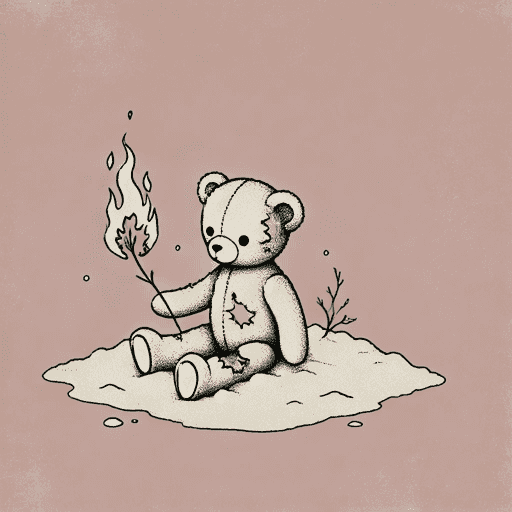
Buttons the teddy bear is a symbol of Mara’s stolen innocence and the systematic cruelty that defined her childhood. Buttons represents Mara’s only connection to a fantasized father and the unconditional love she was denied by her mother and stepfather. The bear is shown to be her sole source of comfort in a hostile world. Its deliberate, ritualistic destruction by those who were supposed to be Mara’s caregivers is the novel’s central depiction of the childhood abuse she experienced. As she witnessed her bear’s destruction, Mara’s grief was absolute: “I watch him burn, and I burn, too, howling with pain that feels physical, like I’ve truly been lit on fire right next to him” (72). This moment marked the death of her childhood and the birth of a deep-seated trauma that informed her entire identity. The bear’s destruction represents the annihilation of Mara’s natural childlike hopes for safety and love in the family home, shifting instead to a mode of endurance until she was old enough to leave.

Unlock the meaning behind every key symbol & motif
See how recurring imagery, objects, and ideas shape the narrative.
- Explore how the author builds meaning through symbolism
- Understand what symbols & motifs represent in the text
- Connect recurring ideas to themes, characters, and events