This Thing Between Us
47 pages • 1-hour read
Gus MorenoThis Thing Between Us
A modern alternative to SparkNotes and CliffsNotes, SuperSummary offers high-quality Study Guides with detailed chapter summaries and analysis of major themes, characters, and more.
Part 3Chapter Summaries & Analyses
Content Warning: This section of the guide includes discussion of death, animal death, graphic violence, suicidal ideation, substance use, and death by suicide.
Part 3 Summary
Although Diane swears Thiago was conscious on the drive to the hospital, he can’t remember it. Instead, he opens his eyes and finds himself on a beach. Waves crash on the sand and, “like Rose standing on the bow of the Titanic” (160), the wall stands at the end of the jetty. The cook is present, and he says that Thiago isn’t supposed to be here because it’s not ready yet. Thiago sees lots of fish trapped within a stone ring. The cook says this is meant to starve them, removing any “off” flavors before they’re eaten at the “banquet” he’s been preparing for Thiago. Thiago senses a metallic note mixed within the pleasing smells, and he thinks how easy it would be to “let go” here. The cook refers to the wall as an “interface” and a “threshold” needed to breach Thiago’s boundaries. He says that all of Thiago’s loved ones are here.
When Thiago wakes up in the hospital, Diane is there. She tells him that police shot the dog. She asks if he’s okay, and he cries as the whole story tumbles out, going all the way back to the Itza. Eventually, Diane begs him to stop. When Thiago is discharged from the hospital, he says that he wants to stay at a hotel because something is after him, and he doesn’t know what it wants. Diane agrees. On the way, they see police at the vet’s office and stop there. The tech tells Thiago that Jacobson is missing. He met the police at the clinic to do a postmortem on the dog, but he never made it home. The tech came to check after Dr. Jacobson’s wife called about his whereabouts; the tech found only the dog’s remains, exploded all over the examination room.
At the hotel, Thiago remembers how hard it was to win Diane over when he was dating Vera. She didn’t think he measured up, and when he asked for her permission to propose, she said that Vera was old enough to make her own mistakes. Now, Diane asks him about the wall she saw in the backyard, and he explains that he and Brimley found it in the woods but that it later moved. He suggests that the wall reanimates bodies to use as vessels, saying that whatever manipulates it tried to convince him that it was Vera. He says that the wall showed him the day Vera died, recreating the platform. Thiago is certain that Vera would never have used her death to make him feel guilty, so “the wall figured out it made a mistake [by failing to impersonate Vera convincingly] and sicced the dog” on him (176). Diane believes him; she says that in Mexico, where she was born, almost everyone has some experience of the supernatural. Diane also thinks that Vera’s not actually dead. Thiago is tired of trying to figure it all out yet feels compelled to do so.
In the middle of the night, someone tries to get into their hotel room. When Diane calls security, two men chase the person down the hall. Diane and Thiago move to another hotel, and he considers suicide to stop whatever pursues him. Diane asks about Fidelia, and Thiago tells her that Fidelia drew a big rectangle in blood on the condo’s wall, about the size of the wall that appeared at the cabin. He says that Fidelia mentioned “canal,” and Diane points out that “canal” is Spanish for “channel”; she suggests that Fidelia created a portal between places and times, and she calls her relatives for advice on how to deal with it.
Thiago and Diane return to the cabin. They pour salt at every entrance and sprinkle holy water too. Diane tells Thiago to write down all the details of his story that he can remember, like he’s telling Vera. Then, they’ll burn it. Soon, they see Dr. Jacobson trudging through the snow as though he’s learning to walk. The dog destroyed his face, and whatever animated the dog is now animating the vet. Diane calls 911 as Jacobson approaches the patio door, telling Thiago to claim his seat at the banquet. Thiago asks why this entity killed Vera. It says that Thiago killed her to “remove distractions […] [f]rom the task” (198). Thiago assumes that “the task” is pulling whatever this thing is out of the wall, and then it speaks to him in his father’s voice as it sweeps the protective salt away. Diane fires a bullet into its head at point-blank range, and it creates a caved-in spot that begins to suck things in, like a vacuum. The vacuum sucks in Diane’s gun, followed by her hand and arm. Thiago drags her out of the hole, but it strips a lot of her flesh away.
Thiago pulls Diane out the front door, only to find the wall blocking their path. It is in flames, but Thiago senses a stationary white light in the trees. Stumbling toward it, he sees that it is the Itza, sitting atop his and Vera’s table with its pulsing LEDs. Diane is now dead, and Thiago watches himself—in boxers and t-shirt—standing at the Itza and cancelling the alarm for the morning of Vera’s death. He screams that this is a lie, and then Dr. Jacobson stabs him with the shovel. Jacobson drags him back to the clearing, throws him into a grave, and begins to bury him. Thiago remembers old movies where someone is buried alive, and he tries to stay calm. He can see Jacobson’s shape above, and someone yells to the vet to drop his weapon. Gunshots pop while Thiago tries to climb out. Three officers help him, and he looks down at Jacobson’s bullet-riddled body.
Part 3 Analysis
The entity possessing the Itza, Brimley, and Dr. Jacobson continues to function in part as a symbol of The Indescribable Intensity of Grief. This is evident in the way Thiago interacts with it. Thiago’s “dream” of the banquet on the beach echoes both the intensity of what he’s experiencing and the fact that he doesn’t try to escape it. Rather, he leans into it. He notes the “debilitating waves of grief and surrender” (230), noting that, as he approaches the wall, he has “only the kernel, the marrow of [his] unbearable sorrow” left (231). The episode suggests Thiago’s ambivalence toward healing; as painful as his grief is, it feels like the most real and significant aspect of his existence, so he is reluctant to let it go.
A similar ambivalence underpins Thiago’s efforts to make sense of his grief. On the one hand, he continuously reaches for metaphors and allusions that will help him understand his feelings. At the same time, the novel suggests not merely that things don’t make sense without Vera but that he doesn’t want them to, as explanation would be another way of containing the experience—rendering it less all-encompassing than he feels it should be. This idea finds symbolic expression in the hole that Diane shoots in Jacobson’s head. The wound acts like a vacuum because this is how Thiago’s grief interacts with his world. It destroys the social support he might have relied on. It destroys his sense of himself, his home, and his peace, but this destruction is in some sense preferable to the alternative.
Underscoring this idea, Part 3 hints that Thiago may not like what he discovers if he attempts to find meaning in Vera’s death. The suggestion that he caused his wife’s death by turning off Itza’s alarm horrifies him, but the accusation that he killed her to “remove distractions” resonates with Thiago’s broader characterization, as the novel has consistently emphasized his impatience with other people and his tendency to push them away. Whether literally true or not, it thus speaks to a psychological truth that Thiago would rather ignore. Thiago’s drinking calls his certainty that he did not cancel the Itza’s alarm further into question. He says that drinking “put[s] blinders on [his] attention” (133), causing him to make poor decisions, so it is possible that he did cancel the alarm and simply can’t remember it. This ambiguity reflects Thiago’s divided mental state—his simultaneous desire to connect with and distance himself from others, Vera included—and thus speaks to the theme of The Limits of Rational Control, as Thiago may lack understanding even of himself.
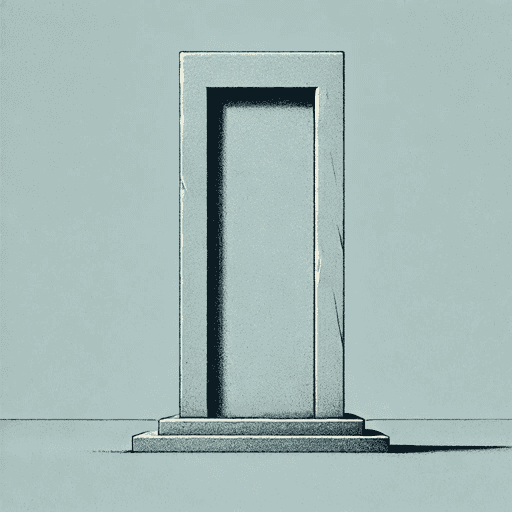
The development of the symbolism of the wall/door further develops this theme. The real estate agent who sold Thiago and Vera the condo says that Fidelia drew a large shape in blood that “[l]ooked like a giant door” (45). The same phrase appears nearly verbatim when Thiago finds the wall in Colorado; he says, “It looked more like a giant door” than a wall (119). The link between the wall and the door becomes clearer when Diane proposes that the “canal” Fidelia spoke of is really a channel, a “passageway, or an opening” (184). This leads Thiago to conclude that it could be a portal, something that need not obey the apparent laws of time and space. The wall/door itself thus defies logic.
Nevertheless, the novel hints that there are “rules” governing the portal’s operation, and these rules once again draw attention to Thiago’s grief. Diane suggests that “[Fidelia] called this [entity] into the world […], but the only way for it to enter is for someone to pull it out. For some reason it wants [Thiago] to do it” (184). Her conclusion recalls the diner cook telling Thiago that “[p]ossession makes a mess of everything. The person gets all fucking torn to shreds. But a body freely given?” (95). Jacobson’s gruesome death bears out the idea that possession of an unwilling body destroys the body, lending credence to the idea that a body that has been willingly surrendered might remain in better shape. The implication this “evil genius or spirit” came through Fidelia’s portal and believes it can get Thiago to willingly hand over his body (95). Accordingly, when Thiago is on the beach with the cook, the man calls the wall an interface, saying, “You’ve got so many boundaries around you […]. So many barriers, defenses. For us to get to know each other, there needs to be a threshold” (162). Here, he characterizes the wall as a way of gaining entry into Thiago’s life. The irony, then, is that Thiago’s isolation—his standoffishness, particularly in the wake of Vera’s death—makes him vulnerable to this most invasive form of interpersonal contact.
The idea that he might willingly allow such possession evokes his broader self-destructive tendencies, including his thoughts of suicide. In a further irony, Thiago’s suicidal ideation arises partly in response to the fear of possession. In this, it alludes to the way the priest in The Exorcist rids Regan of the demon. In the movie, Father Karras provokes the demon to leave the girl’s body and enter his own. When Karras realizes that he cannot resist the demon’s influence for long, he throws himself from a window, dying by suicide and taking the demon with him. In the hotel, Thiago thinks to himself, “How convenient it’d be now to have a rope and pull it around my neck […]. It couldn’t keep chasing me if I was already dead” (181). His thought process is similar to the priest’s: that if he takes his own life, the entity that longs to possess him will be deprived of a vessel. However, the implication that it is Thiago’s very self-destructive impulses that render him susceptible to possession foreshadows that such an effort would be futile.

Unlock all 47 pages of this Study Guide
Get in-depth, chapter-by-chapter summaries and analysis from our literary experts.
- Grasp challenging concepts with clear, comprehensive explanations
- Revisit key plot points and ideas without rereading the book
- Share impressive insights in classes and book clubs