This Thing Between Us
47 pages • 1-hour read
Gus MorenoThis Thing Between Us
A modern alternative to SparkNotes and CliffsNotes, SuperSummary offers high-quality Study Guides with detailed chapter summaries and analysis of major themes, characters, and more.
Symbols & Motifs
Content Warning: This section of the guide includes discussion of substance use, addiction, and death.
The Entity
The entity that seemingly possesses multiple objects and people functions as both a character and a symbol. As the latter, it is central to the theme of The Indescribable Intensity of Grief, representing Thiago’s feelings in the wake of losing Vera. That the cook, the entity’s primary physical incarnation in the text, only appears after Vera’s death hints at its connection to Thiago’s grief. Meanwhile, his words shed light on how grief functions. He talks to Thiago about how there is “some other thing” inflicting terrible pain on people, and he claims that this “thing” is “[s]ome kinda force, or entity. Evil, all-powerful. Controls everything. Got you in a spell-like. Can alter math and change logic so that the sky, the air, the earth, colors, shapes, and sounds, all external things are merely the delusions of dreams devised to ensnare your judgment” (94). The cook’s description—e.g., the “thing’s” ability to “alter math and change logic”—evokes grief’s power to distort perception and even character, hinting at grief’s intersection with The Limits of Rational Control. Certainly, grief does terrible things to Thiago, including making him feel that he must move across the country, that he cannot so much as be distracted from his grief for 10 minutes without feeling guilty, and convincing him that he is to blame for Vera’s accident. Thiago’s entire reality changes because of his grief, and his perceptions—also altered by alcohol and drugs—become suspect.
At the same time, the entity also symbolizes The Horror of Technology and Surveillance. Before it manifests as the cook, the entity seemingly controls the Itza in Vera and Thiago’s condo, and it manipulates electronics—televisions, jukeboxes, etc.—throughout the narrative. The cook’s characterization of the “thing” that torments people resonates with this interpretation as well. In particular, his remark that the entity renders “external things […] merely delusions of dreams devised to ensnare your judgment” hints at concerns about technology addiction and the possibility of virtual reality supplanting “actual” reality.
Lastly, the entity can be read as a symbol of Thiago’s unconscious self—his tendencies toward violence, antisocial behavior, etc. Thiago has a deep-seated belief in his own propensity to depravity, which he characterizes in quasi-genetic terms. At Vera’s grave, he hears his dead father’s voice, telling him about all the “lives [he’s] ruined” and how his “cursed” family’s sins are kept “alive” in Thiago (248). Whether this belief is justified or simply a vulnerability that the entity preys on remains ambiguous. However, the novel leaves open the possibility that suppressed dark impulses did play a role in Vera’s death.
The Wall
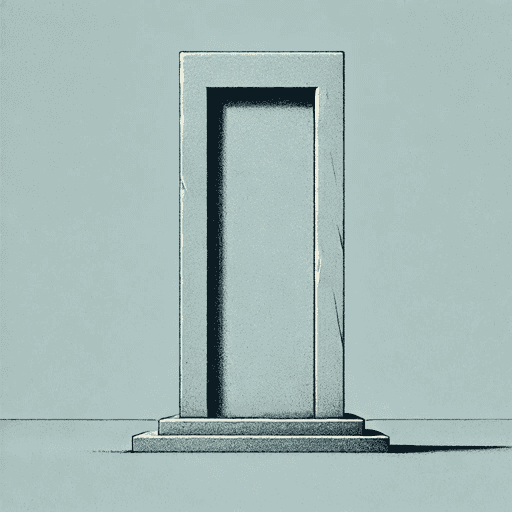
The wall is another symbol that emphasizes The Indescribable Intensity of Grief. The description of it as a “wall” makes the object seem like a boundary, something fixed and immovable; moreover, Thiago says this wall looks like it is made of stone and has moss growing on it, which makes it seem even more unchanging. In addition, walls are meant to separate people, as Thiago’s grief has done. After Vera’s death, he immediately abandons any responsibility for keeping in touch with Vera’s friends and most of her family. The wall thus symbolizes the way his grief isolates him.
However, the wall is not what it seems at first glance. For one, it does move. In this, too, the wall embodies the qualities of grief, as it is both seemingly permanent and constantly changing. More broadly, the wall suggests grief’s paradoxical qualities; it seems like a single, knowable thing, but it has characteristics that are impossible to understand or predict. Thiago says that the wall is shaped like a door, and the cook even refers to it as an “interface,” something that both marks a boundary and serves as a portal between bounded spaces. However, a wall and a door typically have two mutually exclusive purposes: A wall separates things, while a door provides access to something. This points to the way Thiago’s grief functions on a narrative level, separating him from others but also providing an opening for the entity to enter. In this latter sense, the wall also symbolizes Thiago’s broader isolation, which existed prior to his grief and mediates all of his relationships.
Movies
The motif of movies supports the novel’s interest in the human desire for meaning and structure. Thiago cites movies throughout the novel, comparing his own experiences to what might happen in a film. He even dreamed of becoming a filmmaker at one point, an aspiration he shared only with Vera. In a movie, however, everything happens for a reason. Thus, Thiago’s desire for his life (and Vera’s) to align more closely with what might happen in a film reflects his desire for meaning in the tragic events that befall them.
Thiago says that, in the movie of their life, Vera would die first because she would be too smart to be allowed to survive; she’d figure everything out early on and ruin the plot. However, in real life, her intuition didn’t alert her to anything, and her accident was totally unpredictable. Thus, there is no comforting rationale for her accident and death. They seem completely random, the result of her being in the wrong place at the wrong time. While Thiago is eager to avoid the political meanings others ascribe to Vera’s death, he struggles against the idea that it was a “meaningless” event that has no larger purpose or sense. The movie lines that are quoted by the Itza also allude to Thiago’s desire for Vera’s death to mean something other than that the universe is chaotic, that bad things happen to good people, and that humans are fundamentally alone and small amid an uncaring universe.

Unlock the meaning behind every key symbol & motif
See how recurring imagery, objects, and ideas shape the narrative.
- Explore how the author builds meaning through symbolism
- Understand what symbols & motifs represent in the text
- Connect recurring ideas to themes, characters, and events