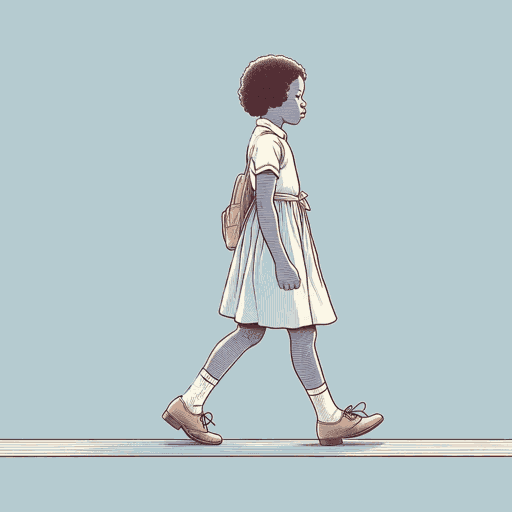
Through My Eyes
47 pages • 1-hour read
Ruby BridgesThrough My Eyes
A modern alternative to SparkNotes and CliffsNotes, SuperSummary offers high-quality Study Guides with detailed chapter summaries and analysis of major themes, characters, and more.
Key Figures
Ruby Bridges
Ruby Bridges was one of the first children to integrate a public elementary school in the South. In 1960, she was the lone Black first-grader to attend William Frantz Public School in New Orleans, Louisiana.
Bridges came from a family that experienced many common elements of Southern Black life in the early- and mid-19th centuries. Her grandparents were sharecroppers in Mississippi, and her parents relocated from their rural homes into the urban center of New Orleans hoping to pursue better job opportunities to support their growing family. Bridges had seven siblings and began elementary school at an all-Black school that was far from her home, because the nearest school, William Frantz, was a segregated, all-white school. Bridges integrated William Frantz through her enrollment after scoring high on a test designed to identify Black children who could meet high academic standards set by the school board.
Bridges transferred to William Frantz at the beginning of first grade and attended the school through the duration of her primary school years. She went on to attend an integrated high school, became a travel agent, and started a family with her husband, Malcolm Hall. The couple has four boys.
Bridges began her activism efforts after the murder of her youngest brother, Milton. His struggles motivated Bridges to utilize the platform she garnered from her fame as the first Black student at William Frantz, an image that had spread in American popular culture since the early 1960s. She created the Ruby Bridges Foundation to provide resources for inner-city schools and promote racial justice.
Mrs. Barbara Henry
Barbara Henry taught Ruby Bridges at William Frantz. Originally from Boston, Massachusetts, Henry relocated to New Orleans after her husband’s job relocated the family there. Mrs. Henry did not fit in with the staff at William Frantz. She had a Northern accent, opposed segregation, and willingly taught Bridges once she arrived at William Frantz.
Mrs. Henry was a kind and loving teacher and was one of the first white adults with whom Bridges forged a trusting and positive relationship. She contributed excerpts to Through My Eyes in which she expresses her care and concern for Ruby. Mrs. Henry “tried to explain integration more than once,” particularly the fact that none of the resulting chaos was the child’s fault (43).
Mrs. Henry left Louisiana after Bridges’s first-grade year. She moved back North and awaited the birth of her first child. Henry and Bridges had no way to communicate until 1995 when Bridges’s child psychologist who took notes on her published The Story of Ruby Bridges. Mrs. Henry contacted Bridges through the publisher and the two women reconnected.
Dr. Robert Coles
Dr. Robert Coles was a child psychologist in New Orleans who took an interest in the children experiencing racist hatred during the integration process. He worked with Bridges, the three girls who integrated McDonogh No. 19, and the white children whose parents did not withdraw them from school in protest of integration. He compiled work on people he identified as “children of crisis” (46).
Coles visited Bridges at her family home, where he and his wife became welcome guests. He often asked Bridge to draw and explain pictures of herself, people she knew, and her school. Coles wrote about Ruby in several publications and in 1995, he published a children’s book about her called The Story of Ruby Bridges. This publication popularized Bridges’s story for a new generation of Americans.
Lucille Bridges
Lucille Bridges, Ruby’s mother, always envisioned a more comfortable life for her children than she had led in her own youth which prompted her to support her daughter’s integration at William Frantz. This was a subject on which she disagreed with her husband, who feared backlash and wanted Ruby to remain in an all-Black school. For Lucille, the draw of a superior education and so many more resources from a well-funded school for her child outweighed the risk of violence. Lucille attended the first few days of the school year alongside her daughter to help protect her.
Lucille was strict and demanded obedience from her children. Lucille’s strictness and Bridges’s own obedience are described as factors that allowed her to endure the hardship of her first-grade year.
Lucille and her husband, Abon, separated when Ruby was in seventh grade. Ruby Bridges said she suspects that the decision about her integration had “put a wedge between them” that time did not heal (23).
Lucille Bridges died on November 10, 2020, in New Orleans.

Unlock analysis of every key figure
Get a detailed breakdown of each key figure’s role and motivations.
- Explore in-depth profiles for every key figure
- Trace key figures’ turning points and relationships
- Connect important figures to a book’s themes and key ideas