Tom's Midnight Garden
52 pages • 1-hour read
Philippa PearceTom's Midnight Garden
A modern alternative to SparkNotes and CliffsNotes, SuperSummary offers high-quality Study Guides with detailed chapter summaries and analysis of major themes, characters, and more.
Symbols & Motifs
The Midnight Garden
Content Warning: This section of the guide includes discussion of death.
The central motif of the midnight garden enhances the novel’s exploration of time, childhood, and friendship. A portal from Tom’s era to the Victorian period, it is a liminal space where the past and present intertwine. The garden’s appearance at midnight when the clock strikes 13 signals its non-conformity to the laws of conventional time. Tom’s experiences there are often non-linear, illustrated when he sees a tree felled by lightning and, the following night, realizes that the tree is standing again. Tom also glimpses Hatty as a much younger, newly orphaned girl on one night but never sees this version of her again. In this instance, the journey back in time seems to be triggered by Tom’s empathy for Hatty and curiosity about why her parents left her in the guardianship of her cruel aunt. The incident suggests that events in the garden are influenced by emotion rather than chronology.
Tom’s adventures in the garden symbolize childhood curiosity and imagination, while the garden itself becomes a symbol of freedom for him. The expansive outside space is a playground for the protagonist, serving as a release from the confines of the Kitsons’ sterile flat. The garden also offers an escape from loneliness as Tom discovers The Transformative Power of Friendship in his interactions with Hatty.
The midnight garden also symbolizes growth and the passage of time. As Tom visits the garden, the seasons shift from summer to winter. This change is a metaphor for growing up, as Tom is disturbed to observe that during this passage of time, Hatty has transformed from a child into a young woman. Tom’s plan to “spend an endless time in the garden” demonstrates his desire for time to stand still so that he and Hatty can remain children forever (180). However, the failure of this plan reflects the inevitability of change, connecting to a larger conversation about mortality.
A key revelation in the novel is that the midnight garden is a representation of Mrs. Bartholomew’s memories. Through her vivid childhood dreams, Tom can visit the garden and meet her younger self. Tom’s observation that the weather is always “perfect” in the garden, regardless of the season, demonstrates the selective nature of memory. Tom’s ability to step into Mrs. Bartholomew’s inner world reflects memory’s power to bring the past alive, even for others. The garden exists because it lives vividly on in Mrs. Bartholomew’s mind.
The Grandfather Clock
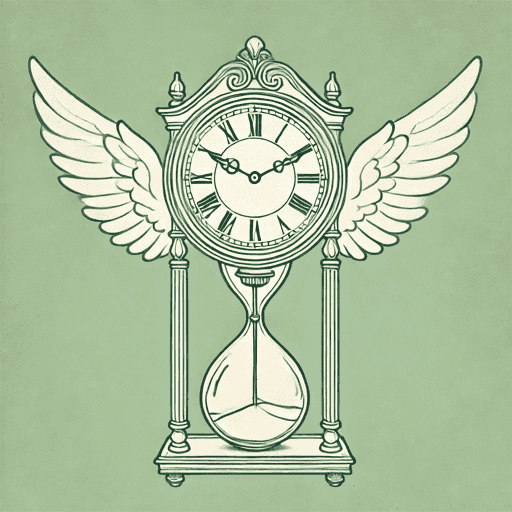
Mrs. Bartholomew’s grandfather clock symbolizes the ephemeral nature of time. The clock is the one constant in the hallway of the manor house when Tom slips between historical eras. A physical reminder of The Impact of History on the Present, the clock provides a gateway to the past when it strikes 13. This anomaly emphasizes the fluidity of time in the midnight garden.
By personifying the clock, Pearce illustrates how Tom sees it as a living entity. When the clock strikes the hour, he perceives the sound as its “voice.” He also observes that “its ticking sound[s] to him like a human heart, alive and beating” (135). In addition, Tom’s shifting response to the grandfather clock illustrates his changing feelings about staying with the Kitsons. His initial aversion to his new environment is demonstrated when he lies awake, noting “the clock [i]s wrong again in its striking—senselessly wrong” (7). However, once Tom discovers the midnight garden, he appreciates how the clock and the garden are “not bound by the laws of ordinary Time” (180). He can spend hours in the garden, but the clock registers that only minutes have passed in his own time. As Tom’s deadline for returning home approaches and he is desperate to spend longer in the garden, the clock becomes an unwelcome reminder of the passage of time. He hates the sound of its ticking, which brings “Saturday, minute by minute, nearer and nearer” (155). On his last night, when Tom cannot access the garden, he perceives the grandfather clock as uncaring as it “tick[s] coldly on” (209).
The mysterious nature of the grandfather clock is heightened by its appearance. Tom is intrigued by the image of the winged man astride the earth and sea and the clock’s inner inscription, “Time No Longer” (161). The protagonist believes that if he can fully understand the inscription’s meaning, he can control time. However, his unsuccessful attempt at remaining in the garden portrays time as an ultimately unstoppable force.
The River
The river symbolizes both freedom and the passage of time, and it is closely related to Hatty’s character arc in the novel. Although her aunt forbids her from going there, Hatty occasionally crosses the garden’s boundary into the meadow by the riverside. Her fascination with the river highlights her craving to break free from the rigid confines of her life. She gazes downstream wistfully, “as though she envie[s] the waters their endless journeying” (86). Perceiving the river as a portal to another, more exciting world, she longs to visit the locations it flows through, such as Ely, before it is “swallowed up […] in the greatness of the sea” (185).
During the Great Freeze, the frozen river allows Hatty to fulfil her dream of journeying downstream. When she skates to Ely with Tom, she observes that it is “the farthest [she’s] ever been from home” (223). The journey marks her escape from the constraints imposed by her aunt. It also symbolizes her transformation from a child into a woman as she meets her future husband, Barty.
Like the grandfather clock, the river is a tangible link between the past and the present. However, when Tom visits the river in his own era, he notes that it is now polluted and devoid of wildlife. This change illustrates an unwelcome effect of “progress” and urbanization. It is also a reflection of Tom’s perception of the past, which is rooted in Hatty’s memories, as a magical place, while the present, to him, is mundane and ugly in comparison.

Unlock the meaning behind every key symbol & motif
See how recurring imagery, objects, and ideas shape the narrative.
- Explore how the author builds meaning through symbolism
- Understand what symbols & motifs represent in the text
- Connect recurring ideas to themes, characters, and events