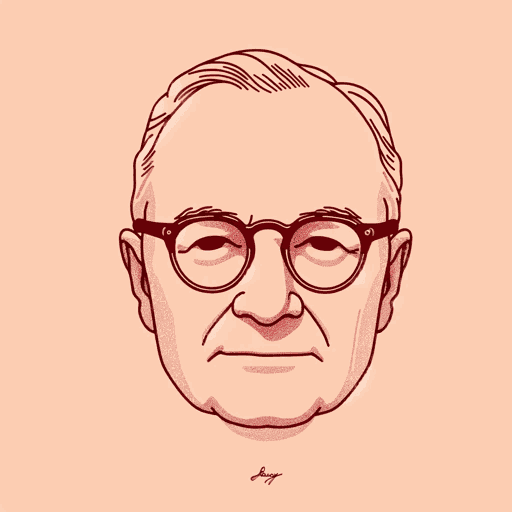
Truman
Truman
A modern alternative to SparkNotes and CliffsNotes, SuperSummary offers high-quality Study Guides with detailed chapter summaries and analysis of major themes, characters, and more.
Summaries & Analyses
Plot Summary
Background
Chapter Summaries & Analyses
Key Figures
Themes
Index of Terms
Important Quotes
Essay Topics
Quizzes
NEWReading Tools
Part 1, Chapters 1-2Chapter Summaries & Analyses
Chapter 1 Summary: “Blue River Country”
“Blue River Country”—Jackson County and the surrounding areas—is a name for the western Missouri frontier in the 1840s. The Truman family history is linked to this area. Many of those who relocated to western Missouri, mostly by steamboat, were farmers with big families. They were also of Scotch-Irish descent, Baptists, and Democrats who, McCullough says, “believed that those who labored in the earth were the chosen people of God” (12). He adds that the extreme climate made farming difficult. And he notes that, at this time, Missouri had a population of up to 50,000 enslaved people.
Anderson Shipp Truman, Harry’s grandfather, relocated from Kentucky in 1846. Eventually, he married Mary Jane Holmes. The Trumans were not slave owners. Truman’s mother’s side comprised Solomon Young and Harriet Louisa. Solomon’s father was a veteran of the Revolutionary War. The Youngs were German and Methodist. Solomon Young amassed a fortune through trade by age 35.
During the Civil War, the civilian population suffered from both the Union and Confederate sides. In the 1863 Lawrence Massacre (Quantrill's Raid), hundreds of civilians were killed by Confederate soldiers. The family of Solomon Young, on the other hand, suffered when the Union soldiers appropriated or destroyed items from his family’s farm on multiple occasions. The parents of Harry Truman, John Anderson Truman and Mattie (Martha) Young, were married in 1881. Truman was born three years later in Lamar, Missouri. His middle name, S., McCullough says, “actually stood for nothing” (33). He was named Harry after his uncle Harrison.
Chapter 2 Summary: “Model Boy”
Chapter 2 describes Truman’s childhood living on a farm. The property comprised a 600-acre farm and another 1,000-acre farm that belonged to Truman’s grandfather. The Trumans owned many domestic animals, and their children engaged in outdoor activities.
The core family included Truman and his parents along with his younger brother and sister, John Vivian and Mary Jane. Truman was also surrounded by extended family members growing up: Aunts Ada, Laura, and Sallie, Cousin Sol Chiles, Uncle Harry, as well as Grandma and Grandpa Young. Some of the family members, such as Aunt Laura, lived in Kansas City. Growing up, Grandma Young was lenient giving, McCullough says, “every youngster free rein,” while Mama taught the children responsibility and “taught that punishment followed transgression” (38). Harry’s father preferred his sister and his mother to him. However, Harry and his father got along well “in the sociability and excitement of politics” (59).
In 1890, the family relocated to Independence to facilitate Harry’s schooling. His father was doing well financially, so they could afford servants. Harry also began wearing eyeglasses because his eyesight was poor from a young age. The boy liked school. The author describes him as “an exceptionally alert, good little boy of sunny disposition” (39). In his free time, Harry enjoyed reading at home and the library. His favorite subject was historical personalities, especially famous military leaders like Hannibal, Andrew Jackson, and Robert E. Lee. In addition to literature, the boy grew to appreciate music, and his hobby was fencing.
At school, Truman was not particularly popular, but the other boys respected him. He met Elizabeth Wallace, Bessie, his future wife at Sunday school. As Truman started high school, he got a job getting J. H. Clinton’s drugstore ready for customers early in the morning. He excelled at most subjects, like Latin and math, but was a poor speller. Toward the end of high school, Truman wanted to apply to West Point.
The author also describes the overall atmosphere and developments in the area. Many of the older Black residents were born into slavery. Blacks were also, McCullough says, “unwelcome at most stores and were denied use of the town library” (50). He adds that lynching took place and the media typically blamed the victims. Further, racial slurs “were used as a matter of course in so-called ‘polite society’” (50).
Chapters 1-2 Analysis
The author believes that to truly understand someone, it is important to examine where they came from. For this reason, he begins his biography of Truman before his birth—with his ancestors’ backgrounds. McCullough describes the difficult lives of western Missouri frontier settlers. Such facts highlight Truman’s farming background and set up one of the main themes in this book, The Rise of an Underdog. The biographer details Truman’s unprivileged life to highlight the unlikelihood of his rise to the highest political office in the United States.
The author also focuses on social history by examining the lives of ordinary people. Social history helps situate individual biographies in a broader context and improves the understanding of the impact of important events and political decisions on the lives of ordinary people. For example, the Civil War demonstrates the complexities of a war in which the civilian population often suffered unjustly from both sides.
The author tackles different types of historical sources, including birth and death records, lawsuits and other legal documentation, personal diaries, letters, as well as local archival records about important historic events in the given area. The availability—or lack of—documentary information demonstrates the limitations of writing this type of history. McCullough points out, for example, how one side of Truman’s family—his mother’s—had much better records than that of his father.
The first two chapters also introduce two other important themes in this biography: Marriage and Political Power and War and Character. Truman met Bess Wallace in his childhood. They eventually married, and she remained not just his wife but also his best friend and confidante. The correspondence between them serves as one of the major sources for this biography. Their letters enrich the dry facts and make the Trumans relatable. Finally, this relationship provides a sense of continuity in Truman’s life, which was full of unexpected changes. As we learn in the subsequent chapters, World War I turned out to be a formative experience for Truman. It was in his childhood that Truman was first fascinated by history and war. Here, McCullough highlights Truman’s favorite historical personalities—military leaders like Hannibal and General Lee.

Get in-depth, chapter-by-chapter summaries and analysis from our literary experts.
- Grasp challenging concepts with clear, comprehensive explanations
- Revisit key plot points and ideas without rereading the book
- Share impressive insights in classes and book clubs